
India Targets 100 GW Nuclear Power Capacity: Plan to Build 5 Next-Gen Reactors by 2033
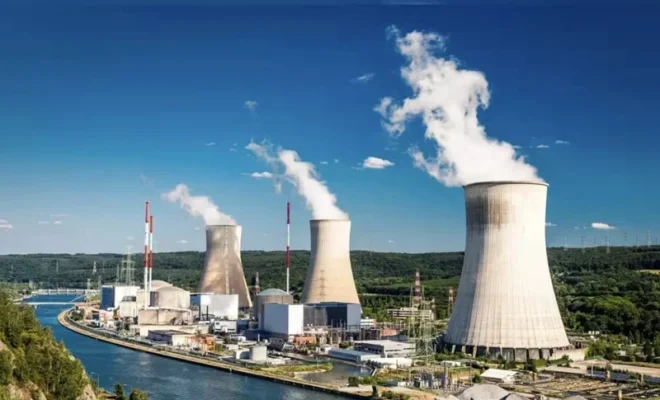
India is speeding up its nuclear energy initiatives in a bid to secure sources of power for meeting its rising demand for electricity, as well as its net zero ambition. There is one key point that should be clarified: India’s stated ambition is the attainment of 100 GW nuclear power capacity by 2047, not 200 GW. In addition, the government has also outlined a separate goal of deploying at least five SMRs by 2033.
This strategy is seen as a major change in India’s energy policy. Currently, nuclear power makes up a rather small proportion of India’s electricity supply, but more and more emphasis is being placed on its reliability as an option for supplying round-the-clock electricity to complement solar and wind power.
Why India Is Expanding Nuclear Power
However, there is likely to be an increase in India’s power needs as its economy continues to develop, industrial use of energy increases and household use of power becomes easier.
Even though renewable sources of power have been increasing, both solar and wind power depend on the conditions and the time of day, whereas nuclear energy provides stable baseload power and it does not emit any carbon emissions like fossil fuel plants do.
Therefore, the government wants to have a greater portion of its power come from nuclear power as well as expanding renewable energy production. The Nuclear Energy Mission aims at providing 100 GWe of nuclear power generation by 2047 along with India’s target of net zero carbon emissions by 2070.
What Is the 100 GW Nuclear Energy Mission?
The Nuclear Energy Mission of Viksit Bharat could be said to be a long-term plan for the massive scaling up of nuclear power generation capacity in India.
Currently, India has around 8.78 GW of nuclear energy generation capacity. The plan of the government is to increase this number to around 22 GW by 2031-32 when some of the projects currently underway are completed.
Besides this, the government aims for an additional 32 GW capacity to be generated by NPCIL through the indigenous development of PHWR and LWR reactors. With this addition, the share of NPCIL will be around 54 GW capacity by 2047.
The rest of the capacity will come from other Public Sector Undertakings, State Governments, Private Companies, and Joint Ventures through various reactors.
The Five Next-Generation Reactors Explained
In contrast to what many people might think, the “five reactors” mentioned in the new plan do not mean that India will have five new large conventional nuclear plants by 2033. It means that the government is planning to develop and commission at least five indigenous Small Modular Reactors by 2033.
The Department of Atomic Energy claims that some indigenous reactor designs are being developed by BARC, which include the 220 MWe Bharat Small Modular Reactor, the 55 MWe Small Modular Reactor, and the 5 MWth High Temperature Gas Cooled Reactor. This reactor is meant to be used for producing hydrogen.
These reactors are significant because small reactors can be deployed where constructing large reactors is not possible.
What Makes Small Modular Reactors Different?
Small Modular Reactors are created with the purpose of being able to generate electricity with lower capacity compared to conventional large nuclear reactors and use the concept of modular construction as well.
In the case of India, the possible applications of SMRs go far beyond producing electricity for the national grid. The government has suggested that they could be used at brownfield sites such as those which were connected with the shutdown of fossil fuel stations and even for captive power needs of certain industries.
India’s BSMR-200 Is Already Moving Forward
Perhaps one of the most important indigenous designs of reactors is the 220 MWe Bharat Small Modular Reactor (BSMR-200).
It has been reported that “the design has been approved in principle for its engineering and construction” by the Department of Atomic Energy. Further, the design has been granted all the necessary technology approvals as well and Tarapur in Maharashtra has been selected for the location of the BSMR-200.
Thus, the program goes beyond the level of conceptualization and India is starting to move towards the implementation stage.
Why Private Companies Are Becoming Important
Nuclear power growth till 100 GW cannot happen with the current public sector framework alone. India’s government vision statement clearly calls for public sector companies, states, and private players to be involved in this expansion plan.
The SHANTI Act of 2025 has facilitated private players in India’s nuclear power program, giving a new legal framework for the growth process.
This can result in structural changes in India’s nuclear program.
Companies like Adani Power, Tata Power, and Reliance Industries have expressed interest in India’s nuclear power projects while Adani Power has even announced plans for a 10 GW nuclear power plant portfolio by 2035.
Kalpakkam Reactor’s Importance to India’s Nuclear Program
India’s nuclear expansion program is also due to advancements in indigenous technologies that are advanced.
In April 2026, the 500 MWe Prototype Fast Breeder Reactor at Kalpakkam in Tamil Nadu attained first criticality, marking India’s entry into the second phase of its three-phase nuclear program. The reactor was built by BHAVINI and marked the next step in India’s effort to use its nuclear fuel resources effectively.
It is especially significant since India’s nuclear program always emphasized development of indigenous technologies suitable for Indian resources.
How Nuclear Power Fits With Renewable Energy
An increase in the number of nuclear reactors in India doesn’t necessarily indicate the country’s shift from solar and wind energy.
In India, nuclear power can serve as an additional component in the power generation system and can be used for the supply of uninterrupted electricity. With the help of solar energy, one can produce sufficient energy in the daytime, whereas, wind energy depends upon the climate conditions.
Therefore, the use of nuclear power plants can facilitate the process of uninterrupted electricity generation and stabilize the power system of the country that includes many variable renewable power sources.
Powering India’s Future: Energy, Growth & Geopolitics
India’s Nuclear Power Push: What’s Next?
Check out India’s nuclear milestone and its role in strengthening energy security.
Could Nuclear Power Secure India’s Future?
Find out how nuclear energy could support India’s growing power needs.
How Are India-Sri Lanka Energy Ties Growing?
Uncover the HVDC power link and Sampur solar project shaping regional cooperation.
What Is India’s 2047 Vision?
Explore PM Modi’s ‘Shakti Ki Sapt Dhara’ roadmap for Viksit Bharat @2047.
What Is China’s Sri Lanka Strategy?
Dive into the geopolitical agendas surrounding China’s research ship near Sri Lanka.
How Can It Delay the Nuclear Power Development Process?
Achieving the target of 100 GW isn’t easy. Building nuclear power plants requires huge investments and long periods of time, apart from safety clearances and technical knowledge.
The country needs a sufficient supply of nuclear fuel and developed manufacturing sector. According to the recent parliament report, the uranium production of the country is able to meet only a small part of the fuel demands of India’s existing PHWRs.
Commercial viability of the reactors is another factor.
What This Means for India’s Energy Future
The implementation of the Nuclear Energy Mission could potentially transform the Indian electricity mix.
For the near-term, the plan would involve going from the present 8.78 GW up to roughly 22 GW by the early 2030s. The much bigger problem would be scaling this up to 100 GW by 2047.
The five domestic SMRs planned for 2033 could potentially become a valuable proof-of-concept for deploying domestic nuclear technologies on a larger scale.
Conclusion
The nuclear program of India is entering a new stage. The government is trying to integrate large conventional reactors, as well as indigenous SMRs into their plans while making the industry more private-friendly.
The government plans to achieve 100 GW of nuclear capacity by 2047, backed up by five indigenous SMRs by 2033.
The ambition is big, and the challenge is just as high. If India can achieve success in the development, financing and deployment of nuclear power while maintaining high levels of safety, then this could potentially become a much larger part of the country’s energy system.