
Can People ‘Fall Through The Crack’? Earth Is Splitting Apart in Iceland
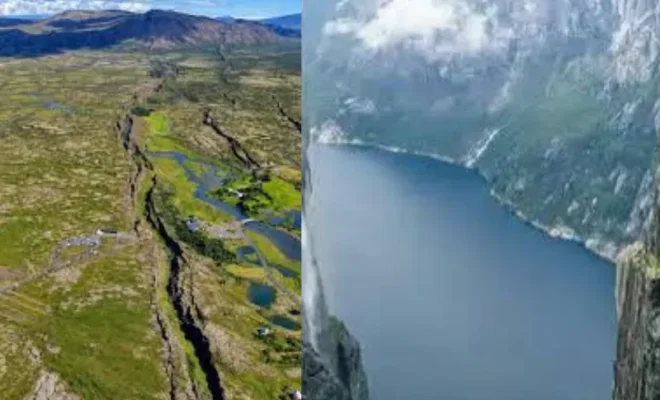
The Silfra fissure in Iceland is real. Located in Þingvellir National Park, it is part of the Mid-Atlantic Ridge, where the North American and Eurasian tectonic plates move apart by roughly 2 centimetres a year.
The claim that people can “fall through the crack”, however, needs context: the danger lies in an underwater cave and passage, not a fresh gap opening beneath walkers.
Why is the Earth splitting in Iceland?
Iceland is located at an active plate boundary. The plates move away from each other and the ground stretches, cracks and creates long cracks called fissures. One of the clearest areas where one can observe this process is at Þingvellir.
In the park, there is a fissure, or crack, filled with water that is named Silfra. It is supplied with water from the glacial meltwater that flows through porous lava to get to the site. It takes 30 to 100 years to filter. The water remains at a temperature of 2 to 4 °C and the visibility is greater than 100 metres, making the site popular among snorkellers and divers.
It has taken thousands of years to be the way it is now, and things don’t change overnight. A large earthquake sequence is registered in the Þingvellir area in 1789 according to the records of UNESCO. In the area around Lake Þingvallavatn, 1 to 2.6 metres of ground subsided. The wider rift is still characterized by tectonic activity.
Can a person really fall through the crack?
The main Silfra route is actually in close proximity to the real underwater hazard. Diving operator Dive says a secret cave is at least 63 metres deep, located under a nearby pool. The pool is connected to the fissure by a small underwater passage. The passage has been dubbed “the Toilet” by the operator, as it is a “strong current that flushes divers down the swim-through.
The operator advises that the cave passages are constricted and unstable, making it dangerous to go in. It states that cave and overhead-environment diving are not allowed and the tunnel is not allowed. Max depth for a Silfra dive is 18 metres.
They cannot come unsuspecting into a huge hole in the ground. Divers and snorkellers are also subject to safety rules in Þingvellir National Park, which is situated on a “fall through” rather than an open surface crack, through which visitors were lost.
Iceland’s landscape is a reminder that Earth is constantly changing. That’s what it looks like in the stone walls of Silfra and it’s what you feel in the cold and clear water of Silfra. But the science is more interesting than the scare: the split is a long-period geological process, not an imminent one on land.
Critical Minerals, Dairy Cooperatives, Technology & Higher Education
Why Has India Banned the Export of Lithium-Ion Battery Black Mass?
Explore the government’s immediate export restriction, understand its impact on domestic critical mineral recycling, and discover how the move could strengthen India’s battery supply chain.
How Do Dairy Cooperative Turf Wars Affect Farmers and Milk Prices?
Understand how political and administrative conflicts within dairy cooperatives could undermine farmer trust, disrupt procurement, and affect milk prices.
Why Are Microsoft Outlook Users Facing a Global Service Outage?
Discover what caused the reported email disruptions, explore Microsoft’s recovery efforts, and understand how the outage is affecting users and businesses.
How Could Nvidia’s Leadership Uncertainty Affect Indian IT and Global AI Stocks?
Explore the reported leadership developments, understand concerns surrounding US chip export restrictions, and discover the potential implications for AI infrastructure and semiconductor investments.
Why Is IIT Kharagpur Launching Postgraduate Medical Programmes Through NEET PG?
Discover the new medical education initiative, understand its significance as the first such offering by an IIT, and explore what it could mean for postgraduate medical aspirants.