
Politics Over Producers: Why Turf Wars in Dairy Cooperatives Threaten Farmer Trust and Milk Prices
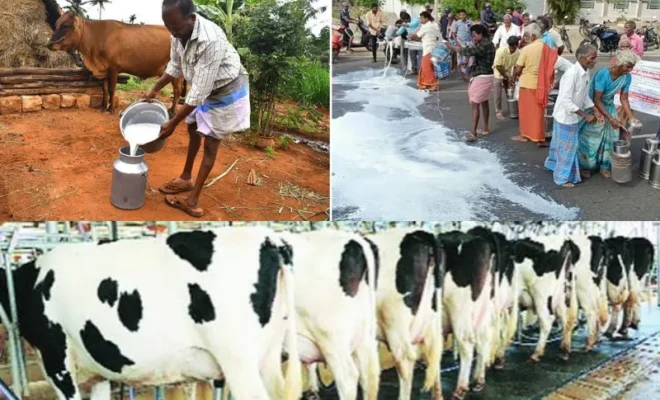
This was the main concept behind dairy cooperatives: the farmers had to own institutions that bought, processed, and marketed their milk. This would allow farmers to be able to earn steady income. Nevertheless, where politics plays a role in the boardroom of a cooperative, the main intention behind the formation of such institutions may be jeopardized.
Recent political wrangling between the state government and members of the Kolhapur District Cooperative Milk Producers‘ Union, which is more commonly referred to as Gokul Dairy in the state of Maharashtra, is an example of such a situation. The row that arose in the November 2026 chairmanship election is indicative of conflicts about government directors, voting rights, and politics within the cooperative.
Gokul Dairy: When Cooperative Governance Becomes a Political Contest
Gokul ranks among the largest dairy cooperatives in Maharashtra, which has a turnover of ₹4,000 crore annually and has a total membership of roughly 4.41 lakh milk producers in around 1,810 villages of Kolhapur district.
The Gokul board election on October 19, 2026, resulted in a razor-thin margin of victory. The panel supported by Congress MLC Satej Patil managed to secure 13 out of the total 25 directors’ seats, whereas the other panel supported by Mahayuti got 12 directors’ seats.
The controversy arose after the state government brought forth an ordinance according to which directors nominated by the government in some large cooperatives could participate in voting during elections for office-bearers. The amendment came to be a point of discussion in the upcoming battle for the chairmanship. Thus, on November 10, a chairman of the cooperative was elected from the panel supported by Mahayuti with 16 votes.
However, the Bombay High Court refused to pass an order staying the ordinance as an interim relief measure. The legal aspects connected with the amendment remain relevant in the discussion.
The example reflects how the control of the farmers’ organization may be involved in political struggle.
Why Political Interference Matters to Dairy Farmers
The cooperative for a dairy farmer is not just a business that has an elected chairman. The cooperative is a fundamental part of the family budget.
Milk production requires expenses every day like food for cattle, veterinary care, transportation, labor force and cattle maintenance. Unlike seasonal crops, milk has to be delivered on regular basis. Inconsistencies in payments and in acquisition policy could cause financial trouble.
Political disagreement does not have to lead to a reduction of prices for milk, but the extended dispute among leaders will have a negative impact on the continuity of the administration, will distract the management from the work.
Farmers require a clear acquisition price, consistent schedule of payments, quality-related price policy and access to the veterinary care services.
Milk Prices Cannot Become a Political Bargaining Tool
The pricing of milk is very tricky because the producer and consumer face different ends of the same market.
Producers hope to be paid prices that take care of increasing production costs and give them reasonable earnings. Consumers, on the other hand, hope to get cheap milk and dairy products. The cooperative needs to balance the two while taking into consideration the processing, transport, storage, packaging, and distribution costs.
As the government of the Union stated in its parliamentary reply dated April 2026, the procurement and marketing prices for milk are set by the cooperative or private dairies in relation to cost of production and the market situation. It further added that most cooperatives employ automatic procurement and direct bank payment systems for the payments to the farmers.
It makes professional management indispensable in such situations. Pricing should be based on economic assessment and not on political pronouncements.
Recent demonstrations in Haryana and Karnataka about procurement prices, cost of production and payments are other examples of the difficulties faced by the dairy producers.
Restoring Farmer Confidence Through Accountability
It does not mean that governments are left out of the cooperative bodies altogether. Public oversight can help ensure financial accountability, construction of infrastructure and regulatory compliance. Nevertheless, it is necessary to keep oversight separate from political control.
Boards of cooperatives need to have their books audited, procurement prices decided and payments made public. Members need to know about administrative appointments, their right to vote and any financial transactions.
Village-level meetings of the members could provide an occasion to raise any doubts and take part in the decision-making process.
Above all else, the elected representatives need to be responsible to the farmers who supply the milk for the cooperatives. It is important that leaders bear responsibility for performance rather than control over institutions.
White Revolution 2.0 Must Keep Farmers at the Centre
The government program titled White Revolution 2.0 plans for a 50 percent increase in procurement from dairy cooperatives in a period of five years.
This goal calls for a set of organizations that can successfully compete against private dairies while safeguarding the producers’ rights. This might pose a problem in case of political uncertainty within the big cooperatives if organizational matters become a minor consideration in face of leadership struggles.
The Indian dairy sector relies heavily on millions of households that earn a stable income from their milk production. It cannot be assured simply through institution branding. It demands fair pricing, prompt payments, and trust in decision making.
The Cooperative Must Belong to Its Producers
However, lessons can be learned from the Gokul debate concerning the Indian dairy industry; having ownership in name does not mean much when producers do not control the organization they support.
Political participation and government intervention can play a role in cooperative management; however, they should not come at the expense of farmers’ economic interests.
At the end of the day, what is important is whether the cooperative generates a stable income for the farmers, the quality of the services it provides and the trust it garners in the villages. When discussions revolve around leadership issues, those who produce the milk may end up being the most unheard voices.
The fate of India’s dairy cooperatives hangs in the balance, and it should be ensured that farmers are always at the forefront of all decision-making processes.
Healthcare, Security, Railways, Pollution Control & Automotive Updates
Venous vs Arterial Doppler Scans: Which Test Do You Need?
Discover the key differences between venous and arterial Doppler scans, explore their costs, and understand when doctors may recommend each test.
What Happened During the Attack on the CRPF Checkpoint in Kulgam?
Explore the reported firing incident, understand the security forces’ search operations, and discover the latest developments from the area.
What Are the Route, Stops and Timings of the New Vande Bharat Express?
Find out about the Bengaluru–Mangaluru–Madgaon route, explore the scheduled stops, and check the expected travel timings ahead of its launch.
Why Is CAQM Planning Urgent Field Visits to Punjab?
Understand the post-Diwali rise in stubble-burning incidents, explore the planned inspections, and discover what the move means for air pollution monitoring.
What Can Buyers Expect from the New Toyota Fortuner in 2026?
Discover the confirmed December India unveiling, explore the expected design and feature upgrades, and find out what is known about its potential pricing.