
Mission Samriddh Gaon Launched: Union Minister Shivraj Singh Chouhan Outlines Rural Poverty-Free Plan
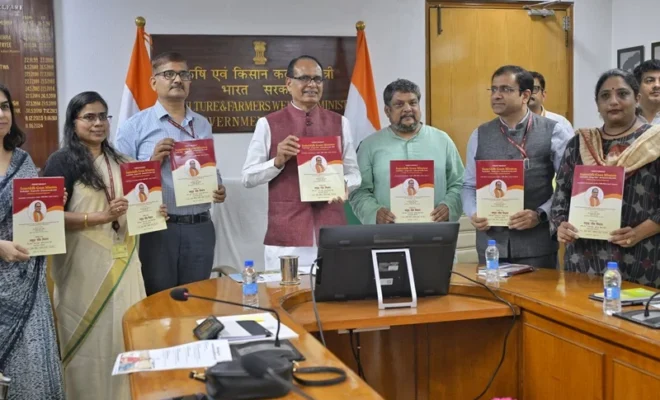
Mission Samriddh Gaon, an innovative scheme to develop rural areas where families are self-reliant and need not go elsewhere for work, has been rolled out by the Centre. Union Minister for Rural Development Shivraj Singh Chouhan launched the mission at Krishi Bhawan in New Delhi. This mission envisages a concept where different government schemes are integrated rather than handling different topics like poverty, employment, agriculture, and basic services separately.
The pilot model of the mission will be implemented in Budni block of Sehore district and Khategaon block of Dewas district in Madhya Pradesh. The government intends to analyze the outcome of the pilot project and replicate the successful model in other parts of the country.
What Is Mission Samriddh Gaon?
“Mission Samriddh Gaon” is basically an integral rural development program instead of an isolated welfare scheme. The mission aims at making the villages free from poverty and with sufficient job opportunities along with all the necessary facilities.
The concept here is about integrating various government schemes according to the requirements of different individuals and groups. This is being done instead of asking the rural families to access different schemes individually. The mission envisages a process of integral development at the level of the family, gram panchayat and block respectively.
According to Chouhan, if the government schemes are efficiently used then the impact of poverty can be significantly reduced. The mission concentrates not only on launching various schemes but also on coordinating between them.
Why Madhya Pradesh Has Been Chosen for the Pilot
The initial experiments will take place in Budni and Khategaon, thus giving the government the chance to understand how various rural development approaches can be synergized at the ground level.
The reason behind the importance of the pilot scheme is that the Centre is not straightaway offering some one-size-fits-all solution. Rather, its objective is to create a working model, find out what works and replicate that.
Thus, the initial stage of the plan should largely involve planning and meeting household requirements.
How Families Will Be Connected to Government Schemes
One important characteristic of Mission Samriddh Gaon is the family level strategy for implementation. As mentioned by Chouhan, every individual family will be linked to various schemes of the central and state government, according to its needs and eligibility criteria.
For instance, a family depending on farming as a source of income will need support and additional means of livelihood; while other families may need more support in terms of employment, education, health, and basic facilities.
This mission intends to incorporate all these needs into an overall development plan. Such an approach could be very effective for rural welfare because help can be provided in accordance with their needs and requirements.
The Bigger Focus on Rural Employment
Providing employment opportunities in the vicinity of the villages is one of the major objectives of the Mission Samriddh Gaon.
According to Chouhan, the aim of the mission is to build those villages in which villagers do not migrate out of necessity for getting any kind of job opportunities.
The concept of providing employment goes beyond just creating regular jobs for the villagers. The aim is to make the agricultural sector strong, support other activities, and facilitate value additions.
This way, an increase in economic activity in the village will provide multiple streams of income rather than relying on a single crop.
Why Integrated Farming Is Central to the Plan
It may be seen that for small and marginal farmers, the complete dependence on traditional grain production will subject their income to the vagaries of the price of crops, weather and seasonality.
Therefore, Mission Samriddh Gaon emphasizes the importance of diversified farming. The need to diversify into farming of fruits and vegetables, fisheries, raising of goats, animal husbandry, poultry and beekeeping apart from agriculture was suggested by Chouhan.
It is a simple logic; diversification will provide alternative sources of income and reduce dependency on agriculture alone.
Another initiative of the mission involves setting up warehouses, food processing and manufacturing based activities. It may help the rural communities to earn money not only through agriculture but also through value addition activities.
Special Focus on Women Farmers and Rural Women
Another significant element of the Mission Samriddh Gaon concept is that of women.
The program will seek to find out women farmers and help them access agricultural inputs as well as knowledge. They will also try to provide increased livelihood options for rural women.
As per Chouhan, the Lakhpati Didi initiative serves as an example where the empowerment of women farmers from rural India helps in boosting their confidence to take up livelihood options.
The overall goal is to have women as an active part of the rural economy rather than just beneficiaries of welfare schemes.
What About Health, Education and Basic Amenities?
Mission Samriddh Gaon is not confined only to agriculture and employment.
The above stated integrated approach has covered sectors such as health, education, livelihood, employment, basic amenities in addition to agriculture and rural development.
This is essential since poverty is seldom a result of a single cause. Though a family may earn money, it may still remain vulnerable due to poor access to health care, education, infrastructure or viable livelihood options.
Bringing all the sectors within the purview of the same development program would ensure a comprehensive approach to the problem of rural deprivation.
Need for Coordination by the Government
Since the success of the mission would largely hinge on coordination, Chouhan has mentioned that government departments, administration, panchayati raj institutions and partner organizations would have to coordinate their efforts.
The mission would also strive for cooperation from NGOs, banks and other organizations. The idea behind the move is to synergize the efforts of the government sector and other institutions in rural development.
Such a coordination is even more crucial at the village level where a number of programs run simultaneously.
Can the Pilot Model Be Replicated Across India?
Replication has been a major theme of Mission Samriddh Gaon.
The government intends to start by developing models in Budni and Khategaon and then display the successful models that can be replicated in other villages and districts.
But rural India is very heterogeneous. A village in Madhya Pradesh that depends on agriculture will have entirely different needs compared to those of a coastal village, a tribal village or a tourism village.
The key issue that is going to emerge in the future will be figuring out the elements of the model that can be replicated nationally and the elements that will have to be modified according to specific needs.
What Mission Samriddh Gaon Means for Rural India
Mission Samriddh Gaon can be seen as an attempt at rural development based on the concept of convergence. As opposed to treating poverty alleviation, agriculture, employment, health and infrastructure as separate goals, the mission tries to converge all of them into a single development of a village project.
If the mission succeeds in its pilot stages, it can serve as an example for increasing the income levels and economic development, as well as for lowering the distress migration.
Conclusion
Samriddh Gaon Mission has been initiated with the goal of creating villages where the incidence of poverty can be minimized by better implementation of schemes and providing employment opportunities and livelihoods.
The Shivraj Singh Chouhan government plans to develop rural areas by taking into account that the family must be the core of rural development. This means that schemes must be designed accordingly and only those who are eligible for a scheme must receive it. Thus, the first pilot experiments in Budni and Khategaon are of great importance as they may affect the further development of the model.
The Samriddh Gaon Mission is not aimed at increasing the number of schemes for rural families. It aims at the proper matching of the schemes, livelihoods and services to make rural villages more developed.
Stay informed with the stories shaping India and beyond.
How Will Iran Sanctions Affect India?
Check out the latest Iran sanctions and what they could mean for India’s energy security and oil imports.
Could Pilot Dope Tests Become Mandatory?
Find out why aviation authorities are considering mandatory checks after an Air India in-flight incident.
Can Global Finance Build Drought Resilience?
Uncover India’s demand for predictable global funding at the COP17 land restoration summit.
What Triggered NIA’s Multi-State Cyber Raids?
Dive into the cyber warfare alert and NIA raids linked to attacks on government sites.
Why Does Bihar Oppose the Farakka Treaty?
Look into Bihar’s demand to scrap the treaty and its impact on Ganga water and siltation.