Indian Navy Steps Up Patrols in Key Shipping Corridors to Protect Maritime Trade and Undersea Cable Networks
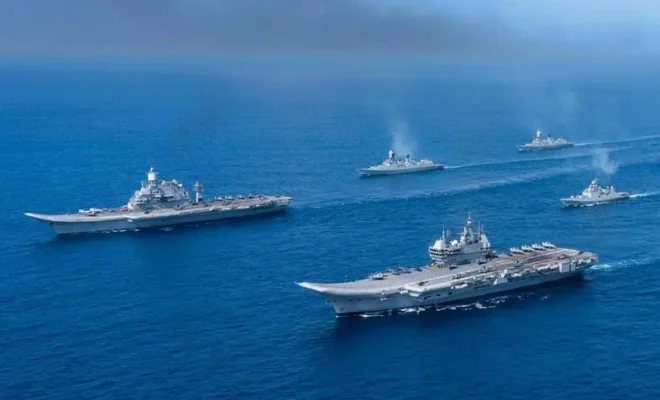
India has now moved past the stage where the sea was only a front for its strategy. The sea has become the road on which many of India’s economic activities, including its trade and energy imports, take place. This makes maritime security synonymous with economic security.
The increased operations of the Indian navy within the Indian Ocean region are happening in an era where commercial ships are having a more complex security environment, ranging from the problem of pirates and smugglers to geopolitical challenges. Some recent measures taken by the government have focused specifically on ensuring safety of Indian ships operating around sensitive regions like Strait of Hormuz, Gulf of Oman and the Gulf of Aden.
The message that comes out of this is quite profound: ensuring security of a merchant ship is not just about keeping it safe from a physical attack. It is about securing the entire supply chain.
India’s Expanding Maritime Footprint
The geography of India gives the nation a unique responsibility in the Indian Ocean since it lies near the most vital commercial shipping routes that link the Middle East, Africa, South Asia and Southeast Asia.
The Government of India views maritime routes as vital to economic development and strategic stability of the country along with the long tradition of involvement of the Indian Navy in fighting piracy and protecting merchant shipping.
The increased visibility of India in this regard was ensured by means of continuous presence, joint exercises and surveillance in the maritime domain. In 2026, the Indian Navy further strengthened its cooperation with other maritime nations in the region and outside through such measures as IOS SAGAR and Indian Ocean Naval Symposium. Within the framework of IOS SAGAR, 16 partner countries came aboard INS Sunayna for maritime security training.
It is not just about sending more ships out to the ocean. It is about building up a broader security net.
Shipping Corridors Need Constant Surveillance
This is one of the reasons why the current security situation has proven that maritime corridors cannot be regarded as permanently secure regions.
On the 3rd of July 2026, the Indian Navy ship INS Trikand was faced with the task of dealing with pirates trying to take control over the merchant ship MV Golden Arsenal in the Gulf of Aden. After the Indian Navy had used the boarding team and a P-8I maritime patrol aircraft, the ship could be evaluated and the threat dealt with.
The event shows how maritime security is implemented in reality. A ship can be located far away from India, however, ensuring its safety will nevertheless remain the concern of India’s security because there can be Indians, interests of India or even international business on board.
The Undersea Cable Problem
One of the less obvious aspects of maritime security is the securing of underwater cables.
The modern economy depends significantly on submarine communication cables. International internet connections, cloud storage, finance transactions, governmental communications, and business information have started traveling through infrastructure that operates underwater.
Cable cutting is almost undetectable, yet its effects will reach out far beyond borders.
This introduces a whole new security dimension to naval operations. The traditional approach to maritime patrols is focused on identifying ships, planes, and other threats in terms of physical security. The task of securing infrastructure involves a completely new form of maritime awareness, such as understanding of seabed dynamics, vessels’ movements, and suspicious activity around the infrastructure.
Thus, India’s maritime security strategy is now inseparable from the notion of securing critical infrastructure at sea.
From Ships to the Digital Economy
The relationship between maritime cargo ships and undersea cables becomes significant since both play an important role in sustaining the same economy.
Whereas one ship carries tangible goods, another carries digital data. The need for both is a sign of a modern economy.
As the country depends more and more on digital transactions, cloud-based computing, international banking, telecommunications, and data companies, any threat to maritime digital infrastructure may affect much more than just the coastline.
Thus, it makes maritime security move beyond military issues towards the economy as a whole.
Indeed, the current focus of the government on technology-powered maritime security is related to this transition. During the National Port Security Conference in August 2026, the Ministry of Ports, Shipping and Waterways stressed the importance of cyber resilience and digital infrastructure as part of port security.
A Networked Approach to Maritime Security
The response of India has been shifting towards one of collaboration as opposed to isolationism.
The Indian Navy has made collaborations with countries around the Indian Ocean, Southeast Asia, Africa, and the Indo-Pacific. The IOS SAGAR Deployment in 2026 included partner navies from countries such as Indonesia, Kenya, Malaysia, Mauritius, Maldives, Singapore, Sri Lanka, Tanzania, and UAE. Press Information Bureau
India also took up the role of Chair of the Indian Ocean Naval Symposium for the 2026-2028 period. The IONS Maritime Exercise Table Top Exercise which was conducted in March included member navies that participated in discussions regarding new maritime non-traditional security issues.
This form of collaboration is important since maritime threats do not recognize national borders. A piracy attack, a trafficking operation, a cyberattack, and the movements of ships are just some of the problems that may include multiple jurisdictions at the same time.
The Gulf and Indian Energy Security
The significance of maritime security becomes very evident when energy supplies come into the picture.
Indian dependency on sea-based energy imports means that unrest in Gulf shipping lanes is a matter of economics to India. In the face of the West Asia security scenario developing in March and June 2026, Indian authorities have stepped up surveillance of Indian flag vessels and Indian seafarers active around the Persian Gulf, Strait of Hormuz, and Gulf of Oman.
The government informed that continuous monitoring of Indian flagged vessels in such vulnerable zones was being undertaken and coordination between various maritime agencies and shipping companies had been improved.
What we see here is a significant aspect of maritime security: that it does not start from an incoming missile or piracy attack. It starts from being aware and prepared.
Why Maritime Domain Awareness Matters
Any response by the Navy in the maritime environment will be significantly influenced by its understanding of what is occurring in that environment.
Maritime domain awareness is a process that integrates information collected from a variety of sources, including ships, aircraft, satellites, coastal assets, international partners, and more in order to provide an enhanced understanding of events in vast maritime environments.
India’s needs in this regard are especially significant, since the Indian Ocean is very large and heavily used for commercial purposes, with thousands of ships passing through it at any time, along with fishing fleets, tankers, navy vessels, and other platforms operating concurrently.
The Challenge of Protecting Critical Infrastructure
Securing the cables poses an especially tough problem because of the distributed nature of the network and its invisibility.
While a port facility or navy base can be secured physically, cables cannot just be encircled with permanent defenses. It demands surveillance of maritime activity, coordination with commercial players, and investigation of any incidents.
Here comes the point when naval power, civilian maritime authorities, and infrastructure operators from the commercial sector find themselves at the same table.
We do not aim to militarize all the commercial operations taking place on the high seas; we just want to secure critical infrastructure from disruptions.
India’s Maritime Role Is Expanding
Maritime interests of India are also growing in parallel with its trade infrastructure. The total amount of cargo handled by major ports of India amounted to an unprecedented 915 million tonnes in the fiscal year 2025-26, the government reports.
With rising volumes of cargo, the cost of any disruption in maritime sector is also increasing.
For example, a delayed tanker might impact the markets of energy resources. Disruption of shipping lanes may lead to an increase in freight prices. Disrupted communications lines will hamper digital services, while pirate attacks might threaten lives of seamen and change commercial shipping routes.
Therefore, the Navy’s mission is not limited anymore to the traditional warfare.
The Bigger Strategic Picture
The rise of India’s naval power must also, in the end, be understood in terms of this larger context.
Patrolling trade routes, fighting piracy, securing critical waters, engaging in international exercises and improving maritime intelligence are all facets of the same mission – ensuring that the sea is secure enough to continue with commerce and communications.
Recent operations by the Indian Navy have made it clear that maritime security is increasingly multilateral, high-tech and commercially driven.
The next step is to maintain the presence without making every maritime threat a military issue.
Conclusion
The Indian Ocean is turning out to be an ever more vital ground for global trade, connectivity and strategic rivalry. India’s increasing maritime concerns are due to not just the expanding economic interests of the country, but also to its geographic location.
Defense of merchant ships is not the end of the task. What follows next is to defend the unseen infrastructure of the ocean bottom, improve maritime domain awareness, protect seafarers and work together with the international community.
The ocean might seem irrelevant for everyday economic activities, but many of those are made possible by the activity in the ocean.
Therefore, for India ensuring maritime trade and security of the undersea infrastructure is not a purely naval task.
India’s Navy Expands Its Maritime Reach
Why Did INS Trishul Dock in Valencia?
Check out how the European maritime visit supports India’s naval outreach.
What Makes INS Nipun Special?
Find out the key features of India’s indigenous diving support vessel.
What Role Will INS Shruti Play?
Uncover the features and mission of the next-generation patrol vessel.
Why Are C-295 Aircraft Important?
Explore how indigenous maritime surveillance aircraft will strengthen coastal security.
How Does Operation Sankalp Protect Shipping?
Dive into how the Navy is strengthening security across the Arabian Sea.