INS Trishul Docks at Valencia, Spain: Why the Indian Navy’s European Maritime Push Matters
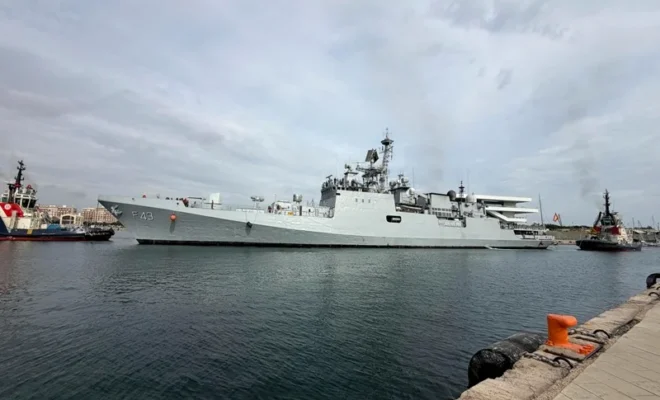
INS Trishul, the Indian Navy warship, has reached the city of Valencia, Spain, as part of its ongoing deployment in the Mediterranean, Atlantic and neighboring maritime zones. The guided missile and stealth frigate ship arrived in Valencia on 30th September, 2026, after taking part in India-France naval drill Varuna in Toulon.
However, the stopover in Valencia is not just another overseas visit. It is part of the ongoing maritime engagement of the Indian Navy with European and other partner navies through operational engagement and sports and cultural activities.
Why INS Trishul Is in Valencia
In its time at Valencia, INS Trishul will be engaging in professional interactions, cross-deck operations, sports events, and cultural activities with the Spanish Navy. As per the Ministry of Defence these exercises are meant to help facilitate the exchange of experiences and understanding between the two navies.
It should be noted that, unlike previous exercises, this one has been defined by the Ministry as a port call and a maritime engagement as opposed to a bilateral naval exercise with Spain.
This is significant because the ship had participated in a more formal exercise recently with France. This exercise at Valencia is therefore another part of a bigger deployment exercise for the Indian Navy.
From France’s Varuna Exercise to Spain
INS Trishul conducted Exercise Varuna, which is the 24th edition of the India-France annual bilateral naval exercise, prior to its transit to Spain.
INS Trishul arrived at Toulon on September 22, and the exercise comprised two phases – harbour and sea. The harbour phase comprised professional interaction among naval personnel from India and France.
In comparison, the second phase was much more operational in nature. It saw the participation of INS Trishul along with French naval vessels, including the frigates Forbin and La Fayette, the nuclear attack submarine Suffren, NH90 helicopters and the Atlantique 2 maritime patrol aircraft.
Some of the tasks covered during the exercise included anti-submarine warfare, anti-surface warfare, live firing and cross-deck helicopter landing serials.
Therefore, it follows that the transit to Valencia is right after this operational exercise with the French navy.
What Makes INS Trishul Important
The INS Trishul is a Talwar-class stealth frigate that belongs to the frontline guided missile warships of the Indian Navy. The ship was launched in June 2003 and is built to carry out a number of tasks within maritime warfare and support of the fleet.
It can be said that India’s navy presence in the European seas shows that operations of the Indian Navy are not confined to its immediate surroundings.
A voyage from the Mediterranean to the Atlantic Ocean takes significant efforts in logistics, navigation, and communication as well as cooperation with the other states.
The European Maritime Footprint Is Expanding
Understanding the importance of the mission comes from seeing it in context of the series of events rather than in isolation of a single port visit.
Prior to the visit to France, the INS Trishul had already docked at Alexandria, Egypt, between September 14 and 17. It is noteworthy that during that visit, there was a Passage Exercise held along with the Egyptian Navy vessel, ENS Bernees.
The next destination after Egypt will be Valencia, Spain. The journey from Egypt to France and further to Spain shows how the Indian Navy maintains maritime relations through multiple partners in one mission only.
Why Spain Matters to India’s Naval Engagement
Spain is a very important maritime partner of Europe and the visit to Valencia offers an opportunity to further enhance the professional familiarity between the two Navies.
Visiting another country’s ship offers the personnel an understanding of how the other navy works their ships, their aircraft and maritime system. Professional interaction can also provide opportunities for the sharing of operational experience.
According to the Ministry of Defense of India, such visits help in enhancing the level of mutual understanding and are part of the Navy’s ongoing engagement with friendly nations.
So the purpose of the visit is not just the visit of an Indian ship to a port of a European nation. It is also about establishing relationships that will facilitate maritime cooperation.
What Varuna Adds to the Deployment
The time chosen for the Spanish visit is of special significance since it comes right after Exercise Varuna, during which INS Trishul was able to engage in complicated sea exercises along with the French Navy.
Exercise included more than one platform and different types of warfare scenarios, which allowed the Indian crew to gain experience in coordination and cooperation between the surface warships, a nuclear submarine, helicopters, and maritime aircraft.
It will bring an operational element to the broader deployment mission.
The Valencia visit will bring more focus to the professional aspect of the deployment mission as well.
A Combination of Naval Power and Maritime Diplomacy
Today, there are other activities beyond exercises that contribute to naval diplomacy.
Activities such as port visits and professional and cultural interactions play an equally important role as they help in maintaining relations when there are no exercises going on.
This was exemplified by the deployment of INS Trishul where in France, the vessel participated in a bilateral exercise that included live firings and warfare exercises whereas in Spain, professional interaction, sharing experiences, and building relations was the main focus.
What Does This Mean for India?
India’s role in this deployment will give an opportunity to showcase its reach and foster ties with European navies.
As per the Ministry of Defence, India’s participation in this deployment falls under the ambit of operational readiness, maritime engagement and international outreach with the overarching aim of helping ensure a secure maritime environment.
This deployment also signals that India has realized the need for maintaining ties with navies outside the Indian Ocean region.
Nevertheless, the deployment should be viewed with caution. India’s Ministry of Defence has not referred to the port call at Valencia as establishment of an Indian naval base in Spain or even a new India-Spain joint naval exercise during this visit.
It must be seen in the context of India’s continuing overseas deployment of its navy.
Why This Deployment Is Being Watched Closely
Indian Navy’s passage through Egypt, France, and Spain is happening against the backdrop of maritime security being an important issue in the international community.
Mediterranean Sea is linked to several important trade routes and is a pathway to the Atlantic Ocean. Ability to sustain naval forces within such regions helps India gain more experience in long-range maritime activities.
Hence, INS Trishul’s present operation combines training, diplomacy, and presence of naval forces in a foreign region.
Conclusion
The arrival of INS Trishul in Valencia marks the latest development in the Indian Navy’s long ongoing deployment in the Mediterranean, Atlantic and surrounding areas.
Having completed the intricate maritime operation with the French navy in the Exercise Varuna, the frigate is now getting involved with the Spanish navy via professional, cross-deck, sports and cultural events.
This deployment is indicative of the way in which India’s naval engagement increasingly includes the exercise with European navies, port visits and overseas deployments.
Instead of being just a visit by an Indian warship to a foreign port, the Valencia visit forms a part of a larger picture of Indian navy maritime engagement.
The visit of the INS Trishul to Valencia shows that India’s naval engagement with Europe is expanding from operational exercise with France to professional engagement with Spain as part of an overall Mediterranean and Atlantic deployment.