
India’s ICU Fire Crisis: Why Hospital Fire Safety Needs Urgent Reform
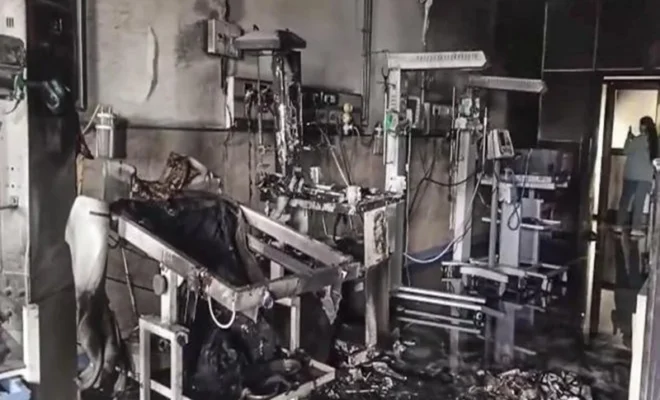
Hospitals are among the last places where one expects to find people running for their lives. But in case of a fire outbreak in a hospital ICU, all traditional laws of evacuation go out the window.
While a healthy individual is able to detect smoke, stand up, find an escape route and run, such actions are impossible for an ICU patient. It is also impossible for a ventilated patient or for a baby in a NICU. An individual who is on oxygen, monitoring, infusion pumps and various other medical equipment cannot be simply picked up and taken down the stairs through smoke and panic.
These considerations make a hospital fire entirely distinct from any office, shop or residential fire. It is not enough to have extinguishers and a fire alarm in place; rather, the question is whether or not the hospital has a means of moving its most vulnerable patients to safety while preserving the means of supporting their life.
Unfortunately, recent incidents proved this vulnerability yet again. In August 2026, three infants were killed by fire that took place in the NICU of District Women’s Hospital in Amravati, Maharashtra. This led to calls for a state-wide fire and electrical audit of hospitals, and political representatives have asked whether the lessons of previous fire tragedies in Indian hospitals have been taken into account.
Unfortunately, it would be hard to pass off the accident as an isolated incident, since India has a specialized national policy regarding the issue.
In May 2026, the Union Ministry of Health and Family Welfare published the National Guidelines on Fire and Life Safety in Healthcare Facilities (2026). The new publication especially emphasized the need to provide fire safety measures in ICUs, NICUs, PICUs and operation theaters. Additionally, the government launched a nationwide Fire Safety Week with auditing, drills and evacuations.
Therefore, the uncomfortable question is not whether India knows how to ensure proper fire safety in hospitals.
Rather, it is whether they are doing it.
ICU Fires Are Not Ordinary Building Fires
The first change requires recognising that the ICU is a unique environment in terms of the risks of fire.
Hospitals possess certain components that may make a fire very hazardous: a lot of electricity, advanced medical equipment, oxygen and other medical gases, flammable substances, complex designs and patients who cannot evacuate themselves. Such specific risks were taken into account in the government’s recommendations for 2026 and special measures to ensure the safety of such clinical facilities have been introduced.
An electrical fault that would not create much trouble in a normal building turns out to be fatal in the ICU since there is a lot of equipment concentrated in one place and it cannot simply be turned off.
Next, there is oxygen. While oxygen itself does not burn, oxygen-enriched air will enhance burning processes. That means that the risk can be transformed into an extremely serious one.
Finally, there is the most significant difference. The patients cannot leave the area themselves.
That means that the evacuation procedures in hospitals cannot assume that.
The Real Test Is Evacuation, Not the Fire Extinguisher
Foryears, fire safety has far too often been an exercise in checking boxes off of a list.
Is there a fire extinguisher? Check.
Is there a fire alarm? Check.
Is there a fire certificate? Check.
But these don’t answer the question of whether the ICU can operate in the event of a fire.
Think of a fire starting up in the middle of the night in a critical care unit. How fast will the fire be detected? Who has the power to order an evacuation? Who evacuates first? Where do ventilated patients go? Where is the portable oxygen kept? Will beds and equipment fit down the evacuation route? What if smoke closes the main hallway? Who takes apart the life support equipment? Where does the evacuated ICU patient go for constant monitoring?
These are operational concerns, not paper work concerns.
These 2026 national guidelines acknowledge the difference by including evacuation procedures for critically ill and immobile patients and specialized high-risk areas.
The hard part will be making sure these guidelines become normal hospital practice.
Horizontal Evacuation Should Become Second Nature
Evacuation of ICU patients does not always imply an immediate evacuation outside the building.
Instead, it is much more sensible to evacuate horizontally, moving patients from fire and smoke to a protected compartment or adjacent safe area on the same floor.
And it is important due to the fact that moving critically ill patients down several floors is potentially risky operation.
It should be stressed that ventilated patient is not a luggage. Newborn baby in an incubator is not a package. Patient on multiple IV infusions cannot be disconnected from them.
It is crucial for hospitals to have evacuation zones mapped out, protected compartments and equipment created for evacuation of non-ambulatory patients.
All these questions are raised in the national 2026 guidelines dedicated to fire safety plan, evacuation routes, horizontal exits and areas of refuge.
But it is even more important to know those routes for every ICU employee without any manuals.
Electrical Safety Cannot Be Treated as Annual Paperwork
One of the most important lessons from hospital fires is that electrical safety needs to be an ongoing process.
Contemporary ICU wards are filled with electrical equipment. The combination of ventilators, monitors, infusion pumps, imaging equipment, refrigeration units, computers, lighting equipment and others creates immense pressure on the electrical system.
An institution can have state-of-the-art medical equipment yet maintain aging wiring, overburdened circuits, faulty connections and poor monitoring of power quality.
This is a risky combination.
In the 2026 National Framework for Hospitals, particular emphasis is placed on electrical systems and risk assessment among other high-risk areas.
It means that hospitals need to go from inspections to audits of their electrical system and preventive maintenance. An audit that detects a risky fault but doesn’t take measures to correct the problem is not a safety system.
It’s just an audit report.
Fire Drills Must Stop Being Ceremonial
Another harsh truth is that the staff may know where the fire exits are located but may not know how to evacuate a patient.
Hence, the fire drill in hospitals should mimic an actual ICU emergency situation.
The staff should practice raising alarms, communication between staff, prioritising the patients, moving the beds, managing the portable oxygen, ensuring the availability of power in emergency, controlling the smoke, among others.
Such drills should not be conducted during a visit by a regulator.
This was reflected in the Fire Safety Week 2026 organised by the Union Health Ministry which included conducting audits, mock drills, evacuation drills and training as part of their preparations.
Even AIIMS has had schedules for conducting fire safety drills and training in the past, proving that such drills can be institutionalised.
All that should happen is that when the alarm rings, the staff should respond by virtue of muscle memory, not improvisation.
Accountability Must Continue After the Inspection
However, there is no total lack of regulations in India.
The Ministry of Health’s 2026 guidelines create a holistic structure dealing with governance, risk assessment, infrastructure, emergency plans, personnel training, compliance and awareness.
There is also the overall Clinical Establishments legislation meant to define minimum requirements for registered health establishments in states and Union Territories that have adopted it.
However, the issue here also relates to implementation and accountability.
In case of a non-compliance found during the audit, who will be accountable for this? How fast the fix will need to be completed? Who will check if the fix has been implemented? What if it remains the same during the next inspection?
An audit process that will allow the same problems in fire safety to be identified again and again creates an illusion of compliance without protecting patients from any risks.
There must be a chain of accountability starting from hospital administration to safety officers, technicians and local authorities.
The 2026 Guidelines Are an Opportunity — If They Are Enforced
The government has made sure to take one very crucial step by updating the national guidelines.
The updated guidelines go further than the previous ones that only covered general building fire standards, and now specifically consider the dangers of hospitals and their intensive care units. They also have a detailed plan of fire-safety planning, fire alarms, sprinklers, emergency systems, evacuation, oxygen infrastructure and other aspects.
That must mark the beginning of a revolution, not its end.
Every state should come up with a public schedule for fire and electricity audits of hospitals. They should reveal whether any critical problems were found and how they were fixed. Facilities at high risk must receive random inspections, and not just annual ones.
And intensive care and neonatal intensive care units must be evaluated based on evacuation capacity, not just equipment availability.
The Cost of Prevention Is Smaller Than the Cost of a Life
The problem of hospital is always financial. The process of upgrading the electrical system, adding additional fire protection measures, compartmentation of spaces and drilling is expensive.
However, when safety upgrades are called too expensive, it becomes impossible to justify this position in case when such measures could save one’s life.
Hospital is always a place of trust. People come to the hospital with a trust that no matter what their health condition is, it is a place where all possible risks were managed for them.
Fire safety is among them.
If a critically ill patient dies not because of a fire itself but because it was not detected on time, because smoke got in there through unprotected passage, because the equipment could not be transferred, because the staff were not prepared to evacuate patients in case of emergency – the tragedy is not just a fire.
The tragedy is that the system was unprepared to it.
India Needs Culture of Fire Safety, Not Just a Reaction
Every major fire at the hospital repeats the same scenario.
People express shock. They send condolences. Authorities begin investigation. Leaders demand audits. Committees are created. Violations are discussed.
And then public opinion gets distracted.
The real change is going to occur when the fire safety becomes as ordinary as infection control, medication safety and clinical practice.
The question which should be asked in every ICU should not be whether they have fire extinguishers or not.
It should be whether they would be able to save all the patients in case of fire.
It means that hospitals have to accept the fact that patients, who are in the worst state and the most at risk, are the least capable to help themselves.
India already has updated national guidelines which are intended to deal with that problem.
What India needs now is enforcement, transparency, constant audits and culture of fire safety.
Because ICU is always a place where technology keeps people alive.
It shouldn’t be a place where a fire kills them.
Stay updated with the stories shaping India and beyond.
How Could Iran War Hit India?
Check out what the conflict could mean for India’s oil supply and energy security.
What Could Japan Rice Talks Change?
Find out how new Basmati rice export mandates could shape India-Japan trade negotiations.
Why Is Hormuz Facing Rising Tensions?
Uncover how escalating Strait of Hormuz tensions could affect global shipping and energy routes.
What Do DGCA’s New Rules Mean?
Browse the latest aircraft engine inspection rules and their impact on aviation safety.
How Will MAHASAGAR Strengthen India?
Dive into India-Sri Lanka maritime security and energy cooperation under the MAHASAGAR initiative.