
5 Hidden Costs Paid by Indian Migrant Workers Whenever Gulf Flight Schedules Are Disrupted
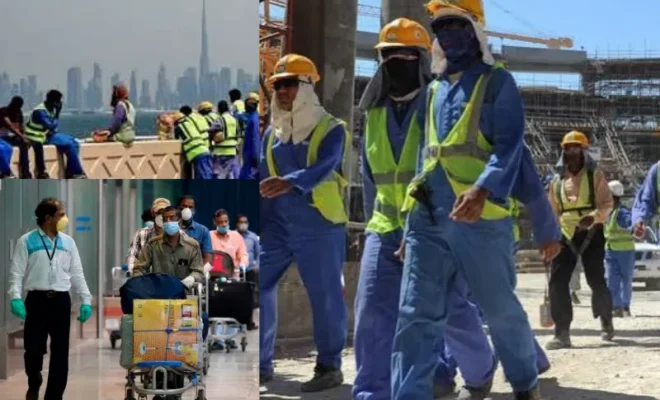
A cancelled flight is considered an inconvenience, where people have to wait for another one to take off, airlines change their booking plans, and plans get revised. However, in the case of migrant Indian workers bound to travel to Gulf nations, a cancelled flight becomes a source of deeper financial troubles. For instance, a late departure means loss of job prospects, accommodation costs without earning any money, absence of pay, extension of loans or sending less money to their families located thousands of miles away.
These implications were clearly seen during the West Asia conflict that took place in 2026, causing flight delays of several Indian workers who waited in cities like Ahmedabad and Surat for resumption of their travel to Gulf nations. In March 2026, The Migration Story reported on the stories of some Indian workers who experienced postponement or cancellation of their flights to Bahrain. Some of them had already resigned from their current jobs, borrowed money and made long-distance travel around the country in order to catch their flights.
Disruption in flights does not have the same impact on all workers. For instance, the newly hired worker awaiting joining a Gulf company is at a different risk than the worker who has taken leave but is returning to his/her job. Both have suffered financial loss which normal airline disruption policy cannot address. There are five hidden costs here.
1. Lost Wages and the Cost of an Opportunity That Never Begins
The first hidden cost involves the income a worker would have earned had the plan been realized. Recruitment into a Gulf job could be considered an important turning point financially for a worker because the person could have quit the previous employment where he earned less money and borrowed money to go through the process of recruitment in order to earn more money abroad.
Cancellation of the flight means that the planned money has vanished from the household budget without any other option.
The case of Baleswar Kushwaha, who is a carpenter from Uttar Pradesh, gives us a good example. Mr. Kushwaha was supposed to travel to Bahrain on February 28, 2026, but the date of his flight was changed and then cancelled altogether. While staying in Ahmedabad and spending all of the money he had, he decided to move to Bharuch and do some temporary jobs instead of going abroad to work.
2. Accommodation, Food and Local Travel Become Unexpected Expenses
The second type of loss is the one caused due to being stuck in a foreign city. The workers move out from the villages and small cities either for the recruitment centers or for boarding flights to their international destination.
While their flights are being rescheduled again and again, they keep on incurring costs.
As Kushwaha, for example, was charged ₹800 per night at a lodge in Ahmedabad until he boarded his flight to Bahrain.
He incurred costs of his domestic travel as well as additional hotel costs which consumed the amount of ₹20,000 loan he had taken from his friend. Eventually, he found himself compelled to look for a job rather than spending time without any earnings.
A few additional nights in a hotel for a salaried individual will not make much of a difference, but the same amount of expense for a carpenter, electrician, mason or machine operator can be quite burdensome.
Also, there is a disadvantage in terms of geography. The worker might not be familiar with the city and also does not have any family members nearby and knows how he can find cheap lodging. Moreover, finding temporary work cannot be ensured especially when there are other workers who are also looking for the same daily work.
It will become even more expensive for the worker when he has to go back to his hometown and again come back to the airport after flights are resumed.
3. Recruitment Debt and Interest Continue Growing Without a Salary
The third hidden cost is especially grave since the effect will linger long after the disruption of flights. For many Indian workers, overseas migration is possible through borrowing from family members, friends, local lending agencies, microfinance institutions and others.
According to the 2024 IOM Report of Returnee Migrants in Telangana published by The Migration Story, almost 72% of returned migrants in Telangana had taken a loan for migration purposes. The amount of the loan was usually within ₹50,000 to ₹2 lakh range.
In another 2024 report of Verité on Indian workers’ migration to GCC countries, 98% of interviewees mentioned exploitation risk due to recruitment debt. The report also mentioned the additional cost burden of the workers beyond recruitment fees, including travel-related ones.
If the overseas work opportunity is delayed, the loan doesn’t stop there. Interest payments will continue accruing, repayment deadline won’t change and the loan payments will be expected even though the worker has not received his/her wages yet.
The problem is not limited to workers whose flights are cancelled. Those returning from India to an existing Gulf job can also face pressure if their unpaid leave extends beyond the approved period. A missed return journey may mean losing paid working days or facing uncertainty over the next salary.
Migration should create a pathway towards financial security, not push workers into a deeper debt trap.
4. Employment, Visa and Contract Uncertainty Can Create a Second Crisis
The fourth cost is administrative and employment-related uncertainty. A flight cancellation does not automatically invalidate a work visa or terminate an employment contract. However, prolonged disruptions can create complications when workers are approaching visa deadlines, returning from approved leave or waiting to join an employer.
For newly recruited workers, the employer may postpone the joining date because a project has been delayed or operations have slowed. In some cases, the original vacancy may remain available, but the company may decide to wait before arranging another deployment. Workers then face uncertainty over whether their appointment will remain valid.
In the case of existing employees, late return after approved leave may cause another kind of issue. The employee needs to communicate with the employer and get new travel arrangement and know whether it will be considered as an authorized one. It all depends on the employment agreement and regulations of the country where the individual is travelling to.
The MEA in its report has stated that Indian laborers in Gulf nations are subjected to issues like delay in payment, arbitrary termination of employment, cancellation of residence permits, living quarters related issues, and getting exit or reentry permission. These vulnerabilities that exist among them become even more complicated because of flight disruptions.
The February 2026 suo motu intervention of the NHRC in the case of 14 stranded Indian laborers in Dubai has shown how serious this issue of vulnerability is in the employment sector. According to the report, these laborers claimed about the confiscation of passports, delay in wages and difficulty in returning to India. The NHRC asked for a report from the government of Jharkhand regarding the issue.
Flight disruptions can never justify the reasons for delaying wage payments or confiscating passports or changing the conditions of employment.
5. Families in India Lose Remittances, Savings and Financial Stability
The fifth cost is faced by those families that might not even take the disrupted flight. In many cases, Gulf migration for Indians is not only an employment issue, but a family strategy of earning money, since the money earned abroad pays for education, health care, housing mortgage, farming expenses, weddings, and household needs.
When the migrant worker does not get a new job, the remittance does not come as expected. When the employed person is unable to continue working, he will earn less or not at all. Then the family will have to use the savings, borrowings from the area or from the relatives.
According to the 2025 remittance survey by the Reserve Bank of India, Gulf Cooperation Council countries contributed approximately 38% of India’s inward remittances in 2023-24. UAE had contributed 19.2% while Saudi Arabia 6.7%. Such statistics clearly indicate the dependency on remittances from the Gulf states to India.
However, it is not uniformly felt. If a family has got multiple sources of income, a delay in a remittance can be accommodated for some weeks. In case where the remittances of a migrant worker constitutes the only source of income, then the family is likely to struggle immediately to cover its needs.
This effect also extends to children and even the elderly in the household. Educational remittances can be delayed, hospital appointments postponed and reduced household expenditures among others. An issue that starts off as a simple scheduling problem in the airline can quickly become a health, education and financial problem at home.
Why Airline Refunds Alone Cannot Address the Problem
Airlines are responsible for communicating cancellations, arranging applicable refunds or alternatives and following the passenger-protection rules that govern their operations. However, a refund for an unused ticket does not compensate a worker for lost wages, accommodation, recruitment-related borrowing or the financial pressure on dependants.
This becomes important since the journey is not always for leisure for migrant workers; rather, it is closely related to the employment contract and project timelines. A delay in arrival means a disruption in the livelihood arrangement.
The response to the problem must involve the airline companies, recruitment agencies, the employers, the Indian embassies and the state governments. Agencies can give the necessary updates regarding the validity of the employment offer and joining date. It is important for the employer to provide information about revised joining date and assure workers that they will not be penalized for delays beyond their control.
It is also possible for Indian missions to give more support by providing information on the availability of services, accommodation and employment-related problems. MEA has the e-Migrate system that enables complaints against recruiting agencies. It also has the Overseas Workers Resource Centre from where help can be sought.
India needs a better-coordinated approach for emergency support to workers stranded due to travel disruptions. This system would allow workers to contact the verified employers, state migrant-worker control room, accommodation arrangements and legal help. Communication is very important so that the workers do not depend solely on informal agents or information.
Protecting Migrant Workers Must Be Part of India’s Aviation and Labour Policy
The connection between India and the Gulf extends far beyond trade, energy and diplomacy, for the ties also involve millions of workers who make possible construction work, hospitals, hotels, transportation and business in the region.
This group of people deserves much more respect and security than just at the point of departure from the airport. The authorities should understand that financial insecurity caused by migration does not start upon arrival in the new country but rather starts back in the native village and can even peak with a canceled flight.
The disruptions to travel from West Asia in 2026 showed how quickly a migrant worker’s meticulously planned migration trajectory could fall apart. One could easily find himself with very little room to accommodate another delay after selling his property, borrowing money, quitting a job he was working in and having travelled hundreds of kilometers.
A more robust system will entail clear recruitment agreements, travel assistance in cases of emergency, grievance redressal mechanisms and also responsibility on the side of the employers. In addition to that, the migrant worker needs to be assured of the status of his job, visa and joining date after a major disruption.
A cancelled flight may only last a few hours on the operations dashboard of an airline, but its economic impact can haunt an Indian migrant worker for months. The true benchmark of a secure migration regime cannot just be the number of people reaching their destination. It should also take into consideration the extent of protection provided to migrant workers in situations where they are unable to travel.
Rural Entrepreneurship, Christmas Tourism, Workplace Privacy, Rail Safety & Women’s Livelihoods
What Makes the National SARAS Mela 2026 Special?
Discover how the Vijayawada edition of the National SARAS Mela is showcasing products made by rural self-help groups, and explore the role of the event in promoting local entrepreneurship and livelihoods.
Can Mizoram Become India’s Premier Christmas Tourism Hub?
Explore Mizoram’s strategic tourism plan, discover how Christmas celebrations could attract more visitors, and understand the opportunities for local communities and businesses.
Why Was an OpenAI Employee Arrested Over a Recording Device?
Understand the reported incident involving a secretly installed audio recording device in a conference room, explore the workplace privacy concerns it raises, and discover the importance of protecting confidential conversations.
Will Train Tickets Now Include Compulsory Passenger Travel Insurance?
Explore the Supreme Court’s reported mandate effective October 27, understand what compulsory travel insurance could mean for railway passengers, and discover its potential implications for ticket bookings.
Why Are States Seeking Urgent Funds for Women’s Livelihood Missions?
Explore the states’ appeal for financial support, understand the funding challenges facing the Women’s Livelihood Mission and NULM 2.0, and discover what continued support could mean for women’s economic opportunities.