
India Approves 13th Five-Year Development Plan Grant for Bhutan: What It Means for Bilateral Ties
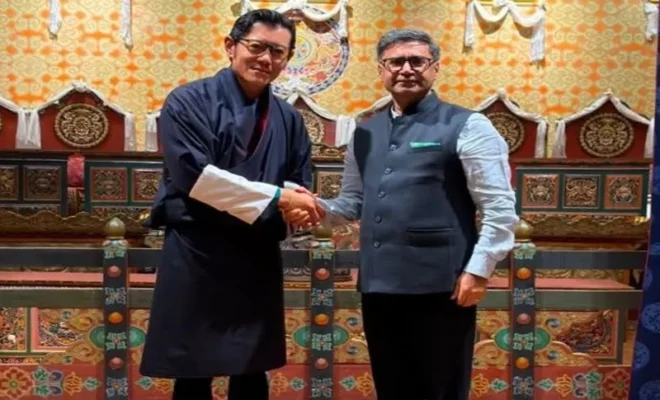
India has reiterated its development assistance to Bhutan through the review of the implementation of the financial package provided to Bhutan for implementing its 13th Five-Year Development Plan (2024-2029). In addition, the two nations have approved 12 more development projects worth ₹332 crore for sectors such as healthcare, infrastructure, agriculture, urban development, and disaster management at the latest India-Bhutan Development Cooperation Talks.
The declaration is much more than financial aid as it clearly signifies the strategic partnership of India and Bhutan through economic development, connectivity, energy, healthcare, and regional stability.
What Is Bhutan’s 13th Five-Year Development Plan?
Five Year Plans of Bhutan act as the country’s main development blueprint and the present 13th Five-Year Development Plan (2024-2029) will emphasize building the economy, job creation, infrastructure, improvements in healthcare and education, and sustainable development of the country along with Bhutanese philosophy of Gross National Happiness (GNH).
In order to fulfill these objectives, India pledged ₹10,000 crore when the Prime Minister of India visited Bhutan in 2024. The financial aid includes Project Tied Assistance, High Impact Community Development Projects, Economic Stimulus Program, and programme grants.
What Has India Approved Now?
During the fifth round of development cooperation talks between India and Bhutan, both the nations assessed the status of implementation of the ongoing projects, and sanctioned 12 new PTAs with an aggregate cost of ₹332 crore.
With this, the number of PTA projects sanctioned under the current Five Year Plan of Bhutan has now risen to 82 with a total cumulative cost of ₹6,860 crore. These projects cover various fields including infrastructure, healthcare, agriculture, disaster management, and urban amenities.
The discussions were jointly led by India’s Foreign Secretary, Vikram Misri and Bhutanese Foreign Secretary, Pema Lektup Dorji.
Don’t miss these top related stories shaping India’s politics, economy, health, and regional diplomacy.
Why Did Bhutan Royals Visit?
Get to know how PM Modi’s warm reception highlights the growing strength of India–Bhutan diplomatic ties.
Does India Need J&J Vaccine?
Find why experts believe India may not require the Johnson & Johnson vaccine candidate at this stage.
How Will New Transit Routes?
Dive into how the India–Bangladesh connectivity corridor expansion could transform cross-border trade and transportation.
Is India Planning Economic Stimulus?
Check out what the Finance Ministry and RBI discussions could mean for businesses, jobs, and economic recovery.
Why Are Protests Rising Nationwide?
Look into why multiple groups across India are protesting simultaneously and what is driving this nationwide unrest
Why Is This Grant Important?
Bhutan has had India as its primary development partner for a long time now. Financial assistance provided to Bhutan during various Five-Year Plans has helped build roads, schools, hospitals, power plants, telecommunications networks, and support community development in Bhutan.
This new round of approvals highlights the continued role of India in assisting Bhutan achieve its own national priorities within the context of Bhutan’s development model and policies.
While most development partnerships revolve solely around finance, the Indian-Bhutanese partnership is built on financial assistance as well as capacity-building and technical cooperation.
What Does It Mean for Bilateral Relations?
This latest grant helps solidify one of the most important diplomatic ties in South Asia.
There was a strong degree of cooperation between India and Bhutan already in the fields of hydropower, trade, education, border management, connectivity, and security. The latest grant approvals help strengthen cooperation through various projects that directly help provide better public services and local development.
Besides that, India and Bhutan examined cooperation in the areas of energy, investment, connectivity, and people-to-people relations during the consultations.
How Can It Help Bhutan?
India’s assistance can bring regular funding to meet the needs of the country without requiring any immediate strain on its resources.
Projects being implemented under this new round of approvals will enhance health care, disaster preparedness, infrastructure, agriculture, and urban development.
India’s ongoing assistance to the Economic Stimulus Program of Bhutan also aims to help Bhutan boost economic recovery and create jobs.
Why It Matters for India
India too finds this relationship strategically significant.
India and Bhutan share a sensitive Himalayan border. This small but strategically important nation is a significant factor when it comes to regional stability and connectivity. Economic ties will further strengthen their relations and enhance trust.
India’s developmental assistance program also helps it with broader regional programs such as cross-border infrastructure and energy cooperation in the Eastern Himalayan region.
Their relationship has continued to be based on mutual respect and diplomacy with strategic interests rather than just commercial interests.
What Happens Next?
Now comes implementation, the new area of focus.
The approved projects will proceed to implementation within the wider context of Bhutan’s 13th Five Year Development Plan. Periodic Development Cooperation Talks are anticipated from both the governments for ensuring completion of the projects within schedule and in accordance with the development requirements of Bhutan.
Conclusion
India’s recent approvals of projects for Bhutan’s 13th Five Year Development Plan prove beyond doubt the strength and forward-looking nature of the relationship between the two countries.
Apart from providing financial help to each other, this project proves long-term commitment of both the countries towards development, stability and economic cooperation. As Bhutan continues to develop further, India’s cooperation is likely to be one of the major aspects of one of the most consistent bilateral relations of South Asia.