
50,000 Migrants in 48 Hours: What the Ceuta Border Crisis Reveals About Europe’s Deepening Divides
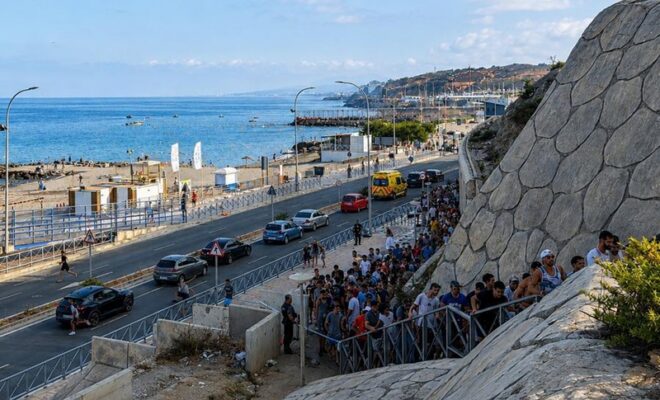
The influx of almost 50,000 migrants into Ceuta, a Spanish enclave in North Africa, in a mere span of 48 hours has again brought to the fore one of the most enduring paradoxes for Europe: how to harmonize its humanitarian duties with its security considerations and border integrity. Even as Ceuta has faced previous waves of migration, it is the sheer magnitude of this wave and its speed that have turned it into much more than an emergency situation. It has turned it into a metaphor for the widening divide in Europe.
Migration has been posing a challenge to the European Union’s rhetoric of unity for years now. And yet, whenever a major crisis of migration has occurred, whether it be the migration of refugees from Syria in 2015, the clash between Belarus and Poland on their borders or now the Ceuta situation, Europe has failed to devise a common policy on migration which can strike a balance between compassion, security, and political cohesion.
In other words, the Ceuta crisis is about much more than the movement of thousands of migrants across a border.
Why Ceuta Matters More Than Its Size
Ceuta holds a distinctive place on the world map. While geographically situated in the north of Africa, Ceuta belongs to Spain and by proxy to the European Union. For migrants trying to get into Europe, the journey into Ceuta translates to having reached European territory.
Due to its distinct geographical location, Ceuta has emerged as one of the most strategically sensitive borders in Europe. The region, which has been protected by fences and technology, among other security measures, has always been used as a border defense for Europe.
When the influx of migrants reaches tens of thousands within a relatively short span of time, the issue becomes not just one of Spain. It automatically becomes a European problem.
Migration Is Increasingly Becoming a Geopolitical Tool
Migration as a strategy of geopolitical influence is also illustrated by the Ceuta case.
Recently, migratory paths have become more intertwined with diplomatic controversies, regional rivalries, and bilateral talks. Accused of softening border controls and facilitating the passage of huge waves of migrants, governments can exert indirect political pressure on their neighbors without resorting to traditional military means of warfare.
This trend has become particularly noticeable along the border lines of several countries of Europe.
Wherever the borders of Poland, Greece, Italy, or Spain, the migration process is always accompanied by political conflicts, so the management of these borders becomes impossible without involvement in international politics.
Migration today has not only humanitarian but also geopolitical dimensions.
Europe’s Internal Divisions Are Becoming More Visible
The most telling feature of the current crisis may be less the sheer number of migrants than the political responses throughout Europe.
Despite being members of the same union, various member states still maintain different perspectives toward migration.
While some member states emphasize humanitarian duties and refugee protection under international law, others believe that deterrence and border control measures are required in order to ensure public safety and political stability.
This difference has prevented the EU on multiple occasions from adopting a cohesive migration policy.
Countries situated on the outer borders of Europe tend to feel an unfair share of the responsibility, whereas other members prefer to refrain from participation in relocation schemes.
For Ceuta, this situation is evident once more.
In the absence of solidarity, each front-line state will inevitably confront future crises alone.
The Domestic Political Impact
Migration remains one of Europe’s most politically polarizing issues.
Every major influx influences domestic political debates, election campaigns, and public opinion.
Concerns surrounding housing, employment, healthcare, public services, integration, and national identity often become intertwined with migration policy.
This has strengthened both nationalist and anti-immigration political movements across several European countries while simultaneously energizing civil society organizations advocating stronger humanitarian protections.
The result is an increasingly polarized political landscape where consensus becomes progressively more difficult.
Ceuta arrives at a time when many European governments already face economic uncertainty, inflationary pressures, and growing public dissatisfaction.
Large migration events therefore become catalysts for much broader political debates.
Humanitarian Responsibilities Cannot Be Ignored
Although security issues tend to monopolize news reports, humanitarian considerations hold equal weight.
Individuals seeking entry into Europe are often doing so due to their escape from conflict, persecution, economic instability, or environmental challenges.
Refugee law under international conventions dictates that asylum applications need to be assessed on an individual basis and not collectively.
This forms one of the fundamental contradictions within European migration policies.
In this case, governments need to ensure the security of their borders, while also providing legal sanctuary to those who genuinely deserve it.
This is becoming increasingly challenging as migration trends become even bigger, faster, and more politically charged.
Security Challenges Extend Beyond Border Control
Management of a flow of this magnitude entails much more than just stopping people from entering illegally.
It entails immediate provision of medical assistance, housing, identification, security clearance, child safety measures, and asylum procedures.
All of these require staff, facilities, funding, and cooperation between local, national, and European officials.
The arrival of migrants within hours rather than days can strain administrative capacity no matter how well-prepared for it one is.
Such operational issues are the reason why migration crises tend to have repercussions in terms of broader governance issues.
The African Dimension
The Ceuta crisis is indicative of wider structural problems that affect some African countries.
Population growth, unemployment among the youth, political instability, climate-related challenges, and economic imbalances continue to fuel migration dreams.
Europe continues to be viewed as a place of opportunities, learning, and employment for many young people in Africa.
Without dealing with these root causes of migration, the problem of migration will not subside much.
Border control alone will not solve demographic and development trends in regions.
Europe’s Migration Policy Needs Long-Term Reform
The fact that migration crises tend to be cyclical shows that emergency measures are not enough.
A viable migration policy for Europe in the long run will probably involve stronger partnerships outside Europe, faster asylum procedures, better return processes for people without protection needs, more legal migration channels, and more cooperation between EU member countries.
Just as essential would be restoring public faith in the humane and efficient functioning of migration policies.
Otherwise, political tensions around migration will only get worse.
The Symbolism of Ceuta
Ceuta is not just a border crossing.
It has become a symbol of the convergence of globalization, inequality, geopolitics, humanitarianism, and sovereignty.
Images coming out of the enclave tell Europe that migration is no longer a one-off problem, but rather something that is permanently part of international politics.
How Europe chooses to act could determine not only its border policy for years to come, but also how committed it really is to human rights and international cooperation.
Top Stories You Can’t Afford to Miss Today
When Will Tata Curvv EV Launch?
Explore the confirmed launch date, expected price, battery options, driving range, and upgraded features of the Tata Curvv EV.
Why Is Income Tax Portal Slow?
Check how to clear your browser cache, verify your e-filing status, and avoid penalties under Section 234F before the deadline.
How Are India-Japan Supply Chains Evolving?
Discover how India and Japan are strengthening Indo-Pacific supply chains through new bio-gas and semiconductor partnerships.
How Can Patients Book Instantly?
Explore how AIIMS Delhi’s new WhatsApp and ABHA Health ID system makes OPD appointment booking faster and easier.
Why Did Washington Change Strategy?
Discover why the latest U.S. terror designation targets financial networks and what it could mean for future counterterrorism efforts.
Conclusion
The arrival of some 50,000 migrants in just 48 hours has revealed weaknesses that go well beyond the borders of Spain.
This crisis has brought into focus existing problems with migration policy, burden sharing, border security, humanitarian concerns, and Europe’s place in a growing world of instability.
Ultimately, Ceuta is not just a test of Europe’s borders; it is a test of Europe’s unity.
Whether the European Union comes out stronger depends less on border fences and emergency reinforcements, and more on how Europe develops a coherent and realistic migration policy.