
Defence Minister to Commission INS Mahendragiri: Everything to Know About India’s New Stealth Frigate
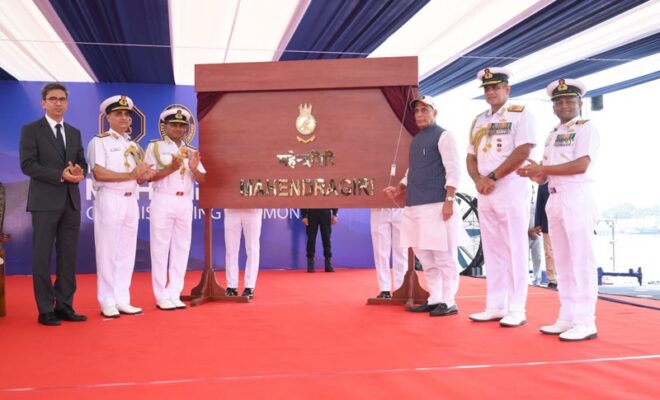
The Indian naval forces have got another formidable indigenous warship with the launching of INS Mahendragiri, which is an advanced stealth guided missile frigate of the Project 17A programme of the Indian Navy. The warship was commissioned by the Indian Defence Minister, Rajnath Singh, at Visakhapatnam, and he termed it a milestone achievement for the Indian Navy on the road to becoming self-reliant and modern.
INS Mahendragiri has been designed and manufactured in India and is fitted with advanced features like stealth capability, sensors, weaponry, and multi-role combat ability.
What Is INS Mahendragiri?
INS Mahendragiri is the last warship that has been made as a part of the Project 17A (Nilgiri-class) frigates. The ship has been designed by the Warship Design Bureau of the Indian Navy and has been constructed by Mazagon Dock Shipbuilders Limited in order to help India move toward defence indigenisation.
Project 17A has been built in order to be an improvement over the older Shivalik-class frigates.
Why Is the Commissioning Important?
Commissioning of the INS Mahendragiri comes amidst a period of rising significance of maritime security in the Indian Ocean region.
Given the strategic contestations and increased naval presence and sea lane protection requirements, the Indian Navy has been progressively upgrading its fleet with domestically produced ships.
Inspection of the INS Mahendragiri will increase India’s capabilities in anti-aircraft, anti-surface ship and anti-submarine warfare, besides being a milestone in the Atmanirbhar Bharat program for defense manufacturing.
What Makes INS Mahendragiri a Stealth Frigate?
Whereas traditional warships are not inherently built for hiding from their enemies’ radar, IR, and electronic reconnaissance, stealth frigates have been purposefully built for this specific purpose.
The stealth attributes of INS Mahendragiri include its innovative hull design, low radar signature, platform management systems, and electronic warfare.
These aspects are essential to increasing its survivability in contemporary naval warfare.
Weapons and Combat Capabilities
INS Mahendragiri has been fitted with capability to undertake several combat missions at once.
The ship is fitted with sophisticated surface-to-air missile systems for air defense, anti-ship missile systems for targeting hostile ships, state-of-the-art naval artillery systems, anti-submarine warfare systems, torpedoes, and close-in weapons system for defense against missiles.
The ship is also fitted with futuristic radar systems, sonar systems, electronic warfare systems, and combat management systems to detect and engage several threats at once.
Indigenous Technology at the Core
Another remarkable feature about the INS Mahendragiri is the high level of indigenous content that it has.
There have been significant contributions from Indian defence manufacturing in terms of design, construction, and several onboard systems. This shows that India has been successful in constructing highly advanced frontline warships on its own without relying too much on foreign sources.
Project 17A is seen as an indicator of India’s growing competence in constructing naval ships.
How Will INS Mahendragiri Strengthen the Indian Navy?
It is predicted that the new frigate will play an integral role in the Eastern Fleet of the Indian Navy.
Its multifunctional capabilities mean that it can engage in tasks such as fleet escort duties, maritime reconnaissance, antisubmarine warfare, long deployments, humanitarian relief efforts, disaster management and maritime security patrols.
Its deployment has helped improve the operational preparedness of India in the strategically crucial Indian Ocean Region.
What Is Project 17A?
Project 17A represents the Indian Navy’s new stealth frigate project that intends to replace their older generation surface combatants with better, networked combat ships.
The project involves the building of seven frigates by Mazagon Dock Shipbuilders Limited and Garden Reach Shipbuilders & Engineers.
These ships incorporate improved automation systems, better sensors, less radar signature, and greatly increased combat effectiveness.
Why This Matters for India’s Maritime Strategy
Naval capabilities have been of growing importance for India due to the changing security environment of the region.
With a modern fleet composed of locally-built ships, the Navy is in a better position to counter traditional dangers, acts of piracy, humanitarian tasks, and strategic deployments in the Indo-Pacific.
The launch of INS Mahendragiri represents the long-standing Indian ambition to construct a technologically advanced, combat-ready, and self-sufficient navy to protect its interests beyond its coastlines.
Stay Ahead With Today’s Biggest Stories
Why Restrict Rental Thar SUVs?
Discover why Goa is considering restrictions on rental Thar SUVs and the safety concerns behind the move.
Passed the FMGE June 2026 Exam?
Check the FMGE June 2026 result, pass percentage, scorecard details, and direct download link.
How Will Semicon 2.0 Help?
Explore how India’s Semicon 2.0 incentive plan could strengthen chip manufacturing and boost investments.
Why Is Jalalabad Being Renamed?
Explore why Uttar Pradesh’s decision to rename Jalalabad after Lord Parashuram is sparking debate.
What Caused Devkund Flash Flood?
Read what happened during the Devkund Waterfall flash flood and why tourists were left stranded.
Conclusion
The induction of INS Mahendragiri is not only about the launch of another warship but also marks an important achievement in India’s domestic defence production process and naval modernization.
Thanks to its stealth capabilities, high-tech weaponry, state-of-the-art sensors, and multi-faceted operation, the warship is poised to serve in the Indian Navy’s interests for many years to come.
INS Mahendragiri is not only the latest stealth frigate that India possesses but also a sign of its increasing capability to design, produce and use such vessels on its own.