
The Myth of the Global Trade Consensus and India’s Pragmatic Pivot
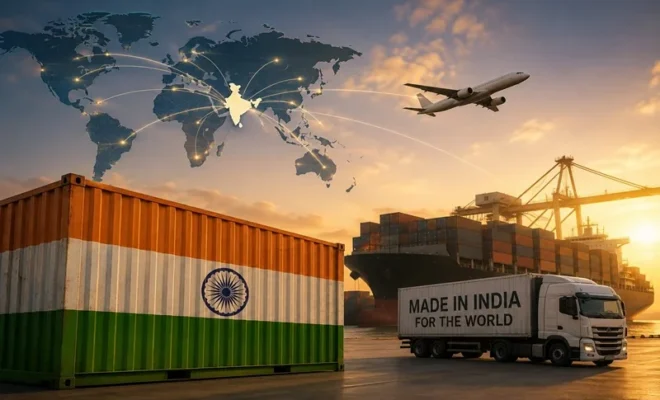
For most of the time since the end of the Cold War, the idea that international trade would eventually involve lower tariffs, increasing multilateralism and a shared set of rules managed through organizations such as the WTO had been comforting.
Now there is no consensus on that anymore.
The international trading system will enter a period where tariffs, industrial policy, supply chain security and strategic autonomy will come back into play as key elements of economic policy making. Major economies will be engaging in a contradictory exercise of defending multilateral rules while implementing policies aimed at protecting their domestic industry. Even the European Union is considering to go further and implement strong “Buy European” provisions in its public procurement policy as a way of responding to industrial challenges brought by China.
For India, the new international environment provides not only a challenge but also an opportunity. New Delhi’s trade policy shows indeed that India is not willing anymore to choose between globalization and economic protectionism but rather to make use of both.
This is not a rejection of global trade; it is just a realistic approach to the fact that the old consensus on international trade is already gone.
The Global Trade Consensus Was Never as Permanent as It Appeared
The original design premise of the WTO was based on a simple yet compelling proposition – countries could work together to lower barriers to trade, as everyone stood to gain from greater economic integration. Developed countries had access to growing consumer markets and increased efficiency, while for the developing nations there were assurances of predictable market access.
These premises have been altered drastically.
The pandemic revealed how vulnerable heavily concentrated supply chains were. The Russia-Ukraine war showed that trade, energy, and national security should not be considered separately anymore. The competition between the US and China has made semiconductors, artificial intelligence, critical minerals and advanced manufacturing strategically valuable assets. The huge trade surplus and industrial model of export of China have caused political concerns in many of the largest economies.
The outcome is an unprecedented paradox. Countries are still using the rhetoric of rule-based trade even as they engage in industrial policies that used to be protectionism in high-globalization days.
The apparent consensus thus is a mere myth.
India’s Position Is More Nuanced Than “Protectionism”
India has often been seen as reluctant when it comes to trade liberalisation because of the country’s tariffs, agriculture, and the insistence on having enough room in the policy for domestic industry. The above criticism is not completely baseless; during the 2026 WTO Trade Policy Review, EU brought forward its concerns regarding India’s customs practices, SPS requirements, government procurement, and quality control mechanisms.
The problem is that such a characterization of India ignores the bigger picture.
During the 2026 WTO Trade Policy Review, India stressed its commitment to an “open, transparent and predictable” trade and investment regime, but at the same time, it stated that the trade policy had to take into account developmental issues, agriculture, supply chains and manufacturing.
Such a contrast is important to make.
India is not saying that globalization has to be rejected. What it is doing is that it is saying that globalization has to work according to the realities of a large developing country, which has millions of people whose lives and jobs depend on the trade policy.
And here pragmatism comes into play.
From One Global Framework to Multiple Strategic Partnerships
Indian trade policies are increasingly becoming diversified rather than being singular.
Instead of relying solely on the WTO for market access, India has entered into an increasing number of bilateral and regional agreements. An example of such an agreement is the UK-India Comprehensive Economic and Trade Agreement which was presented to the British Parliament in July 2026.
In addition to its efforts to engage in deeper trade relations with the European Union, Australia, New Zealand, UAE and other economies, India is engaging in negotiations with other countries.
Why does this matter? Bilateral agreements enable India to negotiate according to the particular configuration of the relation.
Agriculture may be a key issue when negotiating with one country whereas services and mobility may be the focus when negotiating with another. Manufacturing, technology and investments can be the main focus with yet another set of countries.
What this leads to is not the end of multilateralism but trade diversification.
The US Relationship Shows the New Pragmatism Clearly
One of the best examples of the above approach can be seen in India’s current negotiations with the US.
While India has not outright dismissed the idea of entering into a trade pact with the US, it is not willing to sign any deal just for the sake of making an agreement.
The Commerce and Industry Minister Piyush Goyal recently made it very clear that India wanted a preferential tariff regime that would put Indian exporters in a better position vis-a-vis competitors prior to the signing of the proposed agreement.
It is certainly an approach based on transactions.
The logic is simple – when Indian businesses are willing to open their markets or make concessions, they deserve something in return.
It is not an anti-American stance. It is simply the same approach that is currently gaining momentum among big powers around the world.
India’s China Challenge Makes Diversification Even More Important
India’s trading policies can only be fully grasped with the inclusion of China.
This is the dilemma that has emerged in which the reality of geopolitical competition does not negate economic interdependence. For instance, in the first five months of 2026, the trade between India and China rose considerably with a large proportion of the increase being made up of manufacturing inputs, telecommunications, batteries and electronics.
This exemplifies the complexity of constructing resilient supply chains.
India seeks to limit its strategic reliance on China in sensitive industries. Yet, for the production process in India to continue, it needs access to various inputs that China provides on an extremely large scale.
While this may mean anything but closing the doors, it would mean that India needs to look for other options and build its own capacities.
The WTO Still Matters — But It Cannot Be the Only Answer
There is the risk of overcorrection.
As the old trade consensus falls apart and countries opt out of multilateral institutions, it is the smaller and developing economies that would suffer the most. India has historically advocated consensus-based decision-making as the essential element for the legitimacy of the WTO. In March 2026, at the WTO Ministerial Conference 14, Piyush Goyal stated that consensus is the bedrock of the institution and that fragmentation by means of plurilaterals undermines the multilateral system.
This stance is strategically crucial.
India needs the WTO precisely because the role of the rules is greatest when states negotiate against more powerful partners. In a rules-based regime, the smaller and developing economies have predictability and protection that might not be always available under bilateral power politics.
However, India understands that the WTO alone cannot solve all contemporary challenges in international trade.
New technologies, digital trade, security of global supply chains, trade-related climate measures, industrial subsidies and critical minerals call for new ways of cooperation. The issue is what kind of cooperation complements the multilateral system rather than replacing it.
India seems to choose engagement but strategic autonomy.
The Real Pivot Is From Ideology to Outcomes
India’s new trade policy cannot, therefore, be looked at in terms of free trade versus protection.
The better way of looking at it is in terms of ideological trade policy versus outcome-oriented trade policy.
Ideological trade policy starts from the assumption that reduction in tariff rates is always positive. Protectionist trade policy starts from the assumption that protecting domestic firms is always positive.
Neither assumption holds.
India needs cheap inputs for its industries, better market access for its exports, investment that generates employment, and technology collaboration that builds its capabilities.
That can only come through outcomes-oriented trade policies.
A Pragmatic India in a Fragmenting World
The world that India is dealing with today is very different from the world when the WTO was formed.
There has been an increased use of tariffs and industrial policy by America, increased use of economic-security tools by Europe, a greater push towards manufacturing and exports in China, and supply chain restructuring around resilience and geopolitics. Economic interdependence is seen as a vulnerability by governments.
India cannot afford to stand idle in such times. This pragmatism is not about shying away from globalisation but adapting to the changing world of globalisation.
The target is crystal clear: negotiate widely, build diversified alliances, protect domestic interests, increase export capabilities, and maintain the multilateral system which is working for India.
The future of trade will likely be defined by multiple overlapping partnerships, strategic competition and negotiated interests. India’s challenge and opportunity is to ensure that it enters that world not as a reluctant participant, but as one of the economies capable of shaping its rules.
That is the real meaning of India’s pragmatic pivot.
Explore More Stories Shaping Global Trade
- Could Iran-Oman Corridor Reshape Global Trade?
Check out how free transit could impact oil flows and international trade. - Can BRICS Local Currencies Challenge Global Finance?
Find out how BRICS expansion and local-currency trade could transform global finance. - Why Are Buyers Turning Toward India?
Uncover how Gulf trade disruptions are creating new opportunities for Indian exporters. - Why Do India-Russia Trade Talks Matter?
Dive into how Jaishankar’s Moscow talks could influence trade, energy, and diplomacy. - Can Spacenet Transform Digital Global Trade?
Explore how Spacenet’s new platform and ₹99 crore funding could reshape global commerce.