
India Takes Up Embassy Defacement with Slovenia: MEA Demands Strict Action Under Vienna Convention
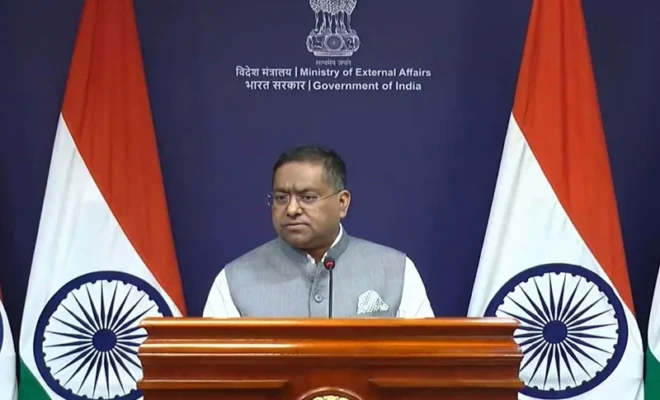
India has taken strong objection to the defacement of its Embassy premises in Ljubljana, Slovenia, which it says is unacceptable and expects the Slovenian authorities to act promptly to deal with those responsible for it. India’s Ministry of External Affairs said it was an issue of “anti-India elements” and added that diplomatic premises had a special protection under international law.
India’s diplomatic reaction has put the issue of embassy defacement in India-Slovenia relations in limelight because this is more than damage done to a property. For India, the security and inviolability of a diplomatic mission is an issue that comes under the Vienna Convention on Diplomatic Relations.
What Happened at the Indian Embassy in Slovenia?
The Indian Embassy in Ljubljana was reportedly defaced by individuals described by the MEA as anti-India elements. India condemned the act and called upon Slovenian authorities to identify those responsible and take appropriate action.
The incident has also attracted attention because Indian diplomatic missions abroad are expected to remain protected from acts that interfere with their functioning or compromise their security.
While reports have linked the incident to pro-Khalistan elements, the MEA’s own statement described the perpetrators more generally as “anti-India elements.”
Why Is the Vienna Convention Important?
The Vienna Convention on Diplomatic Relations provides the legal code for diplomatic missions and how they are treated in the host nation.
Inviolability of the premises of the mission is one of its key tenets. Practically speaking, the host country is required to take all necessary steps to ensure that the embassy is not subjected to interference, damage, disturbance of its peace or of its dignity.
This is the reason why the Indian reaction was based not just on the defacement of its premises but also on the obligations of Slovenia as the host nation.
It was made clear that diplomatic premises cannot be violated by Slovenian authorities.
What Is India Asking Slovenia to Do?
In short, India’s immediate response has been a call to have the Slovenian authorities look into the matter and punish those responsible for the attack.
The language used in the statement made by MEA is important as it puts the blame on the host country for the safety of its diplomatic missions.
Additionally, India has capitalized on this attack to express its dissatisfaction regarding hate propaganda and misinformation being spread by organizations which are hostile towards India.
Why Embassy Security Is a Diplomatic Issue
An embassy is not regarded as a regular private property under international laws.
The diplomatic missions are supposed to be the representation of the one state in another state. The missions offer consular activities, engage diplomatically, help the citizens and establish bilateral ties.
As a result, any action committed against the embassy immediately turns into a diplomatic issue.
In the case of India, for example, the defacement of the India-Slovenia embassy creates concerns about the protection provided to the mission.
Is This Likely to Affect India-Slovenia Relations?
This incident takes place at a time when relations between India and Slovenia continue to grow.
Both countries have cooperated in areas such as trade, science and technology, education, culture, investment, and innovations. According to the Ministry of External Affairs of India, bilateral relations have been growing in recent years.
In this context, it is especially important to handle this diplomatic situation.
A timely investigation and proper actions by the Slovenian government can ensure that the incident does not turn into a bilateral issue.
Why India Is Taking a Strong Position
This reaction is an indication of India’s worries regarding the safety of its diplomatic missions abroad.
India has stressed on several occasions that the nations receiving Indian diplomatic missions must take care of their safety and prevent any intimidation or disruption of such missions.
So through this statement by the Ministry of External Affairs (MEA), India has conveyed two things. Firstly, India wants Slovenia to look into the particular incident. Secondly, India wants other countries to understand the gravity of attacking its diplomatic missions.
The Wider Concerns Over Anti-India Activities Abroad
The case has also brought up issues of anti-India activism and Khalistan-related activities abroad.
But it must be noted that there is a distinction between lawful political activity and those activities which include vandalism or interference with the diplomatic mission.
According to India, these actions of hate propaganda and intimidation against its diplomatic missions cannot be considered as political activism.
India has called upon the law enforcement authorities in the international community to take note of the spread of propaganda against India.
More Global Affairs You Shouldn’t Miss
Why Did UNSC Kashmir Bid Fail?
Check out how India countered Pakistan and China’s Kashmir claims at the UNSC.
Why Is China Acting Unusually Now?
Find out what unusual Chinese actions near the LCA could mean for India’s security.
How Did Embassy Rescue Seafarers?
Uncover how the Indian Embassy in Kyiv activated emergency support for trapped sailors.
Why Leave Ukraine During Ongoing War?
Browse the latest advisory urging Indian nationals to exit Ukraine amid rising tensions.
What Happened To Missing Indian Sailor?
See the confirmed details surrounding the GFS Galaxy attack and the sailor’s death.
What Happens Next?
The next important development will be the reaction from Slovenian authorities.
India will demand an investigation, identifying the perpetrators, and taking appropriate legal action against the culprits. The response to the situation will show how much Slovenia values its duties towards foreign diplomatic missions.
At the moment, MEA has taken a stand – defacement of the diplomatic premises is unacceptable, and the duty to ensure security of diplomatic missions rests upon international law.
Conclusion
The defacement of the Indian embassy in Slovenia has rapidly become a matter of diplomatic relations due to the special nature of diplomatic premises according to the Vienna Convention.
India has condemned the defacement and asked Slovenia to take swift actions against the perpetrators of this crime. The task now will be to see how Slovenia will react to the demands and whether the perpetrators will be identified and punished.
The defacement of the Indian embassy illustrates one of the principles of diplomacy – political conflicts can be resolved via lawful means, but the diplomatic missions should remain intact.
The message of India to Slovenia is clear – protect diplomatic premises, conduct investigation, punish perpetrators.