India and Bulgaria Review Bilateral Framework; Reaffirm Push for Early India-EU Trade Deal
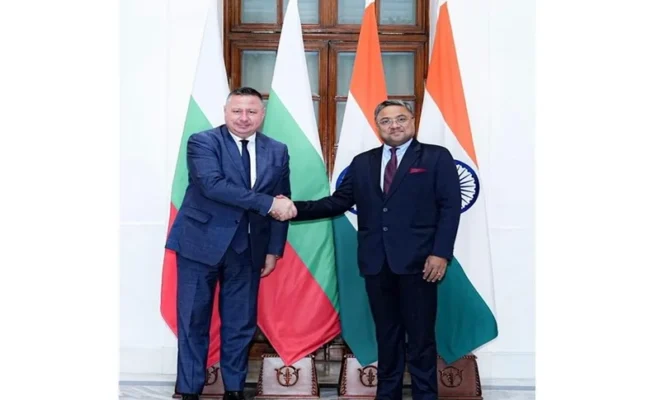
Although the recent interaction of foreign ministers of India and Bulgaria may not have created the same buzz as other summits with leading world players, this event marks an essential component of India’s European strategy formation process. Apart from confirming the existing cordial relations between the two nations, the negotiations revealed a greater geopolitical motive behind the interaction, namely the speeding up of the much-awaited India-EU FTA.
The changing nature of global supply chains and the growing strategic importance of partnerships mean that India’s diplomatic activity with countries such as Bulgaria marks a new phase in its foreign policy.
A Partnership Rooted in Shared Priorities
India and Bulgaria have been in diplomatic relations with each other for more than seven decades now. Although there is limited trade activity between the two countries, both of them have been increasing collaboration in areas like information technology, medicine, agriculture, education, green energy, and manufacturing.
From the most recent meeting, it is clear that both the governments wish to convert their diplomatic relationship into economic activity. The discussion involved matters of trade, connectivity, digitalization, innovation, and investments.
For India, Bulgaria gives it a strategic entry point into Southeast Europe and the larger European Union. For Bulgaria, India is one of the world’s fastest growing economies.
Why the India-EU Trade Deal Matters
Probably the most important lesson from the meeting was the mutual agreement that the India-EU Free Trade Agreement should be concluded as soon as possible.
Negotiations between India and the European Union have undergone numerous delays throughout the past ten years because of divergent opinions on tariffs, market access, intellectual property rights, sustainability standards, and investment protection. Yet, recent changes in the global geopolitical environment give new impetus to the negotiations.
On the one hand, the European Union is attempting to diversify its supply chain and to reduce strategic dependencies by building economic relations with other reliable democracies. On the other hand, India is trying to increase its exports, to attract investments in advanced manufacturing, and to improve the market access for its products in Europe.
An ambitious FTA would allow increasing the volume of bilateral trade, attracting more FDI, conducting technology transfers, and cooperating in such spheres as green energy, digital services, pharmaceuticals, mobility, and advanced manufacturing.
This goal receives additional political support from EU member countries, such as Bulgaria.
Beyond Trade: Strategic Convergence
Today’s relationship between India and Europe goes way beyond trade.
Security issues emanating from geopolitical uncertainties, disruption of shipping lanes on the world stage, resilient supply chains, energy diversity, and new technologies have resulted in a strategic partnership between India and European countries.
European nations have begun seeing India as a very essential partner from the Indo-Pacific region that can play a role in fostering economic resilience and stability.
Likewise, India sees Europe not only as a trade bloc but also as a strategic partner in technologies, innovation, climate change, education, and industrialization.
Conversations like the India-Bulgaria dialogue have served as such a strategic partnership by helping to build bilateral ties that define India’s engagement with the European Union.
Opportunities for Business and Investment
These talks also have major implications for business.
Indian pharma firms already have a good standing in European markets, whereas India’s IT industry is constantly making alliances with European firms. Bulgarian companies, especially in the fields of manufacturing, agriculture, logistics, and engineering, might discover new prospects by forming a partnership with Indian companies.
IT infrastructure, artificial intelligence, fintech, renewable energy, biotech, and research cooperation are emerging as the spheres in which both nations may benefit from each other.
An improved trade process through the potential India-EU FTA will make things easier for those who want to conduct their businesses in both markets.
Connectivity and Supply Chains
There is a restructuring of global supply chains taking place.
Businesses all around the world are trying to find diverse manufacturing hubs and logistics networks owing to the disruption in their operations due to the pandemic, geopolitics, and uncertainties in logistics.
India has become one of the key hubs for manufacturing and investments due to “Make in India,” PLI Schemes, and development of logistics infrastructure.
The unique positioning of Bulgaria being situated at the crossroads of Europe and being a member of the European Union gives Indian firms access to European markets through a new portal.
Such cooperation between both sides would thus increase connectivity between South Asia and Europe and diversify the supply chain.
The Diplomatic Significance
Even though the trade figures between India and Bulgaria have not been able to achieve the potential, diplomacy can move forward gradually.
Forming ties with various nations in Eastern and Central Europe will help India form more ties with other nations within the European Union, especially as far as common goals like free trade, technology transfer, sustainable development, and multilateralism are concerned.
The dialogue between India and Bulgaria is just one part of this gradual diplomatic strategy.
Challenges Ahead
Yet despite the renewed optimism, many obstacles lie ahead for the India-EU Free Trade Agreement to become a reality.
Negotiations would need to sort out difficult matters relating to agricultural market access, standards and regulations, environmental issues, intellectual property rights, digital trade, government procurement, and investment.
While balancing the domestic economy’s needs with the advantages of increased market integration is no easy task, persistent diplomatic efforts and the increasing geopolitical convergence of both parties imply that both the EU and India realize its strategic importance.
Looking Ahead
India’s dealings with Bulgaria show the key point of diplomacy in today’s world: it is necessary to develop geopolitical influence by engaging partners consistently.
India’s growing economic presence in Europe makes such bilateral connections more important in creating a favorable environment for wider regional cooperation.
If the negotiations for the India-EU Free Trade Agreement prove to be successful, meetings such as the latest one between India and Bulgaria can eventually be considered key milestones in that process of change of economic relations between India and Europe.
Conclusion
The India-Bulgaria bilateral review is not a normal diplomatic procedure. It shows the increasing participation of India in the affairs of Europe amid changes being witnessed in global business, strategic alliances, and supply chain management.
The two nations have shown their willingness for greater economic cooperation by endorsing early conclusion of India-EU trade deal and also improving bilateral relations. Though details of the FTA are yet to be worked out, the increasing political pressure on both sides indicates that India and Europe are moving closer towards building their relationship.
India’s Global Trade & Diplomatic Moves
How Did the Rupee Move Recently?
Check out the latest updates on India’s forex market movement.
How Did Indian Grapplers Perform?
Find the key highlights from India’s World U20 Championships medal haul.
Could IMEC Reshape Global Trade?
Uncover how the India-Europe corridor could influence international trade.
How Has India-EU Trade Evolved?
Browse the key developments in India-EU bilateral trade relations.
Why Does Belgium’s India Visit Matter?
Explore the trade, defence, and EU priorities behind the visit.