
Why Fazlur Rahman’s ‘Double Offence’ Remark Sparked a National Debate
Last updated on July 10th, 2026 at 11:12 am
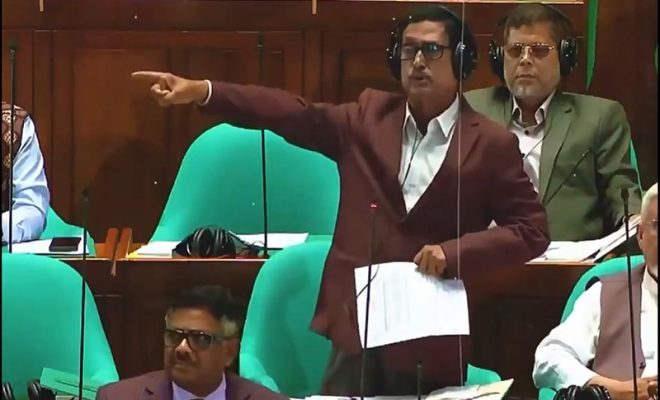
Commentaries by Fazlur Rahman, made on April 28, 2026, have resulted in the revival of a national discourse in Bangladesh. It is regarding history, identity, and political allegiances.
In the course of parliamentary deliberations, Rahman argued that the descendants of 1971 martyrs should not engage in Jamaat-e-Islami politics, which he termed a “double offense.”
While the comment was met with outrage from opposition parliamentarians, resulting in chaos in Parliament. It has also led to further reflections on the lasting implications of the 1971 Liberation War for the country’s political structure.
What Exactly Did Fazlur Rahman Say
In one of the discussions where the emphasis was on the history of liberation war and the relevant laws, Fazlur Rahman explicitly linked current political loyalties to historic facts.
He said that considering the historical fact that Jamaat-e-Islami was a part of the resistance movement against the liberation of Bangladesh in the war of 1971.
It makes an ethical dilemma for those belonging to martyr families (the loss of family members in the war) to join such a party now. This is what Fazlur Rahman meant by “double offence.”
His arguments were part of wider conversations about the collaborators and liberation war history.
Why the 1971 Liberation War Remains Central
In order to comprehend the significance of the conflict, it is important to focus on the context in which the 1971 Liberation War took place.
This war was an effort by the nation of Bangladesh to gain its independence from Pakistan and constitutes the most significant incident in the identity of the nation.
There have been accusations leveled against particular political factions, such as Jamaat-e-Islami and its allied militant organizations, such as the Al-Badr force, of working against liberation.
For the current political leaders, especially those who call themselves freedom fighters, the incidents of the year 1971 form a part of their political conscience and morality.
As Fazlur Rahman, himself a freedom fighter, explained the political situation within this context, he suggested a sense of historical morality in making political decisions.
The 2026 ‘Collaborator’ Bill and Its Impact
These comments by Fazlur Rahman were made right after the passing of the Jatiya Muktijoddha Council (Amendment) Bill, 2026, and have done much to fuel debate about 1971 once again.
According to the law, Jamaat-e-Islami will remain alongside other groups like the Muslim League and Nezam-e-Islam on a list of collaborators linked to Pakistani forces during the conflict.
This move has been fiercely criticized by representatives of Jamaat itself, including Shafiqur Rahman, who has argued for Jamaat’s delisting. It is reasonable to assume that Fazlur Rahman’s comments were prompted by such protests.
Immediate Reaction Inside Parliament
Response to his comments was immediate. Politicians belonging to the Jamaat-e-Islami party and others reacted strongly to the comment, claiming that he had made an offensive statement about something that should not have been discussed in parliament.
It soon turned into a wider discussion, causing disruption to the proceedings. It is not uncommon for people to react in this manner when any mention is made of the liberation war.
A Changing Political Landscape
The dispute also arises from the changing political climate of Bangladesh. Having been constrained for several years by earlier regimes, Jamaat-e-Islami is once again resurfacing as a major political player due to changes in the nation’s political landscape since 2024.
The emergence of this party into mainstream politics has brought back issues related to its historical legacy and relevance in today’s politics. Meanwhile, there are also changes in coalitions and conflicts.
Even though political groups like the BNP and Jamaat share similar views during opposition, their disagreement on history especially the history of 1971 has caused tensions. These issues were made apparent through Fazlur Rahman’s statement.
Fazlur Rahman’s Political Persona
Fazlur Rahman is a very vocal and prominent proponent of the liberation war ideology. He is popularly known by the name “Foju Pagla,” and has established himself as a person who likes to make his voice heard in the parliament.
As a result of being a freedom fighter, Fazlur Rahman’s political ideologies always revolve around the liberation war period whenever he talks about history. It can help us understand the meaning behind the “double offence” statement made by him.
Why This Debate Resonates Beyond Parliament
The importance of this dispute is not confined to one particular sitting of Parliament.
It is indicative of an extended and continuing dispute in Bangladesh on how history should impact contemporary politics. To some, the tradition of 1971 serves as a fundamental guide that will dictate political affiliation and patriotism.
However, to others, active political involvement should not be limited by history, especially when Bangladesh is looking ahead into the future.
This conflict between past and present lies at the crux of the criticism leveled against Fazlur Rahman’s speech.
You Might Also Like
2. Which devices get One UI 8.5?
Discover the supported devices and new features in the latest Samsung update.
1. What makes Casio AE-1600HX special?
Explore the dual time tracking and long battery features that make this watch stand out.
4. How is Gemini improving smart homes?
Explore new regions, languages, and features introduced in Google Gemini for Home.
3. What to expect from Vivo T5 Pro?
Check out the expected specs, features, and price ahead of its India launch.
5. Why did OpenAI acquire TBPN?
Discover the strategy, impact, and future implications of this major acquisition.
The Role of Media and Public Discourse
In addition, the episode has received more attention due to the media and social media conversations which are sharing footage and quotes from the parliamentarians’ meeting.
Media and social media have been able to spread the word of not only supporting but also criticizing the statement made by the parliamentarian.
Therefore, it is not an issue that only concerns the parliament but is also a matter for national discussion.
Conclusion
Fazlur Rahman’s “double offence” remark has become a flashpoint for deeper questions about Bangladesh’s political identity and historical memory.
By linking present-day political choices to the events of 1971, the statement has reignited a debate that remains unresolved even decades after independence.