
The “131st Amendment” Post-Mortem: Why 298 Wasn’t Enough
Last updated on July 10th, 2026 at 11:07 am
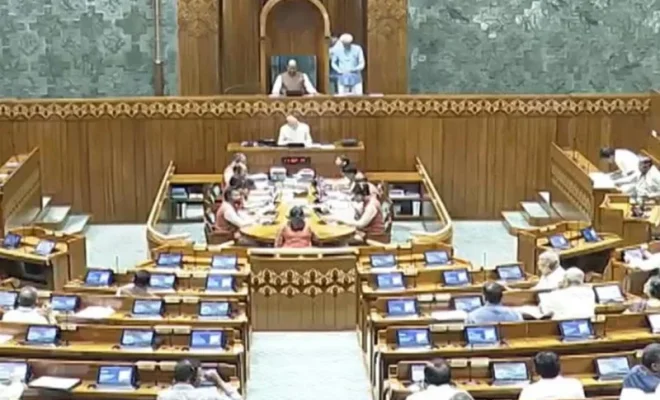
The 131st Amendment debate reached its peak when it failed to secure the necessary parliamentary backing, resulting in its defeat. At first glance, the number appears substantial.
However, constitutional amendments in India require more than simple majorities because they need broader agreement from all voters. The outcome has raised a fundamental question: why were 298 votes not enough?
The answer lies in two domains: constitutional amendment procedures and the political dynamics that determine parliamentary outcomes.
Understanding the Constitutional Threshold
Under the Constitution of India, amendments, particularly those that affect federal structure, governance systems, or key institutional powers, require a special majority.
This means that an amendment must be approved by:
- A majority of the total membership of the House, and
- At least two-thirds of the members present and voting
In certain cases, amendments may also require ratification by at least half of the state legislatures.
The 131st Amendment appears to have fallen short of this threshold, despite securing 298 votes. The number, while large, likely did not meet the specific ratio required under constitutional rules.
Why 298 Was Not Enough
The number 298 requires contextual interpretation for its evaluation. Parliamentary voting outcomes depend not just on the number of votes in favour but also on three additional factors, which include:
- Total strength of the House
- Number of members present
- Voting patterns of opposition and abstentions
The two-thirds requirement would have raised the passage threshold because sufficient members were present to vote. In this situation, where 450 members were present, at least 300 votes would need to be cast to fulfill the two-thirds requirement.
The 298 votes, which represent a majority, fall short of meeting the requirement because they need to exceed the majority threshold. It shows that constitutional design gives more importance to reaching an agreement than to winning through numerical strength.
Political Dynamics Behind the Outcome
The failure of the 131st Amendment also reflects broader political dynamics. Constitutional amendments often require cross-party support, as ruling parties alone may not always have the numbers to meet the special majority requirement. Even small shifts in support, abstentions, or dissent within alliances can significantly impact the final outcome.
The vote count suggests that while there was substantial backing for the amendment, it did not translate into the level of consensus required. This could indicate:
- Opposition resistance to specific provisions
- Strategic abstentions
- Internal disagreements within political blocs
Such factors often play a decisive role in constitutional votes, where margins can be narrow but consequences are significant.
Why the Constitution Sets a Higher Bar
The constitutional framework of India includes a requirement for special majorities, which functions as a mandatory component of its design. Constitutional amendments differ from regular laws because they create changes which will affect the legal system for extended periods of time.
The constitutional system enables changes which require widespread political support because the Constitution establishes a higher requirement for such modifications. The 131st Amendment failed to pass because it had strong support, which demonstrates how the system functions according to its intended design.
Stay Updated with the Latest Tech Launch Buzz
When Will Redmi Note 15 Launch?
Check the expected launch date, pricing, and key specifications in India.
What’s New In Galaxy A57 Series?
Discover the features, specs, and highlights of Samsung’s latest A-series launches.
How Does Google Live Translation Work?
Explore features, supported languages, and how it functions on iPhone devices.
What Makes Vivo X300 Ultra Special?
Discover how the 400mm Zeiss telephoto lens kit enhances photography and flagship performance.
Why Vivo V70 FE Camera Stands Out?
Explore the 200MP camera capabilities and key features ahead of its India launch.
Implications of the Failed Amendment
The immediate implication is that the proposed amendment will not come into effect in its current form. However, the outcome also has broader consequences:
- It highlights the limits of numerical strength in constitutional matters.
- It underscores the importance of coalition-building.
- It may prompt revisions or reintroduction of the proposal in a modified form.
Politically, the result can be interpreted in multiple ways, either as a setback for the proponents of the amendment or as a reflection of the robustness of constitutional checks and balances.
Conclusion
The story of the 131st Amendment is not just about numbers it is about the principles underlying constitutional governance. While 298 votes represent significant support, they were not sufficient within the framework of a system designed to demand broader agreement.
The outcome reinforces the idea that constitutional change in India is not merely a function of majority, but of consensus.