How to Check If Your Car Runs on New E85 Flex-Fuel – Price vs Petrol & Availability Explained
Last updated on July 10th, 2026 at 11:23 am
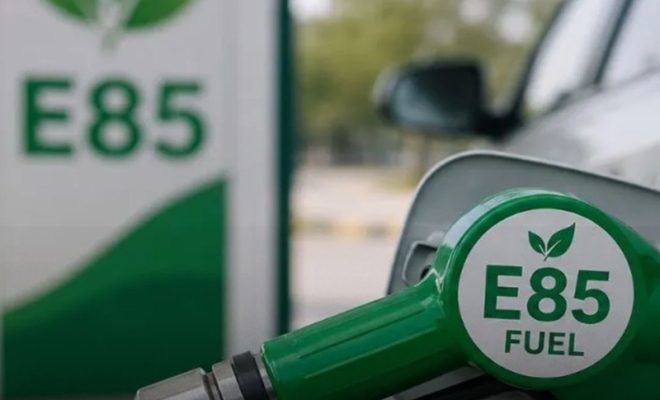
E85 fuel, which comprises 85% ethanol and 15% petrol, is being officially introduced by India as the country’s latest venture into fuels. E85 fuel has been released at around ₹20 less per litre than normal petrol and stands out as one of the most significant fuel policy moves in 2026.
There is, however, one thing to bear in mind: not all petrol-powered cars will run on E85 fuel. It would be prudent for motorists to ascertain first whether or not their petrol-powered car can run on E85 fuel before rushing off to fill up.
What Exactly Is E85 Fuel?
E85 is a fuel formulation composed of 85% ethanol and 15% gasoline. It is intended only for use in flex-fuel vehicles (FFV), where the engine is calibrated to vary its performance depending on the level of ethanol contained in the fuel.
It was introduced by the Indian government as one of its initiatives aimed at reducing dependency on oil imports, promoting the production of ethanol locally, and curbing emission levels.
How to Check If Your Car Can Run on E85
Compatibility can be determined by looking out for terms such as “Flex Fuel,” “FFV,” “E85 Compatible,” and “E100 Compatible.”
If the user guide specifies that your car runs on E10 or E20 fuel, then it may not be compatible with E85 fuel. This is because most cars available in India today are made for E20 fuel but not for E85.
You can also:
- Check the fuel filler cap for ethanol compatibility markings.
- Visit the manufacturer’s website.
- Contact your dealership with the vehicle VIN or chassis number.
- Look for official flex-fuel branding on the vehicle.
If none of these sources specifically mention E85 or flex-fuel compatibility, assume the vehicle is not approved for E85 until confirmed by the manufacturer.
Which Cars Are Currently E85-Compatible?
The ecosystem for the use of E85-fueled vehicles in India is still in its nascent stage. The best-known example is the Maruti Suzuki WagonR Flex Fuel vehicle, which was unveiled in India as the country’s first E85-enabled car.
Several other manufacturers have also demonstrated flex-fuel prototypes, including:
- Toyota Innova Hycross Flex Fuel
- Maruti Suzuki Fronx Flex Fuel
- Hyundai Creta Flex Fuel
- Tata Punch Flex Fuel
However, many of these remain prototypes or are awaiting wider commercial rollout.
E85 Price vs Petrol: Is It Really Cheaper?
The key draw of E85 is its cost factor. The recently introduced E85 fuel is sold for about ₹82 per litre, whereas the cost of petrol in Delhi is about ₹102 per litre, implying a difference of almost ₹20 per litre. Initially, one may think that the savings would be instant.
This is due to the fact that ethanol has less energy content in terms of litres when compared to petrol. It thus follows that the fuel consumption may increase when using the same amount of E85 as opposed to the usual amount of petrol consumed. High mileage users will benefit from cheaper fuel.
Where Is E85 Available Right Now?
It is still available only on a limited basis. Based on latest information, E85 has been launched in Delhi and some other selected petrol pumps in India. There are plans to increase its availability from being available on a limited basis to be available in hundreds of stations in due course.
It will take time for Indian motorists to locate E85 at their fuel pump. Those planning to buy a flex-fuel car should first find out if there is E85 available in their locality.
What Happens If You Put E85 in a Normal Petrol Car?
It is the query on the minds of many drivers. Exposure to high levels of ethanol may cause problems with the seals, fuel lines, fuel injectors, and even engine calibrations because the car may not have been designed for E85. Flex-fuel cars use different materials and software to handle the high ethanol content.
For that reason, there are strict recommendations from authorities on the type of fuel blend that should be used. It should be noted that E20-compliant does not necessarily mean E85-compliant.
Why Is India Pushing E85?
Objectives for India’s ethanol plan include reducing reliance on oil imports and promoting local agricultural production.
Ethanol can be sourced from cane-based biofuel sources, thereby facilitating an alternative source of fuel for the country. This will contribute to lowering greenhouse gases and ensuring energy independence.
E85 and eventually E100 fuels are seen as the future for the country following the successful implementation of E20 petrol across the nation.
Top Headlines You Must Explore
Discover Why US Warned Iran Recently?
Check how this warning affects the ongoing Israel-Hamas conflict dynamics.
Check What India-Iran Port Deal Means?
Explore the implications of the new port agreement and rising US concerns.
Check What Happened In Erbil Strike?
Explore details of the drone attack on Castrol amid rising Iran tensions.
Explore Why Beer Prices May Rise?
Discover how global tensions could impact beer and bottled water costs worldwide.
Explore Fake MBBS Letters Warning Details?
Discover how NMC is alerting students about fraudulent medical allotments.
Conclusion
Even though the cost of E85 fuel can be lower than gasoline, not all vehicles can use this type of biofuel.
To start using E85 fuel, you need to check if your vehicle is a flex-fuel vehicle. Right now, E85 biofuel is an interesting alternative for India, though the amount of vehicles that can use this type of fuel and the biofuel itself is limited.
If you cannot find Flex-Fuel or FFV mentioned in your vehicle manual, do not put E85 into the tank even if the biofuel will be cheaper than gasoline.