Coast Guard Intercepts Iranian Dhow Near Lakshadweep: ₹3,000 Crore Narcotics Seized in High-Seas Operation
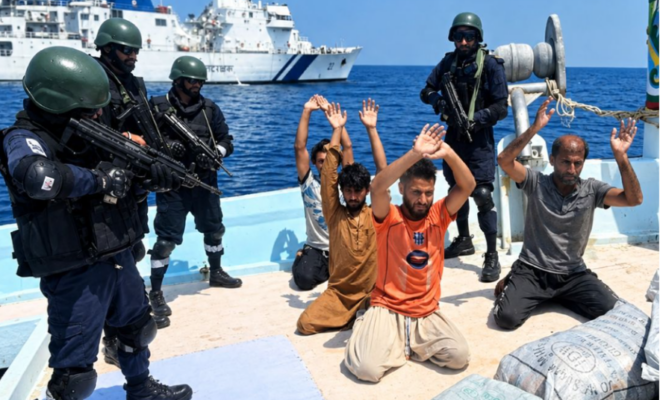
One such major case involving maritime drug smuggling occurred in the Arabian Sea, wherein the Indian Coast Guard, in coordination with Gujarat Anti-Terrorism Squad (ATS), intercepted an Iranian dhow which had 526 kg of heroin and methamphetamine onboard. The worth of these drugs in the international market has been assessed to be in excess of ₹3,000 crore. Five Pakistani nationals onboard the ship have been apprehended in this operation.
This case was carried out west of Lakshadweep on September 25, although it came into the public domain only on September 30. As per the Indian Coast Guard, the operation was based on inputs received and extensive sea-air surveillance prior to interception and boarding of the vessel.
The operation was quite significant in terms of quantity and nature of the narcotics as well as the use of the maritime route for international drug smuggling.
What Happened Near Lakshadweep?
The operation was conducted following actionable information regarding the movement of a suspicious ship in the Arabian Sea. Thereafter, surveillance operations on the dhow through the sea and the air were carried out by the Coast Guard team.
Following the surveillance, the Coast Guard conducted a hot pursuit and boarded the dhow in the Arabian Sea west of Lakshadweep. As many as 526 kg of narcotics, mainly heroin and methamphetamine, were found during the operation.
A total of five people from Pakistan were involved in the operation and were arrested. Later, the dhow, along with the crew members and the contraband, was taken to Mumbai under security escort.
What Drugs Were Seized?
As per reports, the seizure included high-grade heroin and methamphetamine. These drugs together were said to be worth ₹3,000 crore in the international market.
It is important to note here that the valuation is the estimated international-market value of the drugs and not the money found from the ship. The investigators will now try to find the source and other details associated with the consignment.
Why Was an Iranian Dhow Involved?
Dhow is one of the traditional forms of ship that is often utilized in the Indian Ocean and Arabian Sea for commercial and fishing purposes.
However, such ships could also be exploited by the transnational crime organizations seeking to smuggle goods through the sea route.
In the present case, the ship has been found to be Iranian while the five people apprehended on board belong to Pakistan. The nationality of the ship and the crew does not prove anything in terms of the organization and financing of the smuggling process.
Why the Lakshadweep Location Matters
Interception Location
It is also vital to consider the fact that the area around Lakshadweep lies along key maritime trade routes within the Arabian Sea. The long Indian coastline and its presence in critical regions of the Indian Ocean make surveillance by sea a key aspect of India’s fight against trafficking.
The Coast Guard operation has showcased the potential of combining intelligence gathering, aerial surveillance, and maritime tracking prior to the interception attempt.
The Indian Coast Guard claimed that the operation illustrated their capability for surveillance and maritime interception and prevention of any illicit activities within Indian maritime areas.
How Did the Coast Guard Track the Vessel?
As per Coast Guard, there was sea-air surveillance and then constant monitoring and hot pursuit. Thus, the suspicious vessel could be monitored and eventually boarded.
Involvement of Gujarat ATS is also important in this case. Intelligence gathered by Gujarat ATS has played an important role in recognizing the narcotics smuggling movement and organizing the operation accordingly.
Thus, it was not just about stopping a vessel. It was a well-coordinated intelligence-driven operation for maritime security and counter narcotics.
What Happens to the Five Pakistani Nationals Now?
The five people of Pakistani nationality who were caught on board the ship have been moved to Mumbai together with the ship and the drugs that had been seized.
This is because it is believed that they will be subjected to inquiries from various organizations to determine their individual involvement in the matter and the network involved in this shipment. More actions will take place based on the investigations and laws in India.
It should be noted that this is an ongoing investigation; the identity and the involvement of those arrested need to be determined.
Was the Drug Consignment Headed to India?
As far as the reports are concerned, there seems to be an investigation going on in respect of the destination as well as the handover arrangements in connection with the consignment. As per reports published in Indian Express, there was information about the suspected drug deal in connection with a Nigerian national in Ahmedabad, which was supposed to be handed over to the ship based in Tamil Nadu in Indian water.
The above is a part of the investigating report and should not be taken as a final conclusion until and unless the above has been proved legally by the authorities.
Why This Is a Major Maritime Drug Bust
The size of the seized drugs is an important reason for the significance of this operation. More than half a tonne of narcotics worth over ₹3,000 crore has been saved from entering into another phase of the suspected trafficking operation.
Apart from the monetary worth of the operation, it is noteworthy that it shows the increasing relevance of maritime channels in the international narcotics trafficking. This is because the criminal organizations can use ships which are away from the mainland to transport their drugs and then shift them through other means.
What Happens Next?
This inquiry will concentrate on the seized boat, the crew, the drugs, and the communication or financial connections that could shed light on the entire drug trafficking ring.
The dhow and the drugs have been transported to Mumbai for interrogation purposes and legal proceedings. Several agencies are going to scrutinize the information and establish how the consignment of drugs was arranged, its place of origin and destination.
Conclusion
The bust of drugs worth Rs 3,000 crore off the coast of Lakshadweep is amongst the significant cases of maritime drug busting in India. Through the use of intelligence-based surveillance of air and sea, the Indian Coast Guard along with Gujarat ATS stopped an Iranian dhow from off the coast of Lakshadweep, seizing roughly 526 kgs of heroin and methamphetamine.
Fiver individuals of Pakistani nationality have been caught from the ship; the ship and drugs are being taken to Mumbai for further inquiry.
Explore India’s Coastal Travel Alternatives
Why Are Tourists Choosing Lakshadweep?
Check out why Indian travelers are considering Lakshadweep over Maldives trips.
What Sparked Lakshadweep’s 12-Hour Protest?
Find out what prompted the island-wide protest against the new policy.
Why Were Kerala Beaches Temporarily Closed?
Uncover why swell surges affected beach tourism across southern regions.
Which Indian Destinations Rival Bali And Thailand?
Browse Indian alternatives for travelers postponing international holiday plans.
How Will C-295 Aircraft Boost Surveillance?
Explore how indigenous maritime aircraft will support India’s Navy and Coast Guard.