
16 Maoist Commanders Surrender Under ‘Operation Navajeevan-II’ in Jharkhand: Why It Matters for India’s Anti-Naxal Campaign
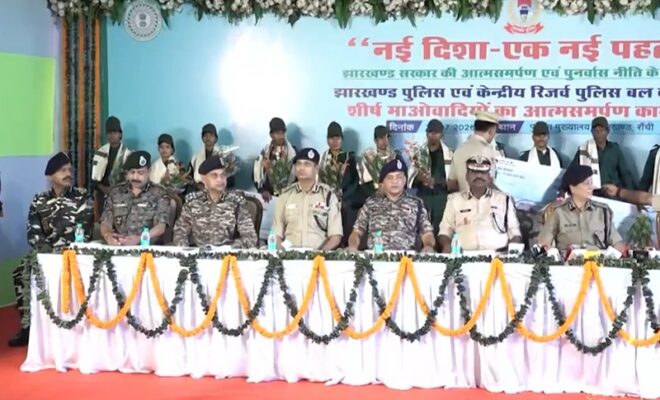
After 16 Naxals, six of whom are senior commanders, gave up and surrendered before security personnel in an operation named ‘Navajeevan-II‘, another major achievement has been achieved in the anti-Naxal operations in Jharkhand. The surrendered cadres, with a total cash reward of ₹39 lakh, have laid down arms in front of officials from the Jharkhand Police, CRPF and other security agencies. The government authorities have said that the surrendered Maoists will be rehabilitated under the Jharkhand surrender and rehabilitation policy.
What Is Operation Navajeevan-II?
Operation Navajeevan-II is a surrender and rehabilitation programme introduced by Jharkhand Police, which is meant to motivate the Maoists to give up violence and join the mainstream. Unlike in other anti-Maoist operations, where force was the only tool used, this programme incorporates rehabilitation, funding and social integration of the surrendered insurgents along with security operations against them.
According to official sources, the programme has proved effective in weakening the network of Maoists in some of the forested areas of Jharkhand.
Who Surrendered?
As per the authorities, the group consisted of six high-ranking leaders, including sub-zonal and area commanders who belonged to the banned CPI (Maoist) and other organizations aligned with it. Many of those who had surrendered were involved in various criminal activities and held government bounties. The total amount of the bounties held by them was said to be about ₹39 lakh.
The police stated that these cadres were operating in Maoist-infested areas like Saranda, Kolhan, West Singhbhum, and adjacent forest areas.
Why This Surrender Is Significant
This surrender has been interpreted as yet another defeat of Maoist groups in Jharkhand. Security personnel feel that as and when seasoned leaders surrender, not only do the insurgent groups lose manpower, but they also lose leadership and intelligence coordination at the local level.
This development highlights the increasing pressures being created through sustained anti-Naxal operations, intelligence-based policing, and rehabilitation programs. The security personnel have time and again asked the remaining Maoists to abandon violence and join the mainstream.
How the Rehabilitation Process Works
The rehab policy for surrendered Maoists, as per Jharkhand, offers them the opportunity to be rehabilitated through different schemes meant to facilitate their re-integration into society. The scheme can range from monetary aid, vocational training, counseling, housing provision, among others.
Government officials argue that the aim is to discourage the attraction of insurgency among those previously involved in such activities by offering them means of peaceful reconstruction of their lives.
The Current Anti-Naxal Situation in Jharkhand
For long, Jharkhand has been one of the states most affected by LWE. Nevertheless, security forces claim that consistent operations have led to the reduction of Maoist influence in several districts.
Recently, there have been various encounters, surrenders and recovery of weapons that have considerably weakened the insurgent organizations in some parts of the state. Officials argue that the operations conducted by Jharkhand Police, CRPF, and other specialized organizations will be continued until all active Maoist organizations are broken.
Why Surrenders Matter More Than Encounters
Surrender of a large number of rebels is seen as a strategic move by security experts since it weakens the insurgency without any protracted armed encounter. Surrendering rebels may also give security agencies valuable information on organizational structure and logistics, thus helping to prevent violence in the future.
On the other hand, the success of the rehabilitation program may motivate other insurgents to disengage from armed insurgency and make their organizations weaker from within.
Keep Reading: Stories That Matter Most to You
1. NATO’s Ankara Summit: Warning Signals India Cannot Afford to Ignore
Explore how the NATO Ankara Summit could reshape India’s strategic and security priorities
2. EPFO VISHWAS 2026 Scheme Explained: One-Time Settlement for Pending PF Dues
Discover who qualifies for the EPFO VISHWAS 2026 Scheme and how pending PF dues can be settle
3. Kashmir Valley Tourism Rebounds: Gulmarg and Pahalgam Witness Record Summer Footfall
Check why Gulmarg and Pahalgam are attracting record numbers of summer visitors this year.
4. Beyond Dharmendra Pradhan’s Resignation: India’s Deeper Youth Unemployment Crisis
Explore the deeper causes behind India’s growing youth unemployment beyond the latest political developments.
5. Income Tax Return (ITR) Filing Deadline 2026: Key Changes in the New Tax Regime You Must Know
Discover the latest ITR filing deadline and important tax regime changes every taxpayer should know.
Conclusion
The surrender of 16 commanders of the Maoists under the operation of Navajeevan-II is yet another milestone in Jharkhand’s campaign against Naxal. Even though security measures are critical, it is worth noting that the government’s focus on the rehabilitation program signals another line of attack against the insurgency.
Navajeevan-II Operation proves that besides security measures, the government of Jharkhand relies heavily on the rehabilitation of rebels in its fight against Left Wing Extremism.