
SpaceX Falcon 9 Lunar Crash Site Reveals New Clues About the Moon’s Surface
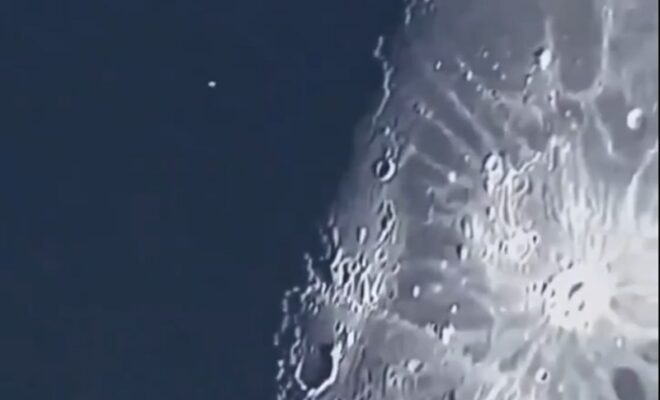
The site of the Falcon 9 rocket crash on the Moon helps scientists learn more about the lunar soil and subsurface composition. It turns out that a crash that seemed accidental has become a useful scientific source of information about the Moon.
With the help of high-resolution images from orbiters around the Moon, scientists are studying the crash zone and trying to understand how lunar soil reacts when hit by a high-speed object. The results can be used to design future spacecraft landings on the Moon.
What Happened to the SpaceX Falcon 9 Rocket?
As a result of the completion of the mission, the upper stage of the SpaceX Falcon 9 rocket crashed into the Moon’s surface. Rather than staying in orbit or falling back to Earth, the stage of the rocket hit the Moon’s surface eventually.
Despite being accidental, it turned out to be an interesting occasion for research because spacecraft and rocket crashes are like controlled experiments that allow scientists to study the material below the lunar soil.
Later, the crash site was located with the help of lunar orbiters’ photographs.
Why Scientists Are Interested in the Crash Site
Any impact on the Moon ejects material from below the surface.
From the analysis of the size, shape, and ejecta pattern of the Falcon 9 moon crash site, scientists will be able to understand how lunar dust and rocks behave upon collision.
There is no atmosphere on the Moon to slow down the impactor, making the impacts happen at very high speeds. This results in craters that preserve important geological information for a very long time.
Scientists think that the study of the site can help them better understand how the lunar surface evolved over billions of years.
What New Clues Have Been Found?
According to scientists, the crater created a difference in terms of the upper layers of soil and what lies beneath them.
This crater has helped show that there are differences in the way the loose soil of the Moon reacts to disturbance. The loose soil on the Moon is called lunar regolith.
Such studies help researchers calculate soil strength, thickness, and composition, which will prove useful for future astronauts and space robots and also for any construction activity on the Moon.
The unusual form of the impact zone has led the scientists to examine the impact of the rocket’s structure on crater formation.
Why This Matters for Future Moon Missions
The new interest in the SpaceX Falcon 9 moon crash site is about more than investigating one crash.
NASA, private firms, and foreign space agencies are all getting ready for more lunar missions in the coming years.
An understanding of the way that the lunar surface responds to such an impact could allow engineers to create better landing technologies as well as determine safer landing zones for future lunar bases.
This knowledge could help improve computer modeling of crater creation and lunar surface stability.
What Is Lunar Regolith?
Another interesting area of study is lunar regolith. As opposed to the soil of Earth, there is no organic matter in the composition of the lunar regolith. It forms over millions of years through the grinding of rocks by asteroids into very fine dust.
This dust is highly abrasive and works differently than soil here on Earth.
Learning about its characteristics is vital since future astronauts would have to move on it, drive vehicles, construct habitats and use equipment directly on it.
There is another chance to observe the movement of this dust due to the crash site.
How Orbiters Help Scientists Study the Moon
The current crop of lunar orbiters is continually photographing the Moon in great detail.
Using before-and-after imagery of the Falcon 9 impact, investigators can discover new craters, measure them, and study debris.
This makes it possible to learn about lunar geology without sending an astronaut team to investigate each crater.
Remote sensing has become one of the best tools for planetary science.
Why Accidental Impacts Are Still Valuable for Science
Even though the Falcon 9 incident was not intentional, accidental impacts have often contributed scientific data.
Such data have been helpful in the past for studying asteroid impacts, planetary surfaces, and the life cycle of craters.
In this instance, the accident created a new excavation for geologic study and revealed material that had been covered up by the Moon’s surface.
Experts claim these natural experiments can complement planned space missions.
Conclusion
SpaceX Falcon 9 lunar impact area has not only served as an incident location; it has also provided science with some very useful information about the geology of the Moon, the formation of craters, and its surface material composition.
The more information we gather during preparation for the next stage of lunar exploration, the better we understand the planet nearest to us.
An unexpected impact sometimes leads to an unexpected discovery. The Falcon 9 impact area has helped science unravel the mysteries lying under the dusty surface of the Moon.
Top Stories You Can’t Afford to Miss Today
When Will Tata Curvv EV Launch?
Explore the confirmed launch date, expected price, battery options, driving range, and upgraded features of the Tata Curvv EV.
Why Is Income Tax Portal Slow?
Check how to clear your browser cache, verify your e-filing status, and avoid penalties under Section 234F before the deadline.
How Are India-Japan Supply Chains Evolving?
Discover how India and Japan are strengthening Indo-Pacific supply chains through new bio-gas and semiconductor partnerships.
How Can Patients Book Instantly?
Explore how AIIMS Delhi’s new WhatsApp and ABHA Health ID system makes OPD appointment booking faster and easier.
Why Did Washington Change Strategy?
Discover why the latest U.S. terror designation targets financial networks and what it could mean for future counterterrorism efforts.