
GI-Tagged Handloom Products Get Innovation Push: What the Textiles Ministry’s Plan Means
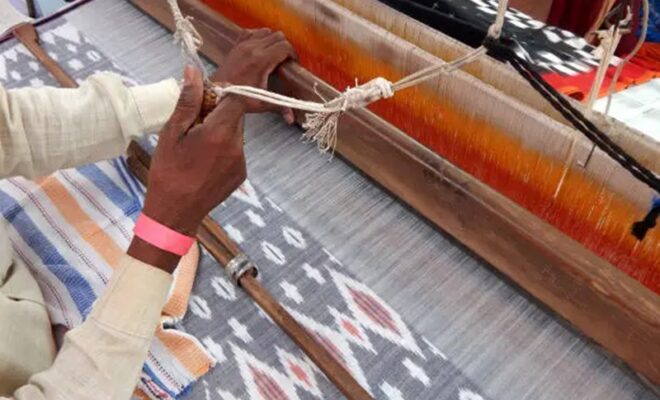
India’s traditional handloom industry is witnessing a technology-based upliftment as the Ministry of Textiles launches more campaigns for innovation, development, and entrepreneurship within the realm of GI-tagged handlooms. The new campaigns will ensure that the traditional craft remains competitive and retains its heritage.
The Indian Government’s scope of activity is not just limited to protecting the traditional weaving craft anymore. It has started motivating people from design, startup, research, education, and artisan backgrounds to innovate solutions that could help the Indian handloom industry become more competitive internationally.
What Are GI-Tagged Handloom Products?
The Geographical Indication (GI) mark is a form of intellectual property that gives protection to products that have a special quality and reputation due to their association with a particular geographical location.
For handlooms, having a GI mark means that only the artisans of that particular region using traditional techniques will be able to sell that product with that name.
There are currently more than 100 registered GI-marked handlooms in India, which include Banarasi Brocades and Sarees, Kanchipuram Silk, Chanderi Fabric, Pochampally Ikat, Muga Silk, Kota Doria, and many other regional weaves. Financial aid is also being given by the Ministry of Textiles for GI protection and awareness campaigns.
Why Is the Government Focusing on Innovation?
Cultural significance is attached to handloom products in the traditional sense; however, artisans do encounter many difficulties in accessing the market, shifting consumer trends, the emergence of fake products, and competition from machine-made textiles.
In order to resolve these problems, the Ministry of Textiles has initiated innovation-related programs including the “Handloom Hackathon 2026,” which will help participants come up with innovative solutions in areas of design, technology, entrepreneurship, digital marketing, sustainability, and logistics. The aim is to blend Indian weaving skills with innovation for productivity growth and better market access.
What Does the Innovation Push Include?
These efforts by the ministry have been targeted at bringing together weavers, designers, institutions of learning, startups, researchers, and industry experts onto a common platform.
These individuals are then advised to come up with innovations to make improvements in weaving processes, design new product styles, brand, produce sustainably, facilitate e-commerce and generally increase competitiveness of the GI-tagged handloom products.
Apart from encouraging innovations, the government has also been assisting in the adoption of technologies, skill enhancement, diversification of products, designing and conducting research in the industry.
What Does This Mean for Weavers?
For the Indian weavers, the drive towards innovation can present new possibilities beyond the usual local markets.
Modern design and improved branding can assist the weavers to connect with younger generations, whereas improved access to digital means can facilitate direct connections with the consumers. Technology improvements and enhanced production methods can aid in cost reduction and increased efficiency for greater profits.
The government has announced its plans to boost the income of weavers and artisans by a great deal via technology assistance, market expansion, and capacity enhancement. A newly established Handloom Technology Centre is one of the initiatives in this regard.
Why GI Tags Matter More Than Ever
GI labeling is not just about the protection of the product name but is also about protecting centuries of knowledge, traditional weaving processes, and regional identity.
GI labels not only help customers differentiate between authentic handmade items and those which are produced in a factory-like manner; they also provide better business opportunities for the artisans and preserve the textile culture of India.
The Ministry of Textiles has always encouraged GI labeling through schemes in the National Handloom Development Program and the Handloom Marketing Assistance program.
Can Innovation and Tradition Work Together?
One of the largest concerns regarding the initiative is whether technology will end up eroding the art form altogether.
From the actions taken by the Ministry, it is clear that the answer is no, at least not according to their plans. Innovation is meant to complement and enhance the artistry of the craftsmen by adding better tools, sustainability, modern product design, and better markets connections without giving up on the traditional way of weaving.
The Weave the Future 4.0 and Handloom Hackathon prove just that.
What Could Consumers Expect?
Consumers can begin to see a broader range of genuine handloom products carrying the GI tag, combining ancient tradition with modern taste.
Better digital authentication, storytelling, sustainable processes, and higher-quality products might result in Indian handloom products becoming more desirable in domestic and foreign markets.
Innovation can also enable younger generations to connect back with their tradition through modern designs.
Top Stories You Can’t Afford to Miss Today
When Will Tata Curvv EV Launch?
Explore the confirmed launch date, expected price, battery options, driving range, and upgraded features of the Tata Curvv EV.
Why Is Income Tax Portal Slow?
Check how to clear your browser cache, verify your e-filing status, and avoid penalties under Section 234F before the deadline.
How Are India-Japan Supply Chains Evolving?
Discover how India and Japan are strengthening Indo-Pacific supply chains through new bio-gas and semiconductor partnerships.
How Can Patients Book Instantly?
Explore how AIIMS Delhi’s new WhatsApp and ABHA Health ID system makes OPD appointment booking faster and easier.
Why Did Washington Change Strategy?
Discover why the latest U.S. terror designation targets financial networks and what it could mean for future counterterrorism efforts.
Conclusion
Innovations by India’s Ministry of Textiles represent a new paradigm for development of its handloom industry as now both heritage and technology are seen to work in collaboration.
India is seeking to preserve its heritage through innovations on handlooms which have the GI tag while ensuring increased income, greater international brand value, and sustainability for millions of artisans and weavers.
Handlooms of India with the GI tag are not just representations of heritage any longer but are now being considered within a technology-driven framework for the future.