
Solar Panels for Apartments- Everything You Need to Know About the ₹1,08,000 Subsidy Claim
Last updated on July 10th, 2026 at 11:21 am
Until recently, rooftop solar systems were thought to be feasible only for stand-alone homes. The owners of apartments always believed that they would be unable to install solar panels on their roofs since the roof belongs to more than one person.
This is gradually changing with the introduction of the ‘PM Surya Ghar‘ scheme, where residential users are eligible for subsidies when installing solar rooftops, and Group Housing Societies (GHS) and Resident Welfare Associations (RWAs) are eligible for financial support towards solar power installations in common areas. In states like Delhi, for instance, a state top-up subsidy makes the total subsidy for 3 kW residential solar systems eligible to be as high as ₹1.08 lakh.
But it must be borne in mind by the apartment dweller whether they qualify under the terms laid down for availing of the subsidy.
Can Apartment Owners Install Solar Panels?
Yes, but there is a difference in the method used compared to independent houses.
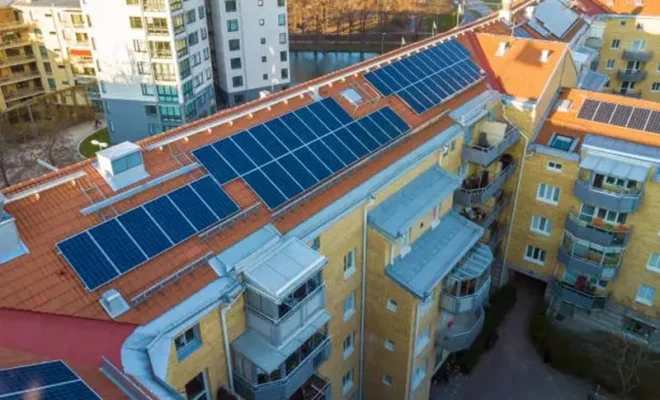
Rooftops in apartments are mostly common property under the administration of housing societies/RWAs. As such, any single person cannot put up solar panels on a communal rooftop without permission from the housing society.
However, apartment solar installations can be done using the housing society. The produced electricity is used to light the common areas, power elevators, water pumps, security systems, and even EV charging stations. It all depends on DISCOM policy guidelines and housing society rules.
Where Does the ₹1.08 Lakh Figure Come From?
The PM Surya Ghar Muft Bijli Yojana scheme of the central government is now offering a subsidy up to ₹78,000 on eligible residential rooftop solar power plants not exceeding 3 kW.
Nonetheless, some states or UTs have introduced additional benefits as well. For instance, the state government of Delhi has decided to provide an extra subsidy of ₹30,000 beyond the central government’s subsidy. Hence, the consumers that qualify for subsidies can now get a combined subsidy of ₹1.08 lakh on their installation of a 3 kW rooftop solar system.
What Subsidy Is Available for Housing Societies?
Whereas Group Housing Societies and RWAs are provided subsidies in another way. Subsidies of ₹18,000 per kW on installing solar panels for common amenities like lights, water pumps, and electric vehicle charging stations up to certain capacity limits are given by the Government.
This will enable the housing societies to use a larger panel and share its advantage among its members by lowering maintenance charges and cutting down on electricity charges for common amenities.
In other words, this type of subsidy is not meant for a specific apartment owner but rather for all the residents.
How Does Solar Work in an Apartment Complex?
Solar projects within apartments generally involve either of the following two models.
In the first approach, solar energy is used for powering the common areas only. The generation of electricity from solar energy during daytime will help reduce the electricity bill for the society.
Alternatively, if the local DISCOM rules support such methods, net metering or virtual net metering could be considered. This enables electricity generated from solar panels to offset electricity usage.
It must be remembered that each state is different and, unlike standalone buildings, there may be certain constraints that would hinder apartment solar projects. One should, therefore, check the relevant laws before proceeding.
How Can Apartment Residents Apply?
The process usually starts with the housing society and not with the individuals. The RWAs or management of the society will be responsible for conducting an assessment on the availability of roof space, getting technical feasibility approval, and liaising with authorized solar companies.
The application procedure will have to be done via the official portal of the PM Surya Ghar project.
After installation is complete, subsidies will be provided using the official government process.
What Are the Benefits Beyond the Subsidy?
Subsidies tend to get more focus, but savings that occur over time are usually the more significant financial benefit.
Solar energy systems have the potential to save money on electricity used in common areas for many years to come, which reduces maintenance costs for tenants. Protection from any rise in tariffs for electricity in the future is another financial benefit for housing societies.
Apartments are also installing solar power systems to help charge their electric vehicles, pump water, provide security, and run elevators.
Since solar systems generally function for at least 25 years, it is easy for the cost savings to become higher than the subsidy itself.
Challenges Apartment Owners Should Know About
Even though it sounds promising, apartment-based solar power systems are not without their difficulties.
Ownership of the shared roof presents itself as the most significant issue. Agreement by all societies is necessary for the process to begin.
Proximity to other structures, shading from buildings, structural tests, and local metering requirements can impact whether such a project will be possible.
It has been observed that apartments usually have greater challenges in implementation compared to standalone homes due to the many individuals involved in making decisions.
Why Interest Is Growing in 2026
The increased cost of electricity, coupled with increased subsidies and government encouragement, has made rooftop solar very attractive in India.
Some of the states are encouraging housing societies to use solar energy as a step towards using renewable sources of energy. The adoption of solar energy by housing societies is no longer seen as merely being environmentally friendly; it has become a way of making a long-term investment.
With the increasing simplicity of online applications, solar energy among apartments will grow rapidly in the coming years.
Stay Updated With Latest News
Explore IPL Stars’ Massive Wealth Secrets
Discover how IPL superstars built huge fortunes through cricket salaries, endorsements, and successful business ventures.
Check Bollywood’s Biggest Box Office King
Explore which Bollywood superstar dominates the highest-grossing films and audience popularity charts.
Discover Shocking Digital Arrest Scam Truths
Check how cybercriminals executed a massive scam and learn smart ways to stay protected online.
Explore IPL 2026 Playoff Match Details
Discover match schedules, IST timings, and live streaming details for the biggest IPL clashes.
Check BJP’s Stunning Falta Election Victory
Explore how Debangshu Panda and BJP achieved a massive breakthrough in West Bengal politics.
Conclusion
No longer are the occupants of apartments barred from participating in India’s solar boom. Through both individually qualifying for roof-top projects, wherever feasible, or through installing systems collectively within the society itself, many ways exist to tap into solar energy and subsidies offered by the Government.
Depending upon the region and whether an individual is eligible to avail of the subsidy scheme, he/she can get a subsidy as high as ₹1.08 lakh, which makes rooftop solar power generation much more viable.
Perhaps the greatest advantage for apartment societies is to pool their resources and convert the rooftop itself into a money-spinner.