
Japan Successfully Launches Historic MMX Probe to Mars Moons Aboard H3 Rocket
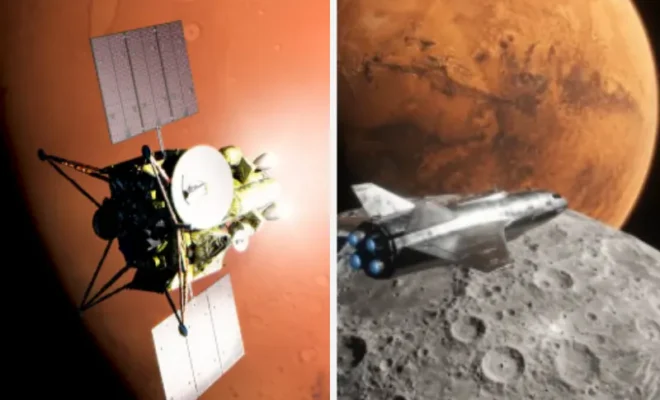
Japan successfully launched the MMX spacecraft on the country’s first-ever H3 rocket, marking an important step forward in the country’s space exploration programme. The Japan Aerospace Exploration Agency (JAXA) had launched the MMX spacecraft from the Tanegashima Space Center located in southwestern Japan on October 20, 2026.
The spacecraft was launched at 4:41 a.m. Japan Standard Time. It is intended to explore Mars’s two natural satellites, Phobos and Deimos. JAXA has reported that the spacecraft successfully separated from the rocket about 71 minutes into the flight and got onto the planned trajectory.
The main purpose of the mission is the investigation of the origin of Mars’ moons and obtaining the samples of Phobos to be brought back to Earth in 2031.
MMX Mission Targets Phobos for Sample Collection
Phobos, which is larger of the two satellites orbiting Mars, will be the main focus of the mission. The origin of Phobos and Deimos is yet to be determined by scientists, who question whether the two moons are asteroids captured by the gravity of Mars, or were created out of material ejected into space due to an impact on Mars.
The Japanese MMX spacecraft will enter the Mars system in August 2027. After that, the spacecraft will make a thorough examination of Phobos, making maps of its surface and analysing its composition in order to choose sites for collecting samples.
The spacecraft will collect no less than 10 grams of material from Phobos in the course of landing and collecting samples operations. Then, scientists will examine the collected material in order to learn about the composition and history of Phobos.
International Collaboration Strengthens Space Research
While the responsibility for the mission lies on JAXA, MMX makes use of some technology that has been developed by international participants, including the United States, France, and Germany.
The satellite carries instruments which will aid in analyzing the surface, its mineral make-up, as well as its surroundings. A French-German mini-rover will assist in analyzing the surface of Phobos.
NASA of the US has supplied scientific instruments and sampling technologies and communication.
From these examples, it can be seen that through international cooperation, the scientific capacities can be enhanced by sharing the cost burden of deep space expeditions.
H3 Rocket: Another Success
Apart from the success of the mission itself, MMX launch also marked another success for the Japanese rocket – H3, which was created by JAXA and Mitsubishi Heavy Industries.
This program is aimed at providing Japanese rockets with a reliable and economically viable launching system.
Mission Could Reveal Clues About the Solar System
The MMX probe is set to conduct observations of the Martian system for several years before embarking on its journey back to Earth. It is planned that the sample-return module of the mission would land on Earth in 2031.
Researchers are hoping that analysis of samples collected from Phobos would shed light on how the moons of Mars were formed and how the solar system developed during the early stages of its existence.
The successful launch marks the start of a difficult undertaking since there are several years of travel, observations and sampling left for the mission to do.
Global Diplomacy, Public Health & India’s Latest Policy Moves
Why Is Jaishankar Calling for Global Financial Reform?
Explore the key takeaways from the 2026 BRICS Foreign Ministers Meeting and India’s push to reform global financial institutions.
What Changes Now That Snakebite Is Notifiable in Maharashtra?
Discover the mandatory hospital reporting rules and what the new classification means for public health monitoring.
What Did India Reaffirm at the UN on Palestine?
Find out what India’s official statement says about support for Palestine and the two-state solution.
Why Has Pakistan Extended Its Airspace Ban on Indian Flights?
Explore the extended restriction on Indian commercial aircraft and what the September 24 deadline means for aviation.
How Could MeitY’s New Sandbox Rules Strengthen Cloud Security?
Uncover the proposed guidelines for cross-border data flows and how they could shape India’s digital security framework.