
Israel’s New Earthen Barriers Explained: How They Could Reshape Gaza’s Geography and Future
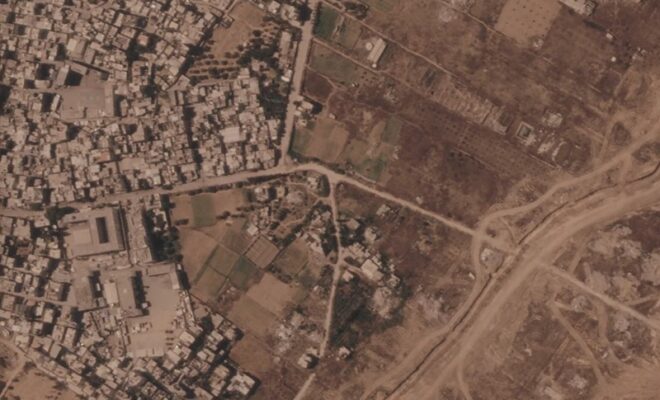
The recent pictures of the construction of a large number of earthen barriers by Israel within the Gaza Strip have renewed the debate on whether the ongoing conflict is moving into a new territorial phase. Spanning major sections of Gaza, the barriers are not only serving as short-term military installations but are increasingly being seen as tangible means to define Gaza’s geography and movements in the future. Over 23 kilometres of the barrier have already been built, dividing the Israeli-controlled zones from other parts of Gaza.
More Than a Military Barrier
Israel has defended its operations in Gaza on grounds of security and destruction of Hamas’ infrastructures. In this larger operation, the construction of earthen barriers is another form of military control meant to restrict movement and secure defensive points.
The difference with other forms of control like check points or fortified military posts is that this one literally transforms the geography of the region since it involves constructing barriers using earth mounds, surveillance equipment, military bases and related infrastructures that create boundaries in an area that was before geographically uninterrupted. Satellite photos show that these barriers generally conform to the “Yellow Line” in Gaza.
How Gaza’s Geography Could Change
Geography has always played an equal role in politics as that of diplomacy. Roads, walls, buffer zones, and military corridors have, in fact, in many instances, developed into political borders in the past.
This type of man-made obstacle has the possibility of dividing Gaza into different zones, thus affecting its physical cohesion and movement between areas. Connections among the different areas, which have been linked before via farmland, residential areas, and transportation links, can be increasingly cut off.
In case this infrastructure continues to exist after the war is over, rebuilding will certainly pose more difficulties. This will include residential areas, utility systems, transportation routes, and other services.
The Humanitarian Dimension
Barriers are also receiving attention because of their humanitarian significance.
As per recent reports, there are a large number of Palestinians who have been displaced in the direction of the western coastal areas, while there is widespread destruction on the eastern side of the proposed barrier. Various aid organizations have repeatedly stated that humanitarian access requires not only ceasefires but also unrestricted movement.
In case the movement continues to be highly restricted because of the military infrastructure, then delivery of food, medical assistance, reconstruction supplies, and other utilities will continue to be problematic even after active fighting has stopped.
Could Temporary Infrastructure Become Permanent?
The main problem that analysts bring forward is not just the fact of the presence of barriers, but their permanence.
It has already been proven that many times during modern conflicts, security arrangements were transformed into something more permanent. For instance, military roads have become borders, checkpoints have become border crossings, and buffer zones began to be considered politically.
The proponents of the Israeli security policy claim that barriers could help to minimize risks of infiltration and provide better control of the area in question.
At the same time, opponents are worried about the fact that infrastructure created in wartime might become the base for future separation, annexation or territorial division, regardless of any formal political claims.
International Law and Diplomatic Debate
The development of such barriers has led to an increase in the international legal discussion as well.
It is claimed by some legal scholars and international bodies that any permanent change in the occupied territories leads to international humanitarian law issues, even including parts of the Fourth Geneva Convention. Other parties believe that all considerations depend on the final result, the period of military occupation, and further negotiation processes.
For instance, Israel claims that all the military actions are necessary in order to meet their security needs after the Hamas’s attack in October 2023.
What This Means for Gaza’s Future
The barriers may also affect the development of Gaza in the longer term.
Governance, reconstruction, infrastructure, humanitarian activities, and economic revival all may be contingent upon whether these divisions remain transitory or become entrenched.
Urban development, transport connections, agricultural access, and demographic settlement all may be shaped by this reconfiguration of the geography of Gaza.
The issue is now not only one of military strategy but potentially one of a changing geography of Gaza that future negotiations will have to address.
Stay Updated on Global Developments
Why Did India Issue Iran Advisory?
Find out why Indian citizens have been urged to leave Iran immediately.
Why Must Indians Stay Indoors?
Learn why the MEA advised Indians in Iran to remain indoors.
Is UAE Safety Affected By Tensions?
Check out how regional tensions could impact Indians living in the UAE.
How Did The Oman Attack Unfold?
Uncover the confirmed details surrounding the Indian sailor’s tragic death.
What Happened To Frozen Assets?
Explore the latest updates on the release of frozen Iranian assets.
Why the World Is Watching Closely
In spite of changes that may occur in future due to diplomacy negotiations, the presence of road, barriers and corridors used for military purposes will often continue to have an impact on functioning of territories socially, economically and politically.
This is the reason why such construction of earthen barriers has been paid attention not only by military analysts but by people who understand its significance as a junction point of infrastructure, security policy, humanitarian issues and geopolitics.
And whether these barriers will become temporary or permanent will become one of the key issues in the future of Gaza.