Gaganyaan Mission Update: ISRO Successfully Completes Three Critical Crew Module Safety and Recovery Tests
India’s daring human spaceflight program has accomplished yet another significant feat. According to the latest updates about India’s Gaganyaan mission, the Indian Space Research Organization (ISRO) has successfully conducted three important qualification tests related to the key systems of the Crew Module, thus putting India closer than ever to the launch of its first human space mission.
In particular, the completed tests were aimed at checking the safety of astronauts upon splashdown, separation of the crew module and service module, and structural integrity of the crew module while deploying parachutes. These systems are among the most important systems needed to ensure safe return of astronauts back to Earth.
Why These Tests Are So Important
Only the Crew Module of the Gaganyaan vehicle will contain the astronauts during the journey to and from space.
The manned space mission differs from a satellite mission in that there are several redundancies required for safety since the astronauts will stay in the spacecraft throughout their mission. This means that all components need to be thoroughly qualified before the mission.
The successful tests by ISRO confirm safety systems that will be involved during the riskiest stages of the mission – re-entry to Earth and recovery.
Test 1: Crew Module Uprighting System
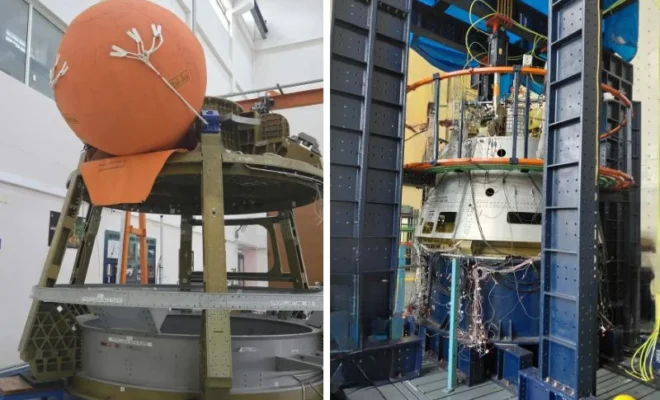
One of the crucial systems put to the test is the Crew Module Uprising System (CMUS).
Following the landing of the crew module in water, waves may flip the spacecraft and make it float upside down or even tilt considerably. In such circumstances, it may slow down the recovery process and pose dangers to astronauts still in the capsule.
ISRO has come up with a flotation device operated by cold gas technology. The qualification test showed that high-pressure gas was able to inflate the system and help upright the capsule.
This system has been described as one of the most crucial systems in ensuring astronauts’ safety as recovery teams must be able to reach the capsule after landing.
Test 2: Crew Module–Service Module Separation
The second qualification test was conducted on the Crew Module Service Module Connect & Disconnect System (CSCDS).
In the course of the mission, the service module ensures propulsion, electricity supply and many other functions. Before entry into the Earth’s atmosphere, however, the module should be separated from the crew module.
ISRO successfully conducted the test of the separation device that would disconnect the two modules without causing any damage to the crew module.
Separation plays an important role as any malfunction can have a detrimental effect on the capsule’s re-entry path.
Test 3: Crew Module Structural Qualification
Qualification number three involved the structural integrity of the Crew Module when the Apex Cover is separated.
The Apex Cover is designed to protect the parachutes during the journey of the spacecraft in space. Prior to the deployment of the parachutes, the Apex Cover needs to be separated in order for the deployment process to take place without any hindrances.
In the recently performed qualification test, ISRO confirmed that the Crew Module has the necessary structural integrity when the Apex Cover is separated.
How These Tests Fit Into the Bigger Gaganyaan Mission
The recent qualification tests form a far greater range of demonstrations that ISRO has been making throughout the past few months.
In addition to that, ISRO made another successful completion of Integrated Main Parachute Air Drop Test (IMAT). This test verified the main parachutes that would assist in decelerating the crew module during the splashdown. Gaganyaan’s deceleration mechanism involves a set of ten parachutes, namely apex cover separation, drogue, pilot, and main parachutes.
In the earlier part of April, ISRO carried out the second Integrated Air Drop Test. During this test, a dummy crew module was dropped by an Indian Air Force Chinook helicopter, then recovered by the Indian Navy.
All in all, it can be stated that a variety of recovery mechanisms are making significant progress towards their flight-ready stage.
What Is Gaganyaan?
Gaganyaan is the first human spaceflight program from India.
Gaganyaan seeks to undertake the flight of Indian astronauts referred to as Gaganyatris into low-Earth orbit on board an Indian launch vehicle, followed by their safe return back to Earth.
Several uncrewed flights will precede the first crewed flight to test all systems of the spacecraft for reliable performance.
Apart from showcasing India’s technological prowess, the Gaganyaan project is set to improve India’s expertise in the area of human spaceflight, space medicine, life support systems, crew safety, and spacecraft recovery operations.
What Happens Next?
Even though the most recent tests have been a great success in their own right, there are many steps yet to come before astronauts can be sent.
ISRO will perform further tests on qualifying the spacecraft for further systems, recovery, launch, unmanned orbiting flights, and other procedures before approving the first manned flight.
Every test performed successfully brings mission risk down and builds up the trust in the spacecraft’s capability of flying with astronauts on board.
Why This Milestone Matters
Human spaceflight is far more demanding than satellite launches because every system must perform flawlessly under extreme conditions.
The successful completion of these three Crew Module qualification tests shows that ISRO continues making steady progress toward one of India’s most ambitious scientific programmes.
As more systems complete qualification, India moves closer to joining the small group of nations capable of independently launching humans into space.
Stay Ahead With Today’s Biggest Stories
Why Restrict Rental Thar SUVs?
Discover why Goa is considering restrictions on rental Thar SUVs and the safety concerns behind the move.
Passed the FMGE June 2026 Exam?
Check the FMGE June 2026 result, pass percentage, scorecard details, and direct download link.
How Will Semicon 2.0 Help?
Explore how India’s Semicon 2.0 incentive plan could strengthen chip manufacturing and boost investments.
Why Is Jalalabad Being Renamed?
Explore why Uttar Pradesh’s decision to rename Jalalabad after Lord Parashuram is sparking debate.
What Caused Devkund Flash Flood?
Read what happened during the Devkund Waterfall flash flood and why tourists were left stranded.
Conclusion
This is yet another milestone for India on its way towards putting humans into space with its latest Gaganyaan mission update.
With ISRO’s latest successful tests of three key Crew Module safety features, namely uprighting after splashdown, module separation, and structural integrity during parachute descent, ISRO is taking solid steps in creating a safe and successful crewed mission.
Each successful safety test takes the Gaganyaan mission nearer to its liftoff date, and brings India nearer to putting its own astronauts into space.