
Black Harela Festival Protest Explained: Why Activists Oppose the Planned Felling of 3,000 Trees in Uttarakhand
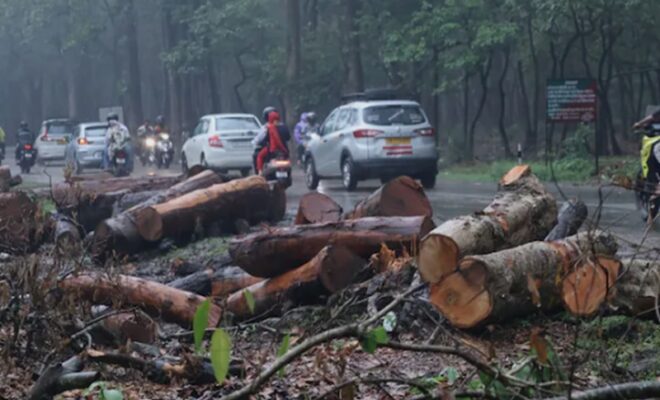
A festival that is known to be related to the planting of trees and appreciation of nature has become an environmental protest symbol in Uttarakhand this year.
Instead of celebrating the festival of Harela with tree saplings plantations, the environmentalists, locals, and the activists marked the day of “Black Harela” in protest against the cutting of more than 3,000 trees to widen a road. It has turned out to be an environmental protest symbol for one of the most valued green festivals in the state.
What Is the Harela Festival?
Harela is one of the important cultural and environmental festivals celebrated in Uttarakhand. This is an occasion celebrated during the monsoon and it marks greenery, prosperity, farming, and the relationship between humans and nature.
Conventionally, people used to sow the seeds prior to the festival and then plant saplings on it. Thus, Harela is a religious festivity as well as a social event highlighting the need of environmental conservation. In the past, schools, society and government departments have tried to use this occasion to initiate tree plantation.
Why Is It Being Called “Black Harela”?
This year, environmental activists preferred to celebrate Black Harela as a means of protest instead of celebration.
These protests were connected to the plan to cut down more than 3,000 trees during Bhaniyawala–Jolly Grant–Rishikesh road expansion project. According to the protestors, it is strange to celebrate the festival of greenery when many mature trees are being cut off.
Most of the protestors were dressed in black and assembled themselves near the affected forest range.
Why Are Activists Opposing the Project?
Environmentalists believe that the area that will be subjected to this process is an environmentally sensitive region in the Shivalik forest.
According to the protesters, the removal of tens of thousands of mature trees can lead to loss of forest cover, changes in biodiversity, wildlife habitats, and microclimate of the area. Moreover, mature forests cannot be substituted with freshly planted trees since it takes several decades before trees provide ecological advantages.
A number of activists have raised questions regarding the adequacy of mitigation measures as well.
What Is the Road Project About?
The tree-cutting activity has been associated with the Bhaniyawala-Jolly Grant-Rishikesh Four/Six Lane Project, which will serve to boost connectivity among Dehradun, Jolly Grant Airport, and Rishikesh via highway construction.
This road project is believed to aid tourism, reduce traffic pollution, and facilitate better access for Char Dham Yatra pilgrims. The estimated length of the project is about 20 kilometers, and the project is being undertaken under the Hybrid Annuity Model.
What Is the Government’s Response?
The NHAI has come out in defense of the project, saying that measures to safeguard the environment have been included in the design of the project.
As per officials, the right of way in forest areas has been cut down from the usual for highways in order to cut down on tree cutting. Also, several hundreds of trees that can be transplanted have been selected and will be moved during the monsoon season. Moreover, there will be elephant underpasses and an overhead bridge built to ensure that animal crossings are safe.
Officials claim that these steps try to strike a balance between development and ecology.
Why Has the Protest Gained So Much Attention?
This protest has gained significant popularity due to the symbolic value of the event.
Harela is considered to be the symbol of Uttarakhand’s dedication towards environmental preservation. By organizing the festival as Black Harela, campaigners emphasize the contradiction that has emerged between development schemes and the preservation of forests.
The contrast of black costumes at a festival linked to nature has contributed to further discussion of the issue of infrastructure development.
The Larger Debate: Development vs Conservation
This conflict is part of a much larger national issue regarding the need to balance infrastructure expansion with environmental conservation efforts.
While proponents of the project claim that upgraded roads are necessary to promote development and ensure safety, environmental activists claim that it is necessary to move forward without any harm to the environment.
Thus, the Black Harela protests have moved from a purely local environmental protest to a much larger discussion of how India must proceed with its infrastructure projects in environmentally vulnerable areas.
Conclusion
This way, the protest movement Black Harela managed to change one of the major environment festivals of the region of Uttarakhand into a symbol of forest protection.
Despite the statements of those in power who claim that the compensation measures are taken, activists insist that it is difficult to compensate the loss of so many grown trees. Further implementation of the road construction project will definitely be a key point for the discussion on sustainable development of the Himalaya area.
Black Harela protest movement does not imply opposition to the development in general but calls for more environmentally friendly development.
Stay Ahead with the Latest Headlines That Matter Most
How Is Railways Stopping Theft?
Discover the technology and CCTV measures Indian Railways is using to curb massive linen theft.
What Happened to Indian Sailor?
Explore the full story behind the tragic Oman coast attack and the latest official updates.
Why Is Services Index Important?
Check how the new monthly services index could influence India’s economic growth and policymaking.
When Will SBI IPO Launch?
Discover the expected IPO launch date, GMP trends, allotment details, and key investor updates.
How Will PF Transfers Change?
Explore the new EPFO transfer options and learn how the portal upgrade benefits employees.