
MoSPI Launches Monthly Index of Services Production: What It Means for India’s Economy
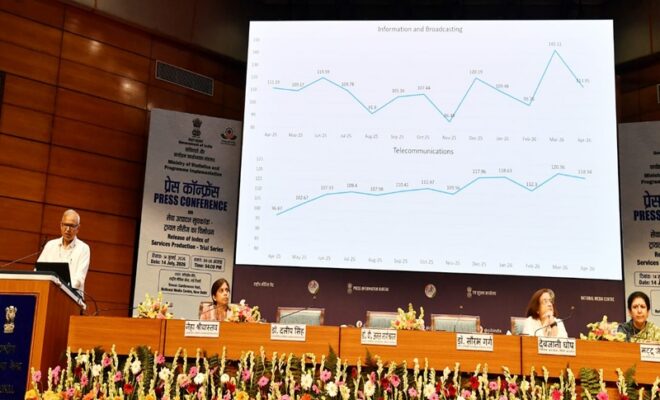
A key milestone towards a better measure of economic performance has been achieved by India. MoSPI has launched the first-ever monthly Index of Services Production (ISP) of India on an experimental basis, providing a new indicator that can be used by policymakers, businesses, and investors to monitor the performance of India’s largest sector.
The services sector accounts for more than half of India’s GDP, but there was no index like the Index of Industrial Production (IIP) to gauge its performance. The introduction of the ISP is supposed to fill the void that has existed so far.
What Is the Index of Services Production (ISP)?
Index of Services Production (ISP) is a newly introduced macroeconomic variable that has been introduced by MoSPI and measures the monthly change in the production in India’s formal sector of services.
As IIP captures production in industry, mining, and electricity, the ISP will capture the production and growth in the major sectors of services. This way, economists would be able to capture the short-term trends in those sectors contributing most to the growth ofthe Indian economy.
Initially, the ISP is being introduced as a trial series with 2024-25 as the base year.
Which Sectors Are Covered?
MoSPI’s first release includes indices of sub-sectors of 19 formal service industries accounting for roughly 60 percent of India’s services sector. These include wholesale and retail trade; transport and storage; accommodation and food services; financial services; real estate; professional and technical services; administrative services; and arts, entertainment, and recreation.
Certain sectors such as education, health, and defence are currently not covered owing to lack of data availability.
Why Is This Launch Important?
The economy of India has been steadily moving from a manufacturing-based economy to a services-based economy over the years.
Nevertheless, in spite of that, policymakers had been dependent on proxy measures along with quarterly GDP figures to gauge performance in the service sector.
The ISP has brought about a transformation here, in the sense that the government can pick up early signals of an economic slowdown or recovery through its monthly data.
What Does the First ISP Data Show?
Trial release one, which covers April 2026, gives an encouraging scenario.
As per MoSPI, 14 out of 19 sub-sectors in the services industry have shown year-on-year growth, thus giving a positive start to the fiscal year. The figures show the resilience of key components of the formal services sector despite any economic uncertainty around the world.
It is worth noting that the ministry has declared that henceforth the ISP will be released on the 29th of every month.
How Will the ISP Help Policymakers?
Monthly data helps the government to take quicker and better-informed decisions with respect to the policies that need to be taken.
For instance, if there is an indication of a slowdown in the service sector, the government might think of some initiatives for promoting growth even before the quarterly figures for GDP are released. Equally, the performance of the service sector could impact fiscal policies, employment initiatives, and investment decisions. Moreover, the ISP will go well with other indices like the IIP, CPI, PMI, etc.
Why Does It Matter for Businesses and Investors?
Firms always keep track of the economic indicators in order to gauge market demand and make future investments.
This monthly services index will be useful for firms working in retail, finance, logistics, hospitality, information technology, and other professional services.
ISP data will further be used by investors and financial organizations to judge the economic strength and sectors that are doing well. The importance of this index may increase for the Indian market because services contribute a substantial share to the GDP of India.
What Are the Current Limitations?
However, despite the launch being a milestone moment, the ISP is currently undergoing trials.
Currently, the coverage is limited to only the formal service sector without incorporating the informal economy, which is quite large in India.
This issue has been recognized by MoSPI, and efforts are underway to enhance coverage and methods using feedback from stakeholders prior to launching a comprehensive overall services index.
Stay Ahead With Today’s Biggest Stories and Breakthroughs
What Happened Near Phu Quoc Island?
Check the latest updates on the tragic Vietnam boat accident that claimed the lives of Indian tourists.
Where Can You Stream Lenin?
Explore the OTT platform, cast details, storyline, and streaming information for the much-talked-about Lenin movie.
How Safe Is Gaganyaan Now?
Discover the latest Gaganyaan mission tests and how ISRO is strengthening astronaut safety for future space missions.
How Will UPI Benefit Travelers?
Explore how India’s UPI integration with New Zealand can simplify international payments and transactions.
Why Did Meta Remove AI Features?
Discover why Meta pulled its newly launched AI image tools and what led to the sudden decision.
Conclusion
The introduction of the Index of Services Production (ISP) may very well be one of the most significant changes that have occurred to the economic statistical framework in India in recent times.
As the ISP offers monthly snapshots of India’s largest sector, it is hoped that it will help in better policymaking, increase investor confidence and allow a greater understanding of how the Indian economy is performing.
Once the ISP develops out of its experimental phase, it might turn out to be as vital as the Index of Industrial Production and provide India with a comprehensive view of its fast-changing economy.
India finally has a monthly indicator for its largest economic driver. The Index of Services Production can soon turn out to be one of India’s most vital indicators for gauging economic growth.