August 12 Solar Eclipse Explained: Duration, Visibility and Key Facts
Last updated on July 10th, 2026 at 11:21 am
The total solar eclipse occurring on August 12 has been termed one of the phenomena of this century. The spectacular total solar eclipse will occur on August 12, 2026, and promises to cast over six minutes of total darkness in certain areas, thus being one of the longest solar eclipses that can be seen in the 21st century.
Scientists and other researchers have been keeping track of this phenomenon due to its incredible duration and scientific value.
What Makes the August 12 Solar Eclipse So Special?
The event of a total solar eclipse takes place when the moon moves between Earth and the Sun, completely obstructing all light during the event as seen by those who happen to be in the path of totality.
The unique feature about the upcoming solar eclipse that will take place on Aug. 2 is the time duration.
The longest period that totality will last is 6 minutes and 23 seconds, which is the longest time span for a total solar eclipse seen from the easily observable land before the year 2114.
Due to the closeness of the moon and the greater distance of the earth from the sun, the moon will seem bigger to cover the sun.
Which Countries Will See the Total Eclipse?
The path of totality is going to be visible over areas of Southern Europe, North Africa, the Middle East, and parts of the Indian Ocean. Countries that are likely to see the totality eclipse include:
Spain, Morocco, Algeria, Tunisia, Libya, Egypt, Saudi Arabia, Yemen, and Somalia. Among the best places to observe this total eclipse include southern Spain, Morocco, and Egypt, especially around the area of Luxor.
Will the Eclipse Be Visible in India?
Parts of India may witness a partial solar eclipse, with visibility depending on location and local weather conditions. Those who are fortunate enough to see the phenomenon from their geographical location would notice that there will be some parts of the sun which would appear to be obscured by the moon.
This is different from a total solar eclipse wherein there would be a complete loss of light from the sun, something which people will not experience in the present event.
Experts advise that one should avoid gazing at the sun during the entire process of the eclipse without certified eclipse viewing glasses or solar filters as doing so may result in damage to their eyesight.
People who are unable to view the event themselves may also tune in to live broadcastings of the event through the Internet.
How Long Will the Eclipse Last?
The entire process of the eclipse will take several hours around the globe due to the movement of the Moon’s shadow on the surface of our planet.
However, the key element of an eclipse is undoubtedly its totality when the sun will be entirely obscured by the Moon’s shadow.
The maximum totality of the upcoming eclipse is going to last approximately six minutes and 23 seconds.
It should be noted that most other total eclipses usually last between two and four minutes only.
Why Is It Being Called the “Eclipse of the Century”?
A great many astronomers and publications have referred to the occurrence as “The Eclipse of the Century.” This is due to several reasons:
First, its long duration, its wide path of visibility, its easy access by those in populated areas, and also due to the large amount of people who will observe the occurrence. It is estimated that tens of millions of individuals will be positioned in the path of the eclipse.
What Happens During Totality?
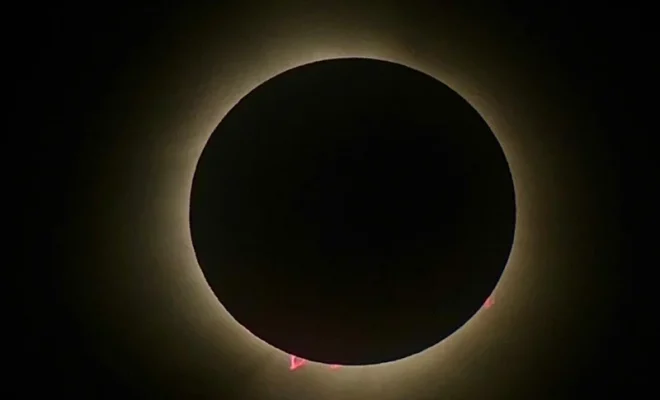
At the onset of totality, the sky becomes dark very quickly and appears to look like twilight. The temperature may fall a little, the brighter planets might appear in the sky, and the outer atmosphere of the Sun, called the corona, will appear around the Moon’s black disc.
It is regarded as the most spectacular stage of the solar eclipse since it displays parts of the Sun that cannot be seen due to its intense brightness. Totality is often referred to as one of the most unforgettable natural events visible on Earth.
Is It Safe to Watch?
Directly staring into the sun without appropriate protection is capable of severely impairing vision permanently.
The advice is to use approved eclipse glasses for the entire duration of the partial phase of the eclipse. It is only during the period of totality, when the sun is entirely obscured, that one is allowed to gaze at the sun without protection but for people within the path of totality only.
Why Scientists Are Excited
But aside from public interest, the solar eclipse on August 12 presents several possibilities for science as well.
Scientists sometimes take advantage of total solar eclipses to observe the Sun’s corona and other astronomical events.
Due to its exceptionally long duration, this particular eclipse provides a good amount of observation time for the scientists.
Stay Updated With Latest News
Explore IPL Stars’ Massive Wealth Secrets
Discover how IPL superstars built huge fortunes through cricket salaries, endorsements, and successful business ventures.
Check Bollywood’s Biggest Box Office King
Explore which Bollywood superstar dominates the highest-grossing films and audience popularity charts.
Discover Shocking Digital Arrest Scam Truths
Check how cybercriminals executed a massive scam and learn smart ways to stay protected online.
Explore IPL 2026 Playoff Match Details
Discover match schedules, IST timings, and live streaming details for the biggest IPL clashes.
Check BJP’s Stunning Falta Election Victory
Explore how Debangshu Panda and BJP achieved a massive breakthrough in West Bengal politics.
Conclusion
The August 12 total eclipse is anticipated to be one of the most important astronomical phenomena for the decade owing to its unusually long period and extensive range of visibility.
Although India will mostly see a partial eclipse, other areas such as Europe, North Africa, and the Middle East will be lucky to see one of the longest durations of totality observed in this century.
The total eclipse scheduled on August 12, 2026, will not be like any other; it is going to be one of the rare occasions where people on different continents witness day turn to night.