State vs. Street: The Shrinking Physical and Digital Spaces for Public Dissent
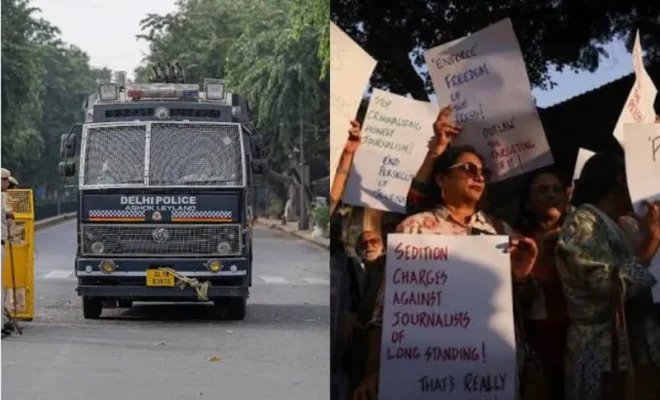
Public dissent is an integral aspect of any functional democracy. Whether it is through mass protests, students’ movements, social media activism, or investigative journalism, people require places to raise questions against those in authority and demand answers and accountability. But the space in which citizens can voice their dissent is becoming more and more contested with increasing restrictions on assembly, digital communication, and online discourse.
What is not in question here is whether governments should keep law and order and protect themselves from any potential threat. Of course, they are supposed to do that. What becomes problematic is when the measures that the governments take to ensure law and order turn into something that discourages criticism.
The Street as a Contested Democratic Space
The public space has been traditionally an important means of political expression. People are able to voice their common complaints straight to the powers that be on streets, public squares, university campuses and designated spaces for demonstrations. Furthermore, demonstrations give social and economic problems a visibility that could have been missed by other people.
Nevertheless, access to public space depends today upon permissions, security arrangements, movement control and administrative decisions. Some restrictions are inevitable in the interest of ensuring public order, preventing violence and securing the provision of important services. At the same time, overly restrictive measures could impair the practical utility of the right to assemble peacefully.
In case of long-lasting permission processes, hard-to-access designated demonstration zones and unjustified prohibitions of gatherings, the right to voice one’s discontent becomes unequal. Rich, influential or politically connected citizens can always use other ways of voicing their problems. Ordinary workers, students and marginalized groups of population lack such alternatives.
Democratic institutions need to control public gatherings without making such a control an obstacle to dissidence. Public order must facilitate peaceful participation instead of interpreting collective protests as a danger per se.
Digital Platforms: New Opportunities, New Restrictions
The initial development of the internet brought many possibilities for political activism. Through social media, people have opportunities to record events in the public sphere, conduct campaigns, disseminate information and communicate beyond borders. Online spaces have even allowed marginalized communities with little coverage in mainstream media to voice their interests.
Nevertheless, participation online is not without limitations. Internet blackouts, content takedowns, account blocking and wide-ranging internet restrictions limit the capacity of citizens to exchange information. Regardless of whether they concern valid issues, their scope, length and transparency are important.
Internet blackouts, in particular, go beyond political speech. Internet blackouts impact not only politics, but education, healthcare communication, banking, business activity and access to emergency services. Restrictions imposed over larger territories or longer periods can affect the issue beyond the immediate case.
Online platforms pose another problem as well. Algorithmic biases affect the visibility of opinions, and coordinated harassment and false information can prevent people from participating in public debates. On the other hand, hidden mechanisms of content moderation can be a reason why people do not know the reasons behind the takedown of their posts or blocking of their accounts.
The Chilling Effect of Uncertainty
However, not all constraints necessarily prevent speech directly. Uncertainty itself can be sufficient to stop people from participating.
If citizens are uncertain about whether making a certain social media post can bring legal repercussions, whether joining a rally might harm their professional reputation or whether providing certain information can bring them under the threat of harassment, they may decide not to speak up. This phenomenon is referred to as the chilling effect: individuals refrain from engaging in legal speech due to the fear of possible repercussions.
This problem can be especially problematic for journalists, students, scientists, activists and whistleblowers whose activities necessarily involve criticizing authorities. When this activity becomes personally or professionally hazardous, then debates can become less diverse gradually.
However, a democracy should not solely depend upon the absence of censorship in order to prove that freedom of expression is ensured.
Balancing Security with Constitutional Rights
Freedom of speech and expression is provided for in India’s constitutional setup under Article 19(1)(a) while the right to assembly is provided for under Article 19(1)(b) as per the Indian constitution, with reasonable restrictions under Article 19(2) and Article 19(3) respectively.
This balancing act cannot be done simply on the basis of security or public order arguments. The restriction has to have a proper legal justification; be in response to a real concern; and be proportionate to the situation. Such decisions also have to be amenable to proper judicial scrutiny.
It is important that the government differentiate between legitimate opposition and a threat to public safety. Digital restrictions have to be narrow, appropriately temporally limited where necessary, and based on proper procedure. Access to remedy and independent oversight could play an important role in making sure that exception measures are not used as a standard response to criticism.
Communication of the restrictions will include explaining the legal justification, geographic extent and the time period of such restrictions.
Reclaiming Space for Democratic Participation
It is not about disregarding the police or the threat posed by misinformation and violence. Dissent protection is about understanding that democracy is also built on the capacity to address grievances.
The government should organize protests, reconsider its practices, and make sure that decisions on public protests are made in a transparent way and without arbitrariness. At the same time, digital governance should include real restrictions on governmental arbitrariness, while online platforms should explain their decisions on content and give people opportunities to appeal them.
Civil society, educational organizations, and the media also need to contribute to fostering rational disagreement and defending the right of peaceful protest.
In the end, it is important to understand that the interaction between the state and the street is not supposed to be based on constant suspicion. At the same time, the online public sphere cannot be created in such a way that people will be able to participate in it from a technical point of view, but not from a practical one.
Dissidence becomes an element of democracy only when people can question the state without violence, while the state can hear citizens’ criticisms without seeing it as disloyalty.
Health Breakthroughs, Global Partnerships & Major Updates
Can Weekly Insulin Awiqli Change Diabetes Treatment in India?
Discover the reported benefits, dosage guidance and eligibility considerations for Novo Nordisk’s weekly insulin, Awiqli
How Is Abu Dhabi Building Its Future Economy?
Explore how energy, artificial intelligence and smart infrastructure are shaping Abu Dhabi’s economic transformation.
What Does Australia’s Support Mean for India’s 2036 Olympics Bid?
Find out how the proposed sports collaboration roadmap could strengthen India-Australia cooperation and support India’s Olympic ambitions.
Which New Indian Railways Rules Could Get Passengers in Trouble?
Explore the ticketing rules, women’s coach restrictions and other violations that railway passengers should know about.
Where Is Typhoon Bavi Heading, and What Could It Affect?
Track the storm’s reported path, expected landfall, potential impacts and latest weather updates.