Shifting Alliances: How the Pakistan-Saudi-Türkiye Defence Pact Could Reshape Regional Security
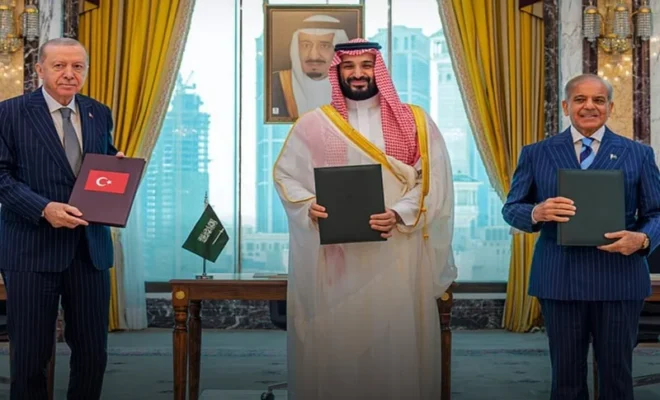
Beyond a new defence agreement among Pakistan, Saudi Arabia and Türkiye, which was signed on August 7 in Makkah, lies the political statement made by three major Muslim states that they wish to have a greater say in determining the security environment for themselves amid the uncertainty about the reliability of existing regional security arrangements.
Under the terms of the agreement, any armed aggression towards any of the three countries will be considered aggression towards all of them. Nevertheless, the three nations emphasized that the agreement is purely defensive and is aimed at nobody in particular. In addition, Pakistan’s foreign minister Ishaq Dar stated that the agreement is “purely defensive” and that the framework could be extended to other countries adhering to its principles.
There is a difference between the agreement and what it is sometimes seen as, namely, a Middle Eastern version of NATO. The details regarding the military response from the signatories to the attack and the command structure have yet to become as public and elaborated as those of NATO. Still, the political message of the pact is clear – Saudi Arabia, Pakistan and Türkiye are moving closer to becoming a new regional security organization.
A Pact Born From a Changing Security Environment
The timing of the deal may be as critical as the deal itself.
The security situation in West Asia has been marked by exceptional turbulence, which includes direct confrontation between Iran, attacks against the infrastructure in the Gulf and uncertainty over maritime routes and energy supplies. The agreement is being signed at this moment and thus acquires an element of urgency that the same kind of deal could not have had several years ago.
The Saudis have for years been trying to diversify their security relations. Their traditional reliance on the US for security assistance has remained very strong, but at the same time they have diversified security relationships with such states as Türkiye, Pakistan, China and others. Increasingly, the logic behind these efforts is strategic diversification – instead of reliance on just one guarantor, Saudi Arabia wants to have multiple guarantors.
There are some additional elements – Pakistan has years of defense cooperation with Saudi Arabia, sizeable military forces and nuclear weapons capability. Türkiye has a NATO membership and developing defense industry as well as much experience. Saudi Arabia has lots of money, geographic position and influence in the Arab and Islamic world.
Combined, all these make a more powerful deal.
Pakistan’s Strategic Opportunity
This agreement can be regarded as a huge chance for Pakistan to convert its longstanding military alliance with Saudi Arabia into a broader strategic one.
Previously, Islamabad and Riyadh inked a Strategic Mutual Defense Agreement in September 2025 stipulating that any aggression on one of these countries will be considered aggression on both. Thus, the trilateral deal continues the established tradition instead of creating a completely new type of collaboration.
In this case, Pakistan acquires a certain prestige due to its role as an indispensable security partner both for Saudi Arabia and for Türkiye. The combination of Pakistan’s military expertise and nuclear deterrence provides the state with a number of assets unavailable to other Muslim-majority countries.
However, there is a trade-off as well since the interests of Pakistan strategically extend from South Asia to the Persian Gulf and even to its western borders with Iran and Afghanistan. In other words, a possible confrontation between Saudi Arabia and Iran may cause a serious dilemma for Islamabad. This aspect has already been noted by some analysts pointing out the problematic nature of this country’s choice of sides in order to preserve the peace along its western borders.
Why Türkiye Matters
It could be argued that the Türkiye factor is what turns the agreement into something different – not simply into a strengthened Saudi-Pakistani relationship, but rather something that has the potential to extend beyond that.
First of all, being a member of NATO, Türkiye finds itself in a unique situation. Having access to advanced military networks and experience, it pursues a more and more independent foreign and defense policy. Its defense industry serves as an important tool in its diplomatic arsenal with Turkish drones, naval systems, missiles and other military technologies spreading Turkish influence in several regions at once.
For Saudi Arabia, Türkiye offers access to military technology and the influence of a regional power whose aspirations spread from the Mediterranean to the Gulf.
For Pakistan, increased defense cooperation withTürkiye would help strengthen already existing relationship.
ForTürkiye, the agreement would give a chance to increase its influence both in the Gulf and South Asia at the same time.
In this regard, the cooperation becomes interesting precisely because the three states have different goals. Therefore, it will not be an ideological union, but a strategic partnership of convenience.
Is This a “Muslim NATO”?
The comparison is politically appealing but strategically premature.
Türkiye’s Foreign Minister Hakan Fidan has apparently likened the collective defense clause of the pact to NATO’s Article 5, with experts reminding us not to assume that the structure has the same level of institutionalization as NATO.
NATO has institutions, command structures, and a long history, which the Makkah agreement currently lacks.
It would be more meaningful to compare old security dependence with new regional security cooperation than to compare the two alliances.
The value of the agreement is the trend itself.
Iran Is Watching — But the Message Is More Complicated
Iran is a necessary element in the context of this deal despite the fact that the parties claim that their accord is not directed against any particular country.
Tehran has declared that there is no cause for alarm in this regard and that such cooperation could be advantageous for the region if it was inclusive enough and dealt with actual threats.
However, the agreement would inevitably be viewed through the prism of deterrence by Tehran.
The increased defense cooperation between Saudi Arabia and Pakistan as well as Türkiye would present a challenge for Iran’s strategic calculus.
In turn, the establishment of an alliance that is hostile towards Iran might have an unintended effect and result in increasing competition in the region.
That is why the language of the agreement is so important. The fact that it is named as a defensive one and leaves room for the addition of more members makes it possible for the countries to assure their neighbors.
What Does It Mean for India?
India probably has the most complex ties with this new alignment.
New Delhi can hardly view Islamabad’s role in isolation as the idea of enhanced military cooperation between Turkey and Pakistan has already been on India’s radar, while at the same time, Saudi Arabia is increasingly becoming a significant economic and strategic partner for India.
It creates an intriguing paradox.
Ties between India and Saudi Arabia have grown significantly over the last few years, in energy, investments, trade, counterterrorism, and strategic cooperation, and yet Saudi Arabia has just entered a defence agreement with Pakistan, India’s key security rival in the region.
Therefore, New Delhi’s reaction to this development needs to be cautious rather than alarmist as when the previous Saudi-Pakistan defence agreement was signed back in 2025, India’s Ministry of External Affairs said that it will examine the national security implications of the deal.
The same principle applies today.
India’s response shouldn’t be to view every move made by either Saudi or Turkish side from the India-Pakistan perspective but instead should focus on developing its relations in the Gulf region and expanding maritime, technological, and defence partnerships with like-minded Indo-Pacific nations.
The Bigger Shift: Strategic Autonomy
But perhaps the most significant shift may end up being the larger push towards strategic autonomy.
The Saudis do not want their own strategic calculations to be entirely dependent on the Americans anymore. While still a member of NATO, Türkiye has sought an increasingly autonomous foreign policy line. Pakistan, too, is trying to use connections with China, the Saudis, Türkiye, and others to have more strategic options available.
The Makkah agreement represents the convergence of all these trends.
It emerges from a world in which middle powers feel that they cannot afford to wait for great powers to solve their regional security issues.
That is not to say that the US is irrelevant anymore; far from it. The American military might continues to underpin the security architecture of the Gulf region. But regional actors have been adding new layers of insurance.
What Happens Next Will Matter More Than the Signing
The real challenge starts from after the ceremony.
Can the three nations come up with ways of conducting joint exercises, sharing intelligence, coordinating air defense and engaging in defense industrial collaboration? Will more countries get involved? Will the deal just remain symbolic or will it become operational?
Turkish government’s intentions to widen the scope of this deal are important in this regard. Turkish officials have stated that President Recep Tayyip Erdogan wants the deal to be made more extensive, whereas the Pakistani side has expressed its intentions to keep the deal open to more partners.
This will be important to create a broader security network in the region through this deal. In case this does not happen, the deal can still remain useful as a message of deterrence.
Five stories shaping India’s global, political and strategic landscape.
Could UAE’s Food Parks Boost India?
Check out how a $2 billion UAE investment could transform India’s food security and crop production.
Why Is India Blaming Islamabad Again?
Find out what sparked India’s criticism of Pakistan at the United Nations and why it matters.
Can India Rethink Its Sunak Expectations?
Uncover why India may need a more realistic approach toward Rishi Sunak and Britain.
Is Turkey Fueling Kashmir’s Political Tensions?
Look into Turkey’s position on Kashmir and its implications for India-Pakistan relations.
What Does NATO’s Ankara Summit Signal?
Track down the warning signals from NATO’s Ankara summit and what they could mean for India.
Conclusion: A New Security Equation Is Emerging
The Pakistan-Saudi-Türkiye defence agreement can be neither considered as just symbolism nor overblown into a fully-fledged “Muslim NATO.”
Its importance falls somewhere in-between.
It institutionalizes a rapidly developing strategic relationship between three strategically significant countries, brings together the military and nuclear strength of Pakistan, the defence-industrial might of Türkiye and the financial and geopolitical clout of Saudi Arabia, and responds to the regional quest for more self-sufficiency in security affairs.
The message to India, Iran, the Gulf states, the United States, and other regional powers is obvious: The West Asian security architecture is no longer dictated by external powers alone; regional states have started designing their own deterrence and cooperation arrangements.
The Makkah agreement will not upset the current status quo straightaway. However, it can prove to be an important building block in shaping the future one.
And in a region where alliances shift much quicker than institutions manage to adapt, it might prove to be its most significant legacy.