
IAF Chief Signals MRFA Deal by FY26-End: Why 114 Rafales and an AI-Augmented Fleet Matter
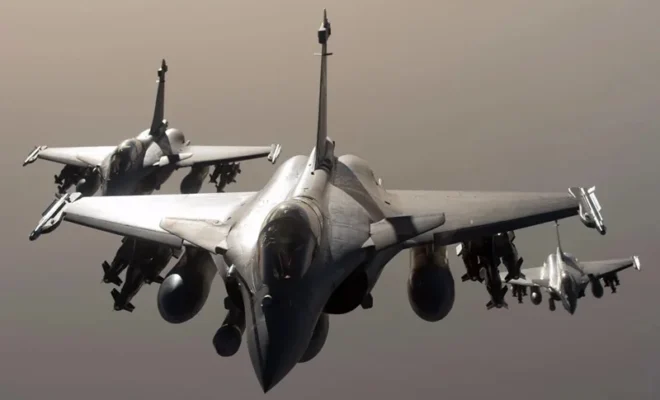
With the awaited MRFA deal being on the cards, India is set to finally move to the finishing line with respect to the MRFA deal this financial year. Speaking on October 3, Air Chief Marshal AP Singh stated that the Indian Air Force was seeking to conclude the deal to acquire 114 Rafale jets from France before the conclusion of the current financial year.
This development emerges in the context where the IAF finds itself under pressure with regard to its fighter squadron numbers and is working towards fast-tracking the process of modernization. Besides acquiring new fighter aircraft, the Air Chief has indicated that India’s future air power needs to be AI-enabled, comprising of manned planes as well as artificial intelligence-based platforms.
What Is the MRFA Deal?
The full form of MRFA is Multi-Role Fighter Aircraft which is a lengthy program for providing modern multi-role fighter aircrafts to the IAF.
Acceptance of Necessity for the procurement of MRFA Rafale aircraft was granted by the Defence Acquisition Council in February 2026. According to the Ministry of Defence, this acquisition would enhance the capability of the Indian Air Force to conduct air dominance operations and long-range offensive operations and most of the aircraft will be made in India.
As per the present agreement, 114 Rafale fighter aircrafts will be procured through a government-to-government agreement with France. The prices have not been finalized yet.
Why 114 Rafales Matter for the IAF
With respect to the proposal, there will be a massive increase in the Rafale fleet of India. As far as India’s Air Force is concerned, it already has a fleet of 36 Rafales bought under some previous agreement. On the other hand, India Navy has placed orders for 26 Rafales-M for naval purposes.
In case the agreement of 114 MRFA is finalized, then the total number of Rafale jets in the inventory of India’s IAF and Navy will go up to 176.
However, the importance of this aircraft is not only because of adding to the inventory. It has other implications for India’s Air Force as well.
Why the Deal Is Being Pushed Now
It is directly related to the requirements of the IAF fighter squadrons.
As mentioned by Air Chief Marshal AP Singh, the Indian Air Force requires around 36 to 40 aircraft per annum for the coming few years to meet its requirements. He has further highlighted that airpower plays an essential part of India’s overall military capability.
This is why MRFA will be pursued concurrently with other indigenous programs such as the Tejas Mk1A and the Advanced Medium Combat Aircraft (AMCA).
It aims at increasing the number of combat aircraft while the fighter programs of India keep on developing.
What Does “AI-Augmented Force” Mean?
However, one of the most important things that the Air Chief mentioned has nothing to do with Rafale.
As he stated: “We have to have an AI-augmented force”. This shows that there is going to be some larger-scale change where artificial intelligence will assist with decision-making, surveillance, mission planning and data processing and coordination between different systems.
An AI-augmented air force is not going to replace pilots with automated machines, but rather enable the people operating the planes to better analyze huge amounts of data and coordinate planes, drones, sensors and weapons.
This is especially relevant to the modern age of aerial warfare.
Rafale Plus AI Could Mean a Different Kind of Air Power
MRFA and the AI initiative thus connect with a much broader modernization drive.
An advanced fighter aircraft is no longer supposed to work on its own. It can be a part of a much bigger network that includes airborne sensors, ground stations, satellites, unmanned systems and aircrafts.
For India, the aim seems to be more about building an ecosystem of combat aircraft rather than simply building more aircrafts.
The IAF is also looking towards building unmanned capabilities. The Air Chief has recently stated that the IAF does not see itself as forming a drone force but would prefer to integrate the unmanned systems and loitering munitions within its operational framework.
What Happens If AMCA Gets Delayed?
A further issue raised by the recent statements by Air Chief is India’s own fifth generation fighter programme, the AMCA.
Air Chief indicated that the IAF would have to look into alternative platforms in case the AMCA programme suffers any delay. The Russian Su-57 fighter aircraft has been offered to India; however, the Air Chief was very clear on the point that no final decision had been taken yet regarding the procurement of this platform.
The statement does not suggest that India has ruled out the AMCA programme. The Defence Secretary of India, Rajesh Kumar Singh, recently clarified that India had not decided to procure a fifth generation fighter aircraft from abroad and the AMCA would continue to be the path of India for the fifth generation.
Why Indigenous Manufacturing Remains Important
Another reason why the MRFA project matters is the fact that a good deal of the aircraft proposed under it is supposed to be manufactured in India.
The ministry of defense says that the majority of the MRFA aircraft would be made within India itself.
At the same time, the IAF chief is stressing the need for self-reliance and pointing out that India must have its own fighter jet engine. Telegraph India
That means that the MRFA project is not just about importing aircraft but also about the broader efforts of India to develop domestic aerospace industry.
What Could Happen Next?
Negotiations for the 114 Rafale aircraft will have to conclude before a contract can be signed.
According to the statement made by the Chief of Air Staff, India wants to conclude all these deals this financial year itself provided the negotiations go smoothly.
Meanwhile, India will continue making progress in Tejas, AMCA, and unmanned aircraft systems.
The outcome may well be a more sophisticated fleet where the Rafale will offer immediate high-tech fighter capability while the other indigenous programmes build up India’s homegrown combat aircraft industry ecosystem.
Conclusion
The latest news concerning MRFA is important for the reason that it is bringing one step closer the possibility of signing the 114-fighter contract.
However, the more significant point is the new air power strategy which India is pursuing now. The Indian Air Force (IAF) is trying to procure additional fighter aircraft, promote indigenization, develop AMCA (Advanced Medium Combat Aircraft), integrate unmanned aircraft into the force structure and use artificial intelligence to improve its combat potential.
In case the 114-Rafale deal is signed before the end of FY26, it will be a serious boost for India’s combat-aircraft fleet. However, it is obvious from the latest statements of the IAF that in the long term its aim is not simply procurement of additional jets but rather creation of an AI-powered networked air force that relies on itself.
MRFA program will enable the acquisition of 114 Rafales, however, the latest IAF roadmap speaks of something different – more aircraft, more indigenization and usage of AI.
Explore India’s Growing Air Power
What Makes Khagantak-243 So Significant?
Uncover the indigenous glide bomb’s test and its reported capabilities.
Why Did Five Rafales Reach Ambala?
Check out the latest Rafale fighter jet arrival at Ambala.
How Did IAF Rescue 121 People?
Find out how IAF personnel carried out the Sudan rescue operation.
Can Vayulink Strengthen IAF Communications?
Explore how Vayulink is designed for jammer-resistant communication.
Will Navy Receive Rafales From France?
See what the Rafale deal could mean for the Indian Navy.