Milestone for Conservation: Captive-Bred Great Indian Bustard Set for Release into Rajasthan Wilds
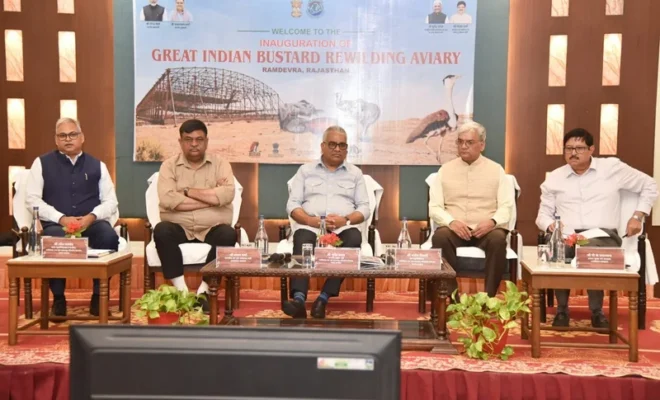
One such landmark in wildlife conservation is currently taking place in Rajasthan, where the Great Indian Bustards, bred in captivity, will be released back into their native environment in Jaisalmer.
The Rajasthan Forest Department has announced the release of ten Great Indian Bustards from captivity on October 3rd and 4th, with GIBs expected to be released in Ramdevra and Sudasari of the Desert National Park. This move is being made as part of a major step in releasing captive bred birds into the wild in the ongoing breeding program.
This comes at a time when the Great Indian Bustard, one of the critically endangered species of India, still survives in the wild in very small numbers.
Why the Great Indian Bustard Is So Important
The Great Indian Bustard, known by its scientific name Ardeotis nigriceps, is among the most massive birds capable of flight, and it is closely linked with grasslands of India.
Thar land of Rajasthan is one of its most important remaining habitat regions. It is also considered to be the official bird of Rajasthan state.
There have been many factors that caused their number to drastically reduce over the years, such as loss of habitat, hunting, and especially collisions with power lines in the air.
Conservation breeding has become especially important due to the above mentioned reasons since keeping a certain number of animals in captivity may serve as a basis for future reintroduction.
What is Happening in Jaisalmer?
The current release will happen in the area of Jaisalmer, where there are specific breeding centres for the Great Indian Bustard in Sam and Ramdevra.
As per the most recent news, 10 birds bred in captivity are to be released at Ramdevra on October 3 and in Sudasari of Desert National Park on October 4. The environment minister of India, Bhupender Yadav, will observe the process, along with many other officials and wildlife experts.
The birds have been prepared for their independent life in the wild. The point is not to simply open the cage and let them out, but to train them for such living conditions.
Why This is Called a Rewilding Milestone
The release of a captive-bred bird into the wild is more challenging than captive breeding.
The bird that has been bred in captivity needs to learn to navigate its way through the environment, feed itself, and avoid any dangers.
This is why the Great Indian Bustard programme has adopted a soft-release and rewilding strategy.
According to the initial conservation strategy of the programme, the captive-bred birds were trained for release, soft-release facilities created, and ultimately excess captive-bred birds were released into the wild.
The current initiative therefore represents a transition from simply increasing the captive population to testing whether those birds can successfully adapt to life in the wild.
How Captive Breeding Helped Reach This Stage
The conservation program of the Great Indian Bustard in India has been working on perfecting the techniques to breed and raise the species in captivity for a number of years.
According to the Ministry of Environment, Forest and Climate Change in March 2026, the captive population numbered 73 birds after more chicks have been hatched.
By June, the growth continued; the captive population included 94 birds, and 26 chicks were born during that breeding season. The breeding included artificial insemination, natural breeding and wild eggs.
The increasing captive population served as a base for the next stage – rewilding.
Why Artificial Insemination Matters
Artificial insemination has played a vital role in the conservation breeding program because of the challenges involved in making sure that there is successful breeding amongst such a small and closely monitored population.
The conservation breeding program has used artificial insemination along with natural breeding and eggs that were taken from the wild to ensure that the captive population becomes genetically healthy.
In March, the government also claimed success of a “jump-start” program in Gujarat where the infertile egg of the wild bird was replaced with a fertile captive-bred egg and a chick was born in the wild.
These are examples of interventions which show that the conservation programs are not only involving the protection of individual birds but also advanced breeding and management methods.
Why Rajasthan is Central to the Project
Jaisalmer holds particular importance as the Great Indian Bustards’ habitats in the Thar Desert are among the last remaining major habitats.
The breeding centers in Sam and Ramdevra have become an integral part of the conservation efforts program as they serve the purpose of breeding, chick rearing, veterinary services, and preparation for future releases of bustards.
The aim here is to create a sustainable population that can survive on its own in suitable grasslands.
There have been recent reports suggesting that the birds are being prepared for rewilding before they are released into the wild.
What Happens After the Birds Are Released?
It is not going to be the end of the conservation effort; indeed, in some ways, it is going to be the start of an even harder period.
Scientists and wildlife officers are going to have to track the birds once they get into their natural or near-natural environments in order to learn about their movements, feeding habits, interaction with the environment and capacity to live without human help.
The birds are going to have to be protected from the factors that made the species decline in the first place, namely, destruction of the habitat, predators and accidents due to power lines.
In other words, the successful conservation effort cannot stop at producing birds but must protect the environment into which they are introduced.
Power Lines Remain a Major Threat
One of the largest problems the Great Indian Bustard faces is the fact that it is susceptible to collision with overhead power lines.
Different from many other birds, the GIB has a large body and limited maneuverability in flight. This has caused collisions to become a big problem for the bird due to the fact that it is often seen flying at the height of power transmission lines.
What this indicates is that despite successful breeding efforts, released birds will still be at risk until their habitat and the main threats have been sorted out.
Why This Release Matters for India’s Conservation Efforts
Beyond the mere numbers of birds to be released, the 2026 release of the Great Indian Bustard has several significances.
It will provide an opportunity for testing whether the years of breeding of the birds, artificial insemination, scientific research and rearing of chicks can eventually result in the establishment of a wild population.
If the release proves successful, it may become a source of useful knowledge for future releases of other endangered species.
In its conservation program, the government clearly sees the future release of captive-bred Great Indian Bustards into restored habitats in Rajasthan and, whenever possible, other range states.
Conclusion
The planned release of captive-bred Great Indian Bustards in Jaisalmer heralds a new era in one of India’s most ambitious bird-conservation projects.
After years of perfecting techniques for captive breeding, and establishing a viable population through the efforts of conservationists, there follows the much more challenging step of rewilding.
The success of the project will eventually depend not only on the number of birds that are bred but also on their ability to survive, breed and play a part in the creation of a viable wild population.
The Great Indian Bustard release is not only about returning to the Thar. It is about testing whether advanced scientific conservation techniques can work to save an endangered bird species in India.
The first captive-bred Great Indian Bustards released into the wild of Rajasthan heralds a new era of shifting from breeding to rewilding. What the future holds will tell us whether these birds can successfully adjust to life in the wild.
India’s Conservation Stories to Explore
Where Is Avian Flu Spreading Across India?
Check out the latest avian flu outbreak updates from four states.
How Is Chhattisgarh Inspiring Young Conservationists?
Find out how the new wildlife initiative engages local youth.
What’s Happening At Kaziranga After Floods?
Uncover wildlife rescue and habitat monitoring efforts at Kaziranga.
Why Does This Wildlife Corridor Matter?
Explore how the new eco boost strengthens India’s wildlife connectivity.
Which Wildlife Retreats Should Nature Lovers Visit?
Browse 10 must-visit wildlife retreats across India for nature lovers.