
India Considers Mandatory Warnings on Children’s Cough Syrups: Health Ministry Advisory Details
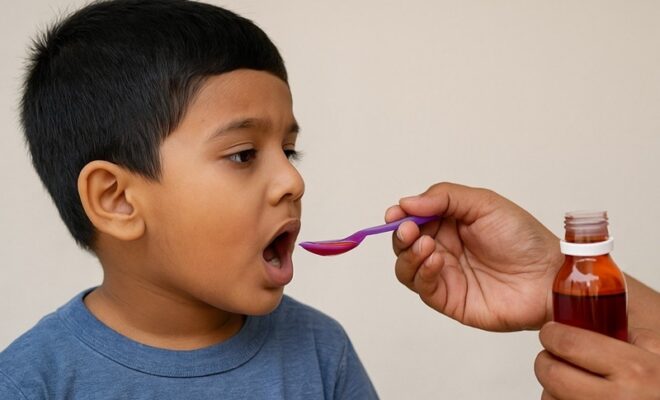
There has been increased regulation on the usage of cough syrups and other medicines for the children in India owing to issues regarding safety and rationale in using paediatric cough syrup. This particular regulation is extremely vital for the parents as there has been a clear mention of the age restriction on certain cough and cold medicines.
For the parents it should be known that not all cough syrups are prohibited and there are certain restrictions in using them and giving cough medicines to children without medical consultation is not recommended. Also it has been said by the government that not all childhood coughs need treatment.
What Is the New Warning for Children?
The Ministry of Health and Family Welfare placed restrictions on all fixed-dose combinations containing Chlorpheniramine Maleate and Phenylephrine Hydrochloride on August 22, 2026. It has become mandatory for the manufacturer to put a warning label saying that this combination “shall not be used in children below four years of age.”
This must be done on the label, package insert, and promotional material for the drug. This is based on the recommendation made by the expert committee and Drugs Technical Advisory Board that this combination poses certain risks to children below four years of age and safer alternatives are available.
Why is the Government So Concerned with Cough Syrup for Children?
A particular caution must be exercised while giving cough syrup to children as they have different body responses from adults towards medicines. The Health Ministry had recommended in the past to the states and healthcare institutions to make sure that paediatric cough syrups are rationally utilized as many coughs in childhood are self-limiting and do not need any pharmacological intervention.
What Happened With Cough Syrup Safety in India?
This reemergence of cough syrup in pediatric health concerns has been occasioned by the outcry from 2025 following cases of child deaths in Chhindwara district of Madhya Pradesh, reported to be due to consumption of cough syrup laced with contaminants.
The Health Ministry reported that tests of the samples were done by the central and state authorities. In those tested samples, Coldrif formulation had diethylene glycol in excess of permissible limit, upon which regulatory actions were taken against the company. Increased scrutiny and testing of cough syrup producers followed this.
It appears this event drew more attention to the quality and manufacturing of cough syrup and not a general perception that cough syrup is harmful per se.
Indian Govt Has Restricted Sale of Cough Syrup
There have been other regulatory changes apart from those related to particular formulations of cough syrup. On June 2026, the Health Ministry made a statement that the exemption provided to certain cough syrup so that their sale would not be subject to licensing requirements applicable to the sale of drugs was revoked.
This will mean that cough syrup formulations in question will henceforth be sold and dispensed from pharmacies licensed for retail sale.
What Should Parents Check Before Giving a Cough Syrup?
Parental judgment must first be guided by the composition and age-specific recommendations of the drug before assuming that any medicine formulated for cough and cold is right for the child.
The recent government warning relates to fixed-dose combinations involving chlorpheniramine maleate and phenylephrine hydrochloride in children under four years old. It must not be assumed that all cough medicines cannot be administered to children.
It is up to a paediatrician or other healthcare provider to determine the suitability of any medication depending on the age, symptoms and other considerations of the child.
Why Is Self-Medication Dangerous?
One typical problem involves giving the child adult medicine for cough or cold but in reduced quantity. This is dangerous since reducing the dose does not imply making it safe for the child.
Multiple active ingredients used in combination medicines can complicate matters by making it harder to decide whether the child is taking too much medicine.
Rational use of cough syrups in children was explicitly mentioned by the Health Ministry in its previous advisory.
What Is the Government Doing to Improve Medicine Safety?
The government has also emphasized increased inspections, audits, and market surveillance by drug regulators. Over 1,100 producers of cough syrup have been subjected to extensive audits, and the number of samples taken from syrup preparations by regulators has increased.
Such measures are aimed at detecting manufacturing flaws, improving quality control and ensuring that the medicine that reaches customers meets the necessary requirements.
The wider strategy of regulation has also included better supervision of pharmacies and producers, which demonstrates the commitment of the government to regulating the quality and appropriate use of medicines.
What Parents Need to Do Right Now
It is important for parents not to panic and stop prescribed medicines without consulting a doctor. However, it is crucial not to give children cough or cold medicines based on old prescriptions, recommendations, or the belief that an adult dose is appropriate at a reduced dose.
If a child has a cough, parents need to consider the child’s age and general condition. Additional attention needs to be paid to severe and persistent symptoms as well as those associated with difficulty breathing, unusual sleepiness, dehydration, and other worrying symptoms.
Conclusion
These new measures by India can be seen as part of its attempts to regulate paediatric medicines. The most detailed new warning is for the fixed dose combination drugs that have chlorpheniramine maleate and phenylephrine hydrochloride. According to the government of India, these should not be given to children under four years old.
In addition, the government has stepped up the control of sale of cough syrups and the rational prescription of them. In simple terms, the new warning means that coughing is not always an indication for medication and you should not give medicines to your child on your own.
It should be noted that this new warning does not mean that all children’s cough syrups are prohibited in India.
AI Meets Healthcare: Discover India’s Next Medical Revolution
How Is Voice AI Transforming Healthcare?
Check out how voice AI pilots are improving healthcare and citizen services in Karnataka.
Where Will New ESIC Facilities Open?
Find out how seven new ESIC healthcare facilities could strengthen India’s medical infrastructure.
Why Is India Facing Worker Shortages?
Uncover how frontline healthcare worker shortages are challenging India amid rising COVID-19 cases.
Can AI Doctors Transform Indian Healthcare?
Explore how AI doctors could reshape medical care from emergency response to smarter treatment.
Can AI Reduce Doctor Burnout?
Reveal how artificial intelligence is helping ease workload pressures across India’s healthcare system.