
Jharkhand Students Protest Today: Why Thousands Are Marching to the Assembly Over JPSC-JSSC Exam Row
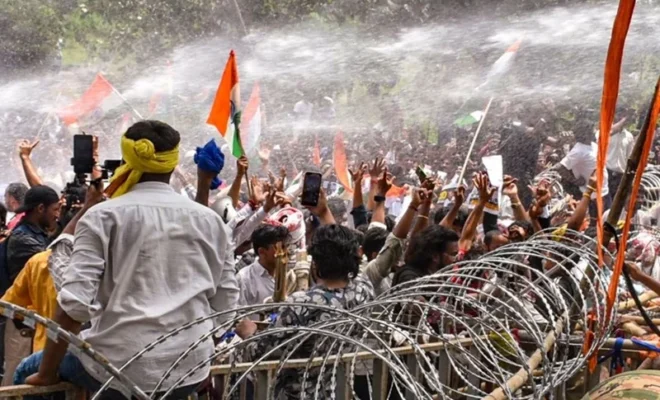
A new chapter in the recruitment examination controversy in Jharkhand has begun on August 10, 2026, when thousands of students and government job seekers started marching toward the state Assembly at Ranchi, demanding action on the issue of irregularities in the examinations that had been conducted by the Jharkhand Public Service Commission (JPSC) and Jharkhand Staff Selection Commission (JSSC).
This ongoing protest movement, now in its 17th day, has gained momentum after all the talks between student leaders and the state government proved fruitless. On Monday, the protesters violated the police barricades during the planned Gherao Vidhan Sabha, forcing the police to resort to water cannons and lathicharge.
What makes this student movement different from others is the involvement of several high-profile individuals in the controversy – resignation of JPSC members, arrest warrant issued against the former JPSC chairman, ED financial probe into the matter, and a continuing hunger strike by student leader Devendra Nath Mahto.
Why Are Jharkhand Students Protesting?
In fact, all the agitation revolves around charges of irregularities and lack of transparency in the conduct of recruitment examinations held by JPSC and JSSC.
The protesters are asking for cancellation of those exams which were reportedly manipulated or investigated. In addition, they want some changes in the recruitment process and an inquiry regarding the alleged irregularities.
In particular, the controversy gained more momentum during the 14th JPSC Civil Services Preliminary Examination. It should be noted that the scandal has resulted in a CID inquiry, searches at the JPSC office and the arrests of a number of persons involved in the exam process. There have been delays in a number of JPSC examinations due to the scandal.
However, for the protesters the scandal is not limited to the results of just one exam. The demonstrators want the recruitment process to be open and trustworthy.
Why Did Today’s Assembly March Become a Flashpoint?
The students had intended to protest at the Jharkhand Assembly following the failure of discussions with the government officials in addressing their grievances.
As per reports, discussions had taken place in three different phases but failed to arrive at an agreement acceptable to the agitating aspirants. In the discussions, the government had made some proposals that include an ED probe and the formation of a fast track court and preparation of chargesheets within 90 days in cases related to examination irregularity. Protesters on the other hand insisted for CBI enquiry.
Prior to Monday’s protest, prohibitory orders had been declared in the vicinity of the Assembly, heavy security had been made and barricades and razor wire fencing had been erected on sensitive areas.
Despite all this, thousands of students had gathered and marched toward the Jharkhand Assembly. Following the breach of barricades by groups in the crowd, water cannons and later lathi charge was used by the police.
Devendra Nath Mahto Becomes the Face of the Agitation
One of the prominent figures of this movement includes student activist Devendra Nath Mahto, who is currently on an indefinite hunger strike.
It has been reported that Mahto attended the Assembly march on Monday in an ambulance after losing nearly 10.5 kg weight owing to his nine-day hunger strike. In spite of his weak health, he has said that the future of the students is more important for him than anything else.
With his presence in the march, there is an addition of emotional element in the movement. Mahto has requested Chief Minister Hemant Soren to refrain from using heavy-handed approach of police and not to reach to a stage where there may be some sort of violence.
What Has Happened Inside JPSC?
There have been some major developments within the commission due to the controversy.
Governor of Jharkhand, Santosh Kumar Gangwar accepted the resignations of three members of the JPSC namely Ajita Bhattacharya, Anima Hansda and Jamal Ahmed on August 9 after a recommendation by the state government.
This development came at a time when the issue of recruitment examinations became very controversial and prior to the Assembly march planned by the students.
In addition to the three members, chairman of JPSC L. Khiangte had also resigned due to raids by the CID in relation to the examination controversy. L.Khiangte had stated that he resigned voluntarily to allow the investigations to take place without raising any doubts about interference with evidence.
CID Investigation Adds Another Layer to the Crisis
The problem with the exam is not confined to demonstrations and political accusations alone. The investigating authorities are also probing into the issue.
Jharkhand CID has carried out raids at JPSC offices and locations connected with the agency that had been conducting the exams. Some recruitment papers and OMR sheets, along with other pieces of evidence, have been seized and a number of persons have been arrested in connection with the case.
L. Khiangte, the former JPSC chairman, had been interrogated by the CID for hours in July. It has been reported that the investigation had been looking into various aspects of the exam process, one being the functioning of the exam agency itself and the recruitment process.
ED Also Enters the Picture
The dispute has now gone well beyond the examination procedure itself.
The Enforcement Directorate has filed an ECIR to look into the financial aspect of any irregularity that is allegedly associated with the JPSC examinations. It is looking into whether there was any financial transaction or any money trail involved in the alleged irregularity of the recruitment procedure.
This is important because while the investigators are investigating the irregularities of the examination procedures, they are also investigating any financial transactions associated with the alleged irregularities.
The investigation by the ED is still ongoing, and any allegation cannot be considered as a fact at the moment.
Why Students Are Demanding a CBI Probe
Demand for an investigation by CBI has become one of the most important aspects of the agitation.
Students have said that since there is a case of fraud in admission tests and some arrests and resignations have also taken place, they would like an investigation by a central body, which will offer more assurance.
On the other hand, the government has relied on other methods of investigations, such as the ED probe and the fast track court. This disagreement in approach has been one of the key factors responsible for the deadlock.
Political Parties Enter the Protest
Student protests have also gained the interest of the political class.
Leaders from BJP in Jharkhand have supported the demand made by the students for a CBI inquiry. On Monday, BJP leaders such as the former Chief Minister Babulal Marandi and President of BJP in the state Aditya Sahu held a protest outside the residence of Chief Minister Hemant Soren and were arrested, as per reports.
BJP leaders have alleged that the state government failed to deal with the demands made by the students.
On the contrary, Congress leaders and others have accused BJP leaders of trying to make political gains from the protests made by the students, saying that most of the demands have been answered by the government.
This is yet another dimension to an agitation which started as one concerning recruitment and exams.
What Happened During Today’s Protest?
The protest march on Monday took an increasingly heated turn once the protesters began reaching the barricades set up by the police in the area surrounding the Assembly.
Video clips which emerged from Ranchi depicted the students getting water cannons directed at them as they tried moving past security barricades. Lathi charge was also employed in controlling some parts of the crowd. In one incident, the students started dancing and chanting slogans in response to the water cannons.
In one particularly symbolic action, there is also video footage of a student protestor dressed up like Spiderman asking the question as to why the government does not listen to the students.
Stay informed with the latest political developments, election debates, governance updates, and national security stories shaping India today.
How To Download Admit Card?
Check out the simple steps to access your UPSC CSE Prelims 2026 hall ticket online.
Why Was Hemant Soren Arrested?
Find the key details behind Hemant Soren’s arrest and Champai Soren’s swearing-in as Jharkhand CM.
What Sparked Delimitation Report Criticism?
Uncover why political parties strongly opposed the J&K Delimitation Commission’s draft report.
Why Criminal Candidates Still Contest?
Look into how Bihar polls revived concerns over parties ignoring Supreme Court directions on candidates.
What Triggered Missile Inquiry Decision?
Dive into the reasons behind India’s decision to launch a high-level probe into the misfired missile incident.
What Happens Next?
The first task of the Jharkhand government is to ensure that the situation does not escalate into a protracted law-and-order issue, while also looking into the legitimate grievances raised by the students.
The students have made it clear that they will keep agitating unless there are some concrete assurances. In fact, Mahto has gone on record saying that his hunger strike will not be stopped by any police bans or the march to the Assembly building.
In all likelihood, the CID and ED investigations may assume more significance in validating the accusations leveled against individuals or institutions.
But, in case of thousands of aspirants, the real issue is simple: Can they believe in the recruitment process of the state.
Conclusion
The protests by the Jharkhand students are no more confined only to the individual results of the examinations. The issue of allegations of irregularities in recruitment, delay in conduct of several examinations, investigations, arrests, and resignations within the JPSC, together with the increasingly aggressive march of the students in the Assembly, have made it a big test of the credibility of the recruitment process in the state.
While today’s clash involving water cannons and lathi charge is putting the entire matter in the political limelight, it still essentially revolves around examination, accountability, and the future of thousands of young hopefuls.
With the investigations still on and the students not giving up their agitation, the next few days could decide if both the government and the protesters arrive at a compromise or if the situation deteriorates further.