
Protecting India’s Poultry Backbone: Why Indigenous Biotech Matters for Rural Livelihoods
The poultry industry of India is not just an industry that provides inexpensive eggs and meat but plays an important role in livelihood creation, entrepreneurship, and food security. Poultry farming is practiced extensively from individual backyard poultry production to large commercial poultry farms, providing employment opportunities to millions of people in the country. Yet, recurrent outbreaks of diseases such as Highly Pathogenic Avian Influenza (HPAI), popularly known as bird flu, are always posing threats to the industry.
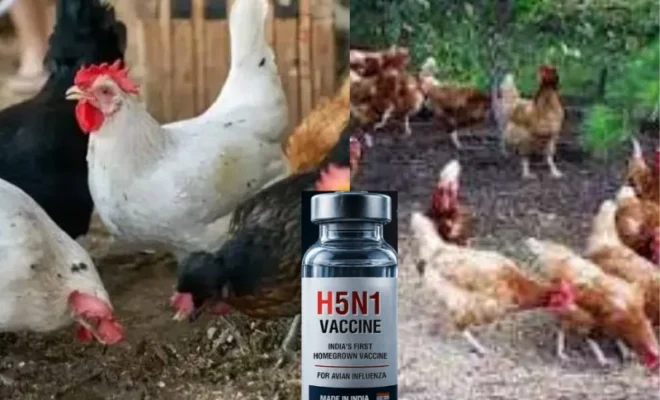
The development of a novel vaccine against H5N1 chicken influenza virus by Indian scientists of ICAR-NIHSAD is one important step taken to meet the threat. The developed vaccine is capable of providing protection against H5N1 virus strain of Clade 2.3.2.1a and its introduction has revealed the need for developing domestic biotechnology capacity in India.
Poultry Farming Is the Backbone of Rural Livelihoods
Poultry farming has emerged as a significant source of additional or primary income generation for families living in rural areas. In contrast to various other farming enterprises, the activity of poultry farming does not require much land and generates regular income from the sale of eggs and meat.
Small and marginal farmers, women entrepreneurs through self-help groups, and rural entrepreneurs can diversify income sources through backyard poultry farming. Besides generating income, commercial poultry farms provide employment in the sectors of feed manufacture, transportation, veterinary services, and distribution and processing.
The industry is contributing significantly towards nutritional security in India by providing access to animal protein for the masses. Any disruption in the activity of poultry farming will have a wider impact beyond the farmers themselves.
Bird Flu Outbreaks Expose the Industry’s Vulnerabilities
HPAI is still one of the greatest disease risks for poultry producers. The H5N1 virus spreads quickly among the susceptible birds and causes very high mortality.
A disease outbreak results in the introduction of measures restricting movement of people and animals, quarantining of the infected sites, and the destruction of huge numbers of birds in order to curb the spread of the disease. This causes great losses for poultry producers, as they lose their flocks within a short time.
These losses extend far beyond the death of birds, as they result in cancellations of orders, disruption of transport services, low demand on the market, and inability to find new sources of financing. Poultry producers who lack sufficient resources are at an even greater risk.
This problem aggravates if several disease outbreaks take place among different production clusters.
Why Indigenous Biotechnology Matters
The indigenous H5N1 vaccine of India is significant in decreasing the dependence of Indian population on external disease control measures.
Virus mutates, and efficacy of vaccine also depends on compatibility of vaccine with existing strain. Vaccine development for virus strains that are prevalent in the local area would enable scientists to take care of particular diseases prevailing among Indian livestock.
There are also other benefits of conducting domestic researches that go beyond vaccine development. They could help in faster scientific reactions, improve disease surveillance and foster cooperation among research organizations, veterinary colleges and pharmaceuticals.
Most importantly, development through biotechnology makes it possible for India to find answers in accordance with agricultural conditions, livestock patterns and disease surveillance requirements.
However, creation of the vaccine is just the beginning. Its effectiveness, regulation, cost and distribution would actually determine the outcome.
Bridging the Gap Between Research and Rural Farms
One of the biggest problems faced in the Indian agricultural biotechnology environment is the delivery of innovations to farmers.
Commercially large-scale poultry enterprises could possibly get access to veterinarians, organized vaccination programs, and disease monitoring. Small-scale farmers, especially operating from villages far off from the city, find difficulty in availing of these services.
Hence, for the launch of this indigenous vaccine, the availability of veterinary facilities and awareness programs becomes necessary.
The animal husbandry departments of state governments, veterinary institutes, poultry organizations and cooperatives can be instrumental in helping farmers understand the importance of vaccination programs, symptoms of disease and bio-security measures.
Affordable availability would also be critical. If vaccination programs turn out to be too costly for small-scale farmers, the advantages of scientific innovation might continue to benefit commercial farms alone.
Biotechnology Must Complement Strong Biosecurity
In addition to vaccination, other measures need to be adopted to manage and prevent the disease. There is a need to ensure that poultry farms practice hygiene by monitoring the health of birds and restricting movements of people and equipment unnecessarily, as well as enhancing testing laboratories and ensuring proper communications between veterinarians and farmers.
India requires a disease-prevention system which integrates the research laboratories with the veterinarian systems in different areas to prevent localized diseases from becoming outbreaks.
Building a Resilient Poultry Economy
Apart from increasing production, the Indian poultry industry should be able to sustain itself through science, affordable veterinary support, and indigenous research capabilities.
Indigenous H5N1 vaccine is an example of how biotechnology can overcome challenges in agriculture and rural development. The significance of the case study goes beyond this, in showing how investment in indigenous scientific solutions can yield fruit.
In essence, the safety of the poultry industry is also the safety of the farmers, rural entrepreneurs, and rural economy which depends on this industry. Biotechnology can help to some extent, but the effectiveness of its use would depend on how effectively the innovation would reach the grassroots.
It is time for India to move towards affordable safety and economic empowerment of its rural economy through science and innovation.
National Security, Democracy, Metro Connectivity, Global Politics & Space Exploration
Why Has the NIA Invoked the Anti-Hijacking Act Against the Omani Pilot?
Explore the allegations involving the Omani pilot and Captain Smit Machchhar, understand the legal provisions invoked by the NIA, and discover the significance of the investigation.
What Does Delhi’s Mass Mobilisation Mean for Democracy and Dissent?
Explore the debate around public mobilisation and state response, understand the role of peaceful dissent, and discover what this moment could mean for democratic participation.
What Changes With the New Chennai Metro Vadapalani–Poonamallee Stretch?
Discover the newly inaugurated metro connection, explore the updated transit routes and timings, and understand how the extension could improve connectivity across Chennai.
Why Has Donald Trump Called Iran a ‘Failed Nation’?
Explore Trump’s latest remarks on Iran, understand his demand for international war crimes trials, and discover the diplomatic and geopolitical issues surrounding the statement.
What Is Next for ISRO’s Upcoming Deep Space Mission?
Discover the announced mission timeline, explore the planned payload specifications, and understand how the upcoming project could advance India’s deep-space exploration capabilities.