12 Cities in India with Rich Colonial Architecture
India is incredibly diverse in its culture and traditions. This diversity extends into the realm of architecture as well. Over the years, the country has preserved its grip on its culture, which has led to its rich architectural heritage and continues to attract global attention in Latest travel news.
India has endured a long history of invasions and colonisation by various external powers. The journey has led to some great additions to the built environment of our country. Every invasion left its imprint on some part of the country by influencing the architecture of the region. The Mughal architecture, for example, can be seen extensively in parts of Delhi, Agra, Rajasthan, and many other Indian Cities where there was a siege of the Mughal Empire, making them top Places to Visit in India.
Similarly, British colonisation led to advancements in the country’s systems. They bought their inventions and architecture for their colonies. Mumbai’s Victorian-Gothic style or Kolkata’s revival-style architecture stands as living proof of the fantastic contributions to this country’s architecture, much like modern Tourist Attractions in Pune that blend heritage with contemporary design.
Here is an overview of 12 cities in India with rich colonial architecture.
Jaisalmer
Jaisalmer, in Rajasthan, is the golden fortress town rising from the Thar Desert. The historic architecture of the region is a blend of Mughal and vernacular Rajasthan architecture. Richly sculptured structures adorned in local sandstone are seen in this marvellous town.
The architecture has numerous peculiar elements that are unique to the state of Rajasthan. Grand courtyard houses such as havelis with ornate balconies called “jharokhas” and the umbrella-shaped cupolas called “chhatris” are a few defining features of the architectural style seen here. The indigenous architecture here possesses several climate-responsive qualities.
There are many temples, palaces, and monuments worth visiting here. A few of the most famous architectural attractions include the Jaisalmer fort, Jain temples, Patwon ki Haveli, and Bada Bagh.
Jaipur: Pink City of India
The pink city of India, Jaipur, has perhaps the most flamboyant architecture. Its splendid historic buildingscape has several monuments, palaces, squares, and gardens of the Indo-Saracenic style. The city has had a glorious past, and its architecture carries glimpses of the same.
It is one of the oldest planned Indian cities and has a blend of traditional and contemporary structures. Jali-patterned walls, jharokhas, and chattris are typical architectural elements. Hawa Mahal is the most popular attraction in the city. The unique marvel is not only known for its exquisite facade but also for its engineering as per the Venturi effect. Visitors also often explore Restaurants in Jaipur nearby, which serve a mix of authentic Rajasthani flavors and modern cuisine.
Other famous monuments in the city include the Jal Mahal, which is one of the finest pieces of Rajput and Mughal architecture. Albert Hall is an architectural marvel and is also the oldest museum in the city.
The Amer Fort is a large fortification located at a distance of a few kilometres from the city. It has several richly ornate structures, and the Sheesh Mahal is one of the most popular attractions. A modern attraction in the city is the Jantar Mantar, an astronomical observatory.
Jodhpur: Blue City of India
Jodhpur is another incredible city in Rajasthan with great architecture. It is often called the Sun City or Blue City of India because of its blue and white buildingscape. The city exists in two parts: the old fortified town and the new city.
The strategic location of the city paved the way for its glorious past in ancient times. It was the nodal city between the west and the east. The city’s diverse monuments have significantly enriched the panorama of the country’s architecture.
The Umaid Bhawan Palace is one of the most famous attractions in the city. This Indo-Saracenic marvel has several exquisite features; it is elaborately ornate and has built-in Chittor sandstone. Other architectural attractions include the Mehrangarh Fort, which is a spectacular fort perched on a hill and has structures with distinct Bengaldar roofs. Jaswant Thanda Palace and the Balsamad Lake Palace are considered other popular tourist destinations.
Ahmedabad: Heritage City
The city of Ahmedabad located along the banks of the river Sabarmati, is a rich amalgamation of the ancient and the modern culture. It is the first Indian city to become a UNESCO World Heritage Site.
The buildingscape is a mix-bag of indigenous architecture that is heavily influenced by vernacular and Mughal styles, along with modern architecture. There are several mosques, temples, palaces, stepwells, and traditional pool houses that constitute the old part of the city. The newer structures include works by eminent modernist architects like Le Corbusier and Louis Kahn. Families exploring the city often combine visits to these landmarks with Family-Friendly Places in Ahmedabad, making it a complete cultural and leisure experience.
Sidi Sayyed Mosque, Jama Masjid, Sarkhej Roza, and Jhulta Minara are a few Islamic marvels of the city. The prominent modern structures include the Sabarmati Ashram, Mill Owner’s Building, Sarabhai residence, IIM Ahmedabad, Sanskar Kendra, etc. The latest addition to the list of attractions is the newly developed Sabarmati riverfront.
Varanasi: Oldest Living City
Situated along the banks of the holy river Ganga, Varanasi is the oldest living city in India. The magnificent ghats and temples define this holy city. There are over 88 ghats in this city, and it’s believed to be one of the holiest places on the planet. Visitors often enjoy the spiritual aura while also exploring Ganga View Restaurants in Varanasi, which add a modern charm to the city’s ancient setting.
Built in the ‘Nagara’ style of architecture, the city boasts over 23,000 temples and is thus the spiritual capital of the country. Among them, Kashi Vishwanath Temple is the most famous. This magnificent temple has several smaller shrines and is planned in a quadrangle shape.
The city also has numerous mosques built in typical Mughal architecture. Ramnagar Fort is also a famous example of Mughal architecture. The composite religious architecture of Varanasi portrays its plurality and diversity.
Mathura: Temple Town of North India
The pilgrimage town of Mathura positioned on the banks of the Yamuna, is located 15 km from Vrindavan. The city boasts hundreds of temples spread across the city, which is of great significance as it is the birthplace of Lord Krishna.
Banke Bihari temple, Govind Dev temple, Radha Vallabh temple, and Rangji temple are a few of the most well-known temples. Devotees from all over the country visit the place for its temples. The architectural style of these temples is a blend of Hindu and Mughal styles.
Banke Bihari temple is a magnificent temple with a massive footprint. It has all the elements of a Hindu temple: a front court, a courtyard, a garba griha, etc. It boasts superior, traditional stone masonry. Similarly, the Govind Dev temple is slightly influenced by the Mughal architectural style.
Agra: The City of Architectural Wonders
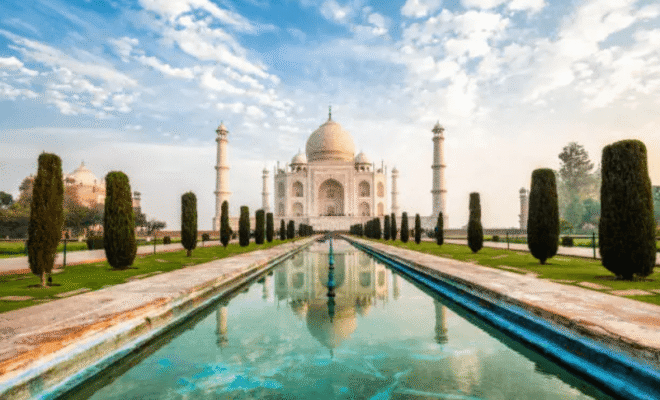
The city of Agra, home to one of the world’s seven wonders, is known for its historic architectural fabric. The city is one of the most visited places in the country, where people from all across the world come to see the mighty Taj Mahal. Many visitors also look for Taj Mahal View Restaurants in Agra, where they can enjoy the sight of this marvel while dining.
The monument is the epitome of architectural genius; its remarkable scale, form, intricate carvings, and surrounding landscape make this mausoleum out of this world. The city is also proud of its three UNESCO World Heritage Sites. The rich Mughal architecture adorns the city.
Agra Fort, or Lal Quila, and Fatehpur Sikri are the other two UNESCO sites. These structures built in red sandstone are a blend of Indian, Islamic, and Persian architectural styles. The Tomb of Itmad-ud-Daulah is also a significant Mughal monument that marked the beginning of a new era where Mughal buildings used marble.
Delhi: Capital City of India
Delhi, one of the oldest surviving cities in the world, is also the capital of India. Although the city has been the cradle of several civilisations, it reached its peak during the reign of the Mughals. It was initially developed in eight parts; the walled city of Shahjahanabad is the most significant of them all.
Jama Masjid, the Old Red Fort, or Purana Qila, and Humayun’s Tomb are a few of the most famous architectural works of the Mughal style in Delhi. The city particularly flourished during the British era, with Sir Edwin Lutyens’s design of the Capitol Complex and the central vista.
The plan of Lutyen’s Delhi has two major visual corridors, one with the Purana Qila and the other with Jama Masjid. Along the Purana Qila axis is the central vista that ends with the Viceregal Palace or the Parliament Building. The India Gate also lies on this same axis.
The structures around this are formally set up and borrow elements from the European, Indian, and Mughal styles of architecture. The architectural fabric of the city is gloriously rich and diverse.
Chandigarh: Planned Modern City
The city of Chandigarh, the joint capital of the states of Punjab and Haryana, is distinctly modern. Built after Independence, the city aimed to make a modernist statement, symbolising freedom and independence.
The city follows a strict rectilinear grid with rectangular, monolithic buildings. One of the greatest architects of the modern era, Le Corbusier laid out the masterplan of the city. The Capitol Complex with the Secretariat Building, the High Court Building, and the Palace of Assembly are noteworthy buildings.
The Brise soleil and the hand-like sculpture are two other structures that are also part of the Capitol Complex. The architectural language of Chandigarh has cues from Indian architecture blended with modern forms in concrete.
Hampi: Historic Town
Hampi, the once-forgotten historic town of Hampi in Karnataka is home to relics of the resplendent Vijayanagara style of architecture. It has over 1600 remains of forts, temples, palaces, mandapas, etc. that date back to 1336.
Even in its ruined state, the city has a unique charm. A few of the famous temples include the Vitthal Temple complex, the Krishna Temple complex, the Pattabhirama temple, and more such temples carved in sandstone.
Several pre-Vijayanagara temples consist of monolithic sculptures of gods and goddesses. Hampi has numerous structural ruins of Mughal architecture in the form of mosques, graves, and monuments. The city is a UNESCO World Heritage Site and is under the preservative care of the Architectural Survey of India.
Auroville: The Creative Township
Auroville in southern India is the centre of architectural innovation in India. With various experimental architectural works, this city is a hotbed of new-age sustainable innovations. Once a desert land, the city now thrives as a green pocket.
The city’s fabric flaunts vernacular houses with thatched roofs and Kahn-like modern sandstone houses. The architecture is centred on earth-based techniques and adopts several climate-friendly measures, like the use of solar panels.
Matrimandir Temple, Auroville Visitor Centre, Vikas Settlement, and Temple Tree Retreat are a few of the famous public buildings designed by eminent architects. The built environment of Auroville is vividly unique.
Kolkata: Port City
The port city of Kolkata flourished during the British era in the 18th century. Situated on the banks of the Hooghly River, the city has several architectural marvels and was historically divided into the White Town and the Black Town.
The architectural style is predominantly Neoclassical. It was an important cultural centre and, briefly, the capital of the British Empire. Victoria Memorial, William Fort, Writer’s Building, and High Court Building are a few of the popular monuments. These buildings are predominantly European, with cues from Islamic and Venetian architecture.
The traditional courtyard houses of the Bengali tradesmen are also spectacular architectural works. A few Art Deco and Art Nouveau-style buildings can also be seen in the city. Metro Cinema and Esplanade Mansion are a few popular examples of art deco buildings.
Here’s a neatly organized table highlighting 12 cities in India with rich colonial architecture, along with their key colonial influences and notable landmarks:
| City | Colonial Influence | Notable Colonial Architecture |
| Kolkata (West Bengal) | British | Victoria Memorial, Writers’ Building, St. Paul’s Cathedral |
| Mumbai (Maharashtra) | British | Chhatrapati Shivaji Maharaj Terminus, Gateway of India, Rajabai Clock Tower |
| Puducherry | French | French Quarter, Basilica of the Sacred Heart of Jesus, Aayi Mandapam |
| Chennai (Tamil Nadu) | British | Fort St. George, Madras High Court, Ripon Building |
| Goa (Panaji & Old Goa) | Portuguese | Basilica of Bom Jesus, Se Cathedral, Church of Our Lady of the Immaculate Conception |
| Delhi | British | Rashtrapati Bhavan, India Gate, Connaught Place |
| Shimla (Himachal Pradesh) | British | Viceregal Lodge, Christ Church, Gaiety Theatre |
| Lucknow (Uttar Pradesh) | British | Residency, La Martiniere College, Dilkusha Kothi |
| Darjeeling (West Bengal) | British | St. Andrew’s Church, Planters’ Clubs, Colonial schools (St. Paul’s, Loreto) |
| Thiruvananthapuram (Kerala) | British & Dutch | Napier Museum, Kanakakkunnu Palace, Kowdiar Palace |
| Chandannagar (West Bengal) | French | Chandannagar Strand, Sacred Heart Church, French Institute |
| Shillong (Meghalaya) | British | All Saints Cathedral, Shillong Club, Raj Bhavan |
Frequently Asked Questions
1. Which Indian city is considered the hub of British colonial architecture?
2. Are there any French colonial cities in India apart from Puducherry?
3. Which cities in India display Portuguese colonial architecture?
4. Why are hill stations like Shimla and Darjeeling included in colonial architecture lists?