Armoured Vehicles vs Main Battle Tanks: Know Key Differences
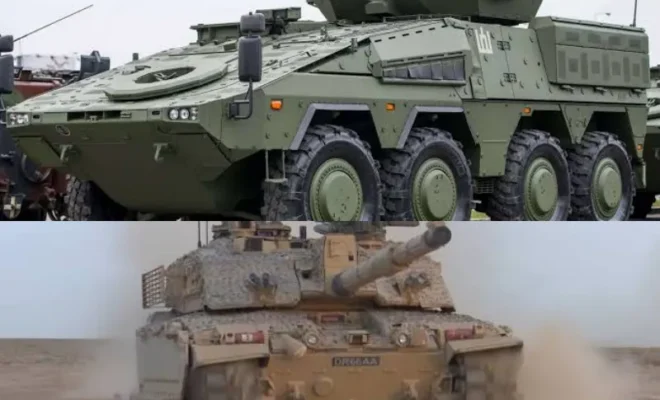
The phrase armoured vehicles vs main battle tanks points to a common confusion: every main battle tank is an armoured vehicle, but not every armoured vehicle is a tank. The difference is not simply size. It is what the machine is built to do- carry troops, gather information, support infantry or confront enemy armour directly.
What counts as an armoured vehicle?
The term armoured vehicle is used to refer to any military vehicle which is protected by armour. Some travel on wheels; others use tracks. An armoured personnel carrier (APC) is primarily an armoured vehicle used to transport troops and protect them from gunfire on the battlefield.
An IFV (Infantry Fighting Vehicle) is also a type of vehicle designed to transport troops, but it is also equipped with more powerful weapons to be used in combat. Reconnaissance vehicles provide troops with a view of and report on what is coming up. Not all of these vehicles are meant to engage enemy tanks head-on.
What makes a main battle tank different?
The design goals of a main battle tank (MBT) are three-fold: heavy armour, effective firepower and traversing difficult terrain. Typically, it will be equipped with tracks, thick armour, and a large main gun on a turret. In a NATO Special Operations Handbook, common tanks are defined as being 45 tonnes or heavier and armed with 100 – 125mm guns (which varies by country and type).
The Challenger 2 is a good example of the British Army. It has been reported that it has a 120mm main gun and a mass of 62.5 tonnes, with add-on armour modules bringing this to 75 tonnes. That weight is indicative of the amount of protection and equipment in a tank designed for high-intensity combat.
Firepower is only part of the picture
Tanks are primarily intended for close-range fire engagements with enemy tanks, fortified positions and other targets on the battlefield. It has tracks that enable it to cross rough terrain, and also has armour that provides greater protection than lighter vehicles. But nothing is impenetrable: above and beyond, mines and anti-tank can still be dangerous. Narrow roads, weak bridges or poor ground may also prohibit the use of heavy vehicles.
The British Army encapsulates the challenge of the design in three words: “firepower, mobility and protection.”
Why armies need both
An APC can carry troops and provide them with protection while moving to an area under armour; an IFV is able to carry troops and fight alongside them; and an MBT can bring heavy firepower against enemy armour and defended positions. They are best employed as part of a coordinated force and not as interchangeable machines.
The main thing to get readers of the conflict footage is that a large, armoured vehicle is not necessarily a tank. By its function, its armament, its ability to transport infantry, and its defense, one can deduce its purpose and the need for a variety of vehicles in an army.
Celebrity News, OTT Releases & Technology Updates
What Do We Know About Aamir Khan and Gauri Spratt’s Wedding?
Discover the reported wedding date, relationship updates, and everything revealed so far about the couple’s upcoming celebration.
When and Where Can You Watch Daadi Ki Shaadi Online?
Find out the OTT release details, streaming platform, and what to expect from Neetu Kapoor and Kapil Sharma’s comedy.
Why Has the Government Ordered the Chinese E-Rickshaw App’s Removal?
Explore how the app could reportedly stop e-rickshaws mid-ride, why authorities raised concerns, and what the removal order means for drivers.
When Will Hangman Release on OTT?
Discover the confirmed streaming platform, release date, and key details about Brahmaji’s mystery thriller.
What Can Fans Expect from Enola Holmes 3?
Explore the upcoming film’s cast, expected storyline, OTT release timeline, and where viewers may be able to stream it.