Beyond Oil Diplomacy: Why the UAE’s New Energy Doctrine Is Reshaping Global Conversations
Last updated on July 10th, 2026 at 11:13 am
Traditionally, for years, the UAE had been known as an oil producer with wealth coming from energy extraction being the key to the country’s success and progress in various aspects, from the creation of necessary infrastructure to the establishment of Abu Dhabi as an important player in the sphere of energy. Now, however, the UAE seems to want the rest of the world to see it differently.
In other words, the country positions itself more as a diverse nation whose global economy is based on trade, logistics, artificial intelligence, aviation, financial services, energy production, and strategic partnerships.
Given that the world’s economy now experiences significant shifts and efforts are made by many countries to build new economic realities despite their dependence on fossil fuels, this is indeed crucial for the UAE.
The UAE’s Transformation Beyond the “Oil State” Identity
The UAE has evolved in terms of economics past the stereotypical perception about countries that rely on Gulf hydrocarbons.
Currently, less than 25 percent of the GDP of the UAE can be attributed to revenue generated by oil. Though this remains the key source of economic stability for the region, other industries have taken the lead over the last two decades.
Logistics, international trade, aviation, tourism, IT, AI, and other sectors now characterize economic progress in the UAE.
Diversification into other sectors has not happened overnight. The country followed a state-oriented strategy which allowed the government to utilize hydrocarbon revenues to develop the necessary infrastructure, attract investment, build transport links and develop the UAE into an international trading hub.
The philosophy of former petroleum minister Mana Al Otaiba, according to whom oil was “a means to an end”. In fact, the UAE never intended to remain a country that would depend on hydrocarbons alone. Instead, it wanted to create the foundation of a modern knowledge economy.
The UAE now believes that this transition has reached a stage where old frameworks no longer fully reflect its modern economic structure.
Why the UAE Believes the Traditional OPEC Framework No Longer Fits
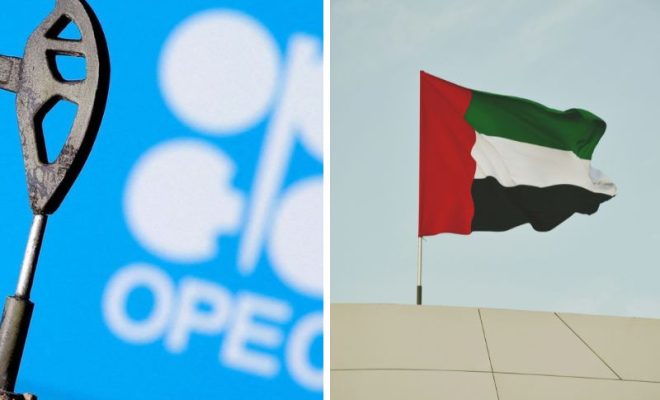
The UAE’s entry into OPEC years back was amid a much different structure of the international energy market, where the economies of the Gulf region were highly reliant on exporting crude oil, and production management would protect them economically and politically.
Nonetheless, according to the UAE, the present economy of the state is far from being characterized by these structures. Rather, the current focus of the UAE is on global integration, economic arrangements bilaterally, the reliability of supply chains, and forming strategic investment partnerships.
One can note the formation of Comprehensive Economic Partnership Agreements by the UAE with various nations, including India, South Korea, and other emerging markets.
Such an approach is based on the economic reality and no longer reflects efforts geared towards production management like it did several decades ago.
This is not to suggest the abandonment of energy cooperation; rather, the shift represents changing economic circumstances.
Energy Security as a Global Responsibility
It becomes more and more challenging to defend such decisions at times of global energy uncertainty, interruptions in energy supplies, and price volatility.
In terms of the UAE, it views itself as one of the countries that can help bring stability to the global energy market because it is a reliable exporter.
Countries producing energy, which are capable of increasing their energy output in times of insecurity, should be given more freedom.
It is particularly important against the backdrop of the current instability surrounding tanker routes, logistics, and energy infrastructures in the Gulf region.
Overall, the UAE considers itself a reliable provider of energy that invests in the development of its pipeline infrastructure to secure constant energy supplies.
Financing the Global Energy Transition
The importance is the rejection by the UAE of the simple dichotomy of “oil versus renewables.”
The UAE adopts a dual-track approach. According to the UAE, hydrocarbon funds need to be used in order to finance the shift to a more environmentally sustainable approach to energy generation.
As a result, this approach constitutes one of the main explanatory aspects of the campaign’s effectiveness since it does not paint hydrocarbons as something standing against the future, but rather as the funding required for the shift to the future.
Furthermore, the UAE has been making significant investments into renewables through companies like Masdar, conducting projects across several countries.
Moreover, the construction of the Barakah nuclear power plant indicates significant investment into the infrastructure required to produce other types of energy.
In parallel, ADNOC continues working on developing lower-carbon energy technologies and conducting projects related to energy transition.
Therefore, the UAE is aspiring to become a “total energy provider” in the sense of being able to supply conventional energy while investing in new technology.
Importantly, this message makes the UAE appear pragmatically motivated rather than ideologically driven.
Geopolitical Friction and Regional Stability
UAE brings up the problem of possible contradictions within the aim of maintaining market stability due to the instability of the Gulf energy infrastructure and transport routes.
The question becomes connected with the problem of attacks on tankers, tensions in the region, and danger to international routes of transportation of energy.
In contrast to a narrow focus on certain countries, it provides the general idea that energy security is intrinsically connected to geopolitical stability.
The United Arab Emirates strives to combine its energy strategy and its foreign policy based on the following elements: protection of trade and infrastructure, development of strategic relationships, and the economy.
There is an evident trend of change in terms of the UAE’s perception of itself on the international scene. Not being merely seen as a regionally-oriented oil producer anymore, the UAE considers itself a globally active economic entity.
Trending Now: Explore Today’s Biggest Headlines & Viral Stories
Explore Vijay’s Political Team Plans
Check the possible Tamil Nadu ministers and the latest buzz around Vijay’s V-Team blueprint.
Discover Salman’s Upcoming Superhero Film
Explore Raj & DK’s new project featuring Salman Khan and Kareena Kapoor together.
Check CUET UG Admit Card Updates
Discover the release date, download steps, and important CUET UG 2026 details.
Explore Virat Kohli’s Luxury Car Collection
Check how Virat Kohli’s premium cars reflect his passion and smart investments.
Discover R. B. Choudary’s Final Wish
Explore the emotional story behind the veteran producer’s last wish and legacy.
Why This Narrative Matters Beyond the Gulf
Rather, it is part of a worldwide discussion about how nations that produce hydrocarbons deal with the dual challenges of a new age, wherein both climate and energy pressures play a role.
Many economies are still relying on fossil fuels, even as they try to make rapid progress towards energy transition.
In the case of the UAE, the state is trying to straddle this paradox by asserting that transition and production go hand-in-hand.
This may be debatable among the critics; however, it clearly conveys how the UAE wants to project its image abroad in the future. There is no longer a need for a focus on oil resources.
Conclusion
The deeper message is that the UAE believes its economic evolution, global partnerships, and transition investments now require a different framework than the one that shaped Gulf energy politics decades ago.
By framing oil as “a means to an end,” the attempts to place the UAE’s hydrocarbon legacy within a much larger national transformation story. That transformation toward diversification, global integration, and energy-transition leadership is the narrative this campaign seeks to amplify.