
Microsoft Expands MAI Code-1 Flash Across More Copilot Surfaces: Features and Benefits Explained
Last updated on July 10th, 2026 at 11:37 am
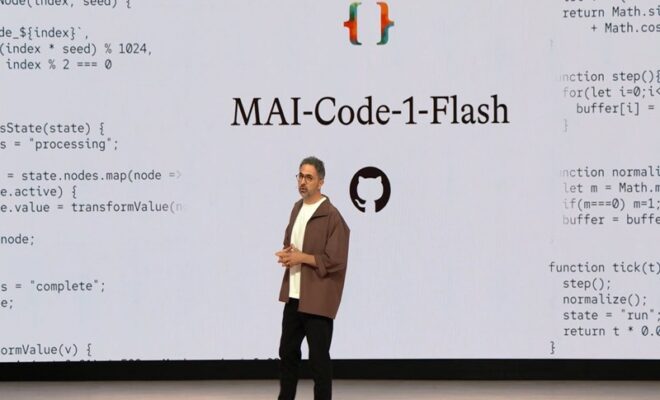
Microsoft is rolling out the MAI Code-1 Flash AI coding model more widely within Copilot as part of its overall efforts to enhance AI assistance in terms of speed, intelligence, and accessibility.
This development reflects Microsoft’s increased interest in developing AI models that will be capable of performing coding functions in an efficient way but using fewer computing resources. In contrast to large and resource-heavy AI models, this new development represents fast AI models that aim at delivering AI assistance in real-time.
The development should benefit software developers and programmers who have been using Copilot.
What Is MAI Code-1 Flash?
Code-1 Flash is an artificial intelligence model created by Microsoft that is meant to facilitate coding tasks inside the Copilot services.
The difference between Code-1 Flash models and other language models is in the purpose of these models – they are intended to work fast and be responsive. The model is capable of understanding coding context, generating code, explaining coding language syntax and helping with debugging without spending too many computing resources on it.
For Microsoft, the key advantage of this model is speed.
What Does “Expanding Across More Copilot Surfaces” Mean?
By referring to Microsoft’s plans to bring MAI Code-1 Flash to more Copilot surfaces, it becomes apparent that the AI system will be incorporated into various AI-based products offered by Microsoft rather than being limited to a single product.
This depends on the type of product and could mean that users will meet the AI system in coding environments, developer products, business productivity software, and other services powered by Copilot where coding support is needed.
Key Features of MAI Code-1 Flash
A significant advantage of MAI Code-1 Flash is its fast performance.
The model was designed to give coding suggestions with reduced latency to help developers keep working on their projects without having to wait. Fast responses would be particularly helpful while debugging code, suggesting autocompletion, and performing iterative coding.
Other capabilities of the model include code generation, explanations of programming concepts, syntax, and intelligent code completion.
Given the high level of efficiency of the model, Microsoft is confident that it will provide a better user experience even in common development activities when large AI models are not needed.
Benefits for Developers
The group that is likely to benefit the most from the new extension by Microsoft will be developers.
With the faster response time, the suggestion would come in virtually in an instant as one writes the codes, hence no interruption in programming.
Fast feedback from AI can make coding more productive since it can help one detect syntax error, explain unknown function, generate sample code, and even optimize.
As such, developers interact with AI multiple times as they write codes.
Benefits Beyond Professional Programmers
The upgrade can be used by both proficient software engineers.
However, students studying programming, novice coders, teachers, data analysts, and IT workers can also find MAI Code-1 Flash beneficial.
Such a system can easily describe the code using layman’s terms, provide recommendations on how to improve code, and increase knowledge about programming.
It makes AI-assisted programming more accessible to beginners.
Why Microsoft Is Using Smaller AI Models
One of the most notable emerging trends of artificial intelligence at present is the trend of going for small models.
Big AI models are still highly versatile, but at the same time, they demand a lot of computational power and take quite some time to respond to requests.
With focused models such as MAI Code-1 Flash, it will be possible to deliver increased efficiency for coding purposes without the need for more expensive hardware setups.
Another advantage of doing so will be the ability to choose the right model according to users’ needs.
How This Strengthens Microsoft’s AI Strategy
Microsoft has made considerable efforts to incorporate AI into Windows, Microsoft 365, Azure, GitHub, and other enterprise offerings.
Increasing the scope of MAI Code-1 Flash is consistent with Microsoft’s approach to incorporating specialized AI models in various workflows rather than confining them within chat interfaces alone.
With Copilot becoming an integral part of Microsoft’s software offerings, it is crucial to have lightweight models such as Flash for providing efficient assistance to the user.
What Users Can Expect Going Forward
As Copilot is further developed by Microsoft, the AI will have even more task-based models for writing, coding, productivity, researching, and conducting business tasks.
Instead of having a universal AI assistant, it would make sense to develop multiple AI assistants that work in tandem.
It seems like MAI Code-1 Flash might be an example of such an approach.
Trending Stories You Shouldn’t Miss Today
1. What’s New About Diljit’s Ranna Ch Dhanna?
Explore the release date, cast, story details, and latest updates about Diljit Dosanjh’s upcoming movie.
2. How Did CBI Crack Scam Network?
Discover the nationwide CBI raids, digital arrest scam details, and safety measures everyone should know.
3. Which Documents Prove Indian Citizenship?
Check the mandatory documents and new 2026 rules related to citizenship proof and passport validity.
4. How Did AI Reject UPSC Candidates?
Explore how AI technology flagged 569 candidates and what happened during the UPSC 2026 prelims process.
5. Why Is Vaibhav Sooryavanshi Restricted?
Discover the reason behind the young cricket prodigy’s ban from the senior Indian changing room.
Conclusion
The fact that Microsoft is expanding MAI Code-1 Flash within more Copilot experiences shows that the need for faster and efficient AI models becomes increasingly important today.
As the company seeks to boost the efficiency of software engineers with speed and coding support, AI-powered coding looks to become more available.
The future of AI coding might not be only about larger models; it could be about smarter and faster models, such as MAI Code-1 Flash.