
What Is WOH G64? Inside the Evolution of a Massive Red Supergiant Star

The WOH G64 star is one of the most fascinating objects studied by astronomers. Located in the Large Magellanic Cloud, a neighboring galaxy to the Milky Way, this enormous celestial body belongs to a class of stars known as red supergiants some of the largest stars in the universe.
Scientists have been studying WOH G64 for decades to better understand how massive stars evolve and what happens during the final stages of their life cycle.
Where Is WOH G64 Located?
The Large Magellanic Cloud star WOH G64 lies about 160,000 light-years away from Earth. The Large Magellanic Cloud is a satellite galaxy orbiting the Milky Way and contains many massive stars that help astronomers study stellar formation and evolution.
Because WOH G64 is outside our galaxy, it offers scientists a unique opportunity to observe stellar behavior in a different cosmic environment.
Why WOH G64 Is So Unique
The red supergiant star WOH G64 is remarkable because of its enormous size. Astronomers estimate that if this star replaced the Sun at the center of our solar system, its outer layers could extend beyond the orbit of Jupiter.
The immense size makes the WOH G64 size comparison one of the most dramatic examples used to illustrate how large red supergiants can become.
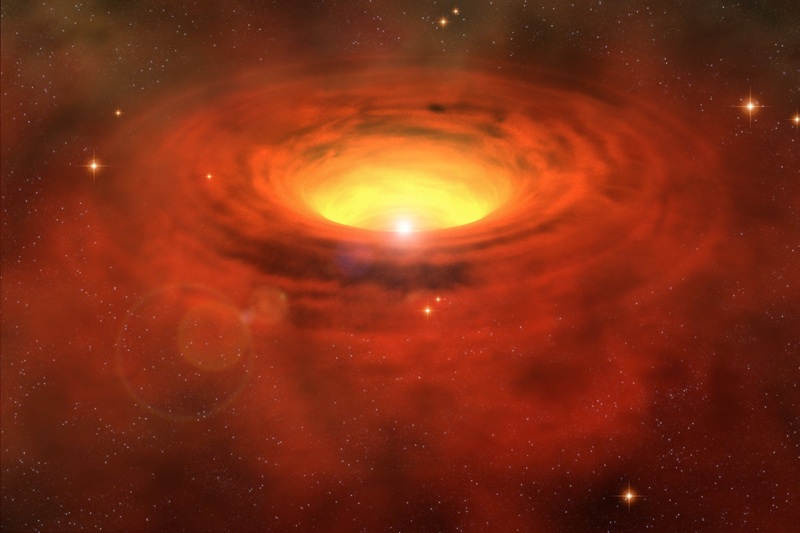
In addition to its size, WOH G64 is surrounded by a thick cloud of gas and dust created by powerful stellar winds, which are common in stars nearing the end of their lives.
Understanding Massive Star Evolution
The study of massive star evolution astronomy helps scientists understand how stars much larger than the Sun live and die.
Stars like WOH G64 begin their lives by burning hydrogen in their cores. As they age, they expand into red supergiants, dramatically increasing in size while cooling at the surface. Eventually, such stars are expected to end their lives in spectacular supernova explosions.
WOH G64 is believed to be in one of the final stages of this process, making it an important subject for astrophysical research.
Why Astronomers Continue Studying WOH G64
The WOH G64 star provides valuable insights into stellar physics. Its unusual structure, massive size, and surrounding dust envelope help researchers test models of how giant stars lose mass before collapsing.
Observations from modern telescopes and space observatories continue to reveal new details about this extraordinary star.
Epilogue: A Giant Nearing the End of Its Life
The red supergiant star WOH G64 stands as a powerful reminder of the immense scale and complexity of the universe. As astronomers continue to observe this massive star in the Large Magellanic Cloud, it may one day provide clues about the dramatic supernova events that mark the final chapter of the universe’s most colossal stars.
FAQs
1. What is the WOH G64 star?
The WOH G64 star is a massive red supergiant located in the Large Magellanic Cloud, known for its enormous size and advanced stage of stellar evolution.
2. How big is WOH G64 compared to the Sun?
The WOH G64 size comparison suggests that the star could extend beyond Jupiter’s orbit if placed at the center of our solar system.
3. Where is WOH G64 located?
The Large Magellanic Cloud star WOH G64 is about 160,000 light-years away from Earth.
4. What will happen to WOH G64 in the future?
According to massive star evolution astronomy, the star may eventually explode as a supernova once it reaches the end of its life cycle.