
Surya Kant Becomes India’s 53rd Chief Justice: Key Highlights and What to Expect
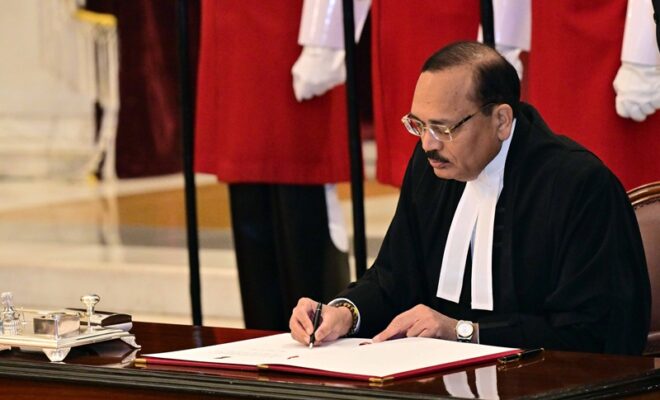
Justice Surya Kant has formally been sworn in as the 53rd Chief Justice of India (CJI), marking a significant occasion for both the judiciary and a noteworthy vantage point for him and his extraordinary professional journey. His selection is a tribute to his longstanding, extensive judicial background, his well-earned reputation for fairness and respect for constitutional principles, and successful navigation of this country’s judicial landscape. He assumes the role at a moment when the Indian judicial system faces multi-layered social and political complexities, and observers await his leadership at the Supreme Court in the coming months.
A Journey of Grit and Steady Progress
Justice Surya Kant’s story is also one of steady progress. He hails from Petwar village in the Hisar district of Haryana, and it is a humble background steeped in strong family values that has contributed to his down-to-earth persona. Over time, Justice Surya Kant has constructed his legal profession as a career that ranges from being an advocate in the various courts in Haryana.
His judicial trajectory has included time on the bench as a judge of the Punjab and Haryana High Court, and more recently on the bench as Chief Justice of the Himachal Pradesh High Court (2018). He became the Supreme Court of India justice from May 2019. He has built a reputation as a thoughtful and considerate judge.
Significant Judgments & His Judicial Philosophy
Justice Kant is known for placing a considerable amount of weight on fairness, transparency, and constitutional morality. He has served on the Supreme Court in a variety of benches that heard some of the most sensitive and impactful cases in recent years.
- Article 370: Justice Kant participated in decisive hearings concerning the special status of Jammu & Kashmir.
- Pegasus Surveillance Case: Justice Kant asked important questions about privacy, accountability and uses of state power.
- Electoral Reforms: He has supported transparency finding its way into electoral rolls and has argued for proper safeguards to ensure clean, verified and accurate voter data.
- Sedition Law: He has questioned the unbridled use of the sedition provisions embodied in colonial law and advocated for the use of a rights frame.
- Gender Justice: Among his decisions was supporting the reinstatement of women leaders who were removed from office unjustly and promoting gender diverse representation in the legal profession.
- Social Welfare Cases: He has also ruled on pension rights, including advocating for protections around the One Rank One Pension scheme.
These judgments reflect his belief that justice must be within the reach of every person – not just privileged people, but average citizens whose stakes in the appropriate interpretation of the law hang in the balance.
What His Leadership Means for India
Surya Kant’s appointment has been perceived as an inspiration and important development. His rural background embodies the possibility of merit-based rise in the Indian judiciary. Surya Kant’s calm demeanour, robustness in constitutional law, and reputation for giving a fair hearing suggest a thoughtful and people-focused phase of leadership for the Supreme Court.
Relevant stakeholders have been anticipating that with Surya Kant in the Chief Justiceship, the judiciary will further cultivate a sense of independence while working through complex political realities. The opinions that he has expressed on privacy, fairness, and women’s rights indicate an era when sensitive matters are likely to be dealt with capacity and constitutional depth.
Conclusion
The elevation of Justice Surya Kant to be the 53rd Chief Justice of India signals a new era for the country’s judiciary. Given his experience, along with people-first sensibilities, we can expect a phase of clarified, reformative, and renewed confidence in India’s judiciary.