AppIndia Successfully Conducts High-Speed Rocket-Sled Test
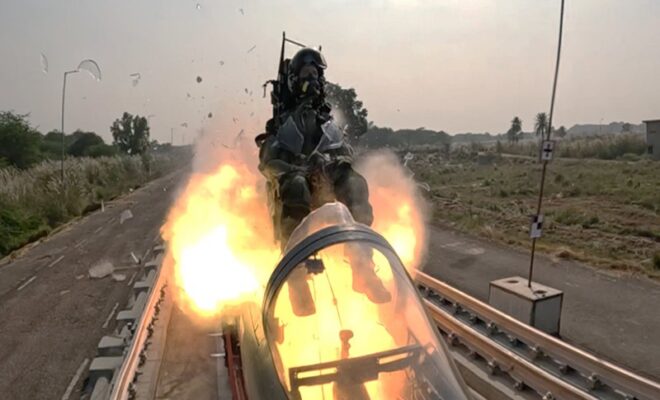
AppIndia has also made a significant milestone in propelling India towards the indigenous pilot-safety technology by achieving a high-speed rocket-sled test in a major breakthrough to the aerospace and defence ecosystem. The experiment reenacted the conditions of fighter jet ejection in the real world at very high velocities putting the important components of the escape system to a test under dynamic conditions. The trial, which reached speeds of nearly 800 km/h, was an indication of the increased capacities of India to design, test and certify high levels of performance aerospace systems in the country. Its achievement not only reflects technological excellence, but also augers well with India being determined to rely on itself in high-technology defence engineering.
A Landmark Achievement in Indigenous Aerospace Testing
The successful firing of the high-speed rocket-sled test by AppIndia is a technical capability that is a rarity and is highly technical. One of the most challenging validation experiments in aerospace research is the rocket-sled tests which are experiments that simulate the behavior of real aircraft during flight on a rail-ground test track. Engineers can simulate the powerful aerodynamic forces and acceleration of high-speed flight by mounting an aircraft fore-body or test structure on a sled accelerated by behaviour using a series of rocket motors. The success of AppIndia puts India under a few countries with the potential to perform such complicated tests using native infrastructure, further strengthening the nation’s private space innovation momentum similar to recent developments like Agnikul Cosmos Delays Private Rocket Launch.
Simulating Real Emergency Conditions for Pilot Safety
The rocket-sled was accelerated by the use of phased rocket ignition to a ground level near-supersonic speed during the test. The canopy-severance system of the aircraft was fired at the exact time of maximum dynamic pressure, after which a test dummy full-equipped was shot out. This chain is similar to the actual emergency escape case of fighter pilots. In real time, the acceleration forces, structural response and seat-trajectory data were recorded by high-speed cameras and in-board sensors. The findings affirmed that all the key safety subsystems were operating successfully even in severe conditions.
Why the Rocket-Sled Test Is So Important
High-velocity rocket-sled test Unlike fixed or slow-velocity ejection tests, a high-velocity rocket-sled test authenticates safety operation in the most hazardous and unforeseeable flight conditions. It is also important to make sure that the ejection seat, canopy-cutting system and pilot-restraint system operate flawlessly under the exposure to violent airflow, shock loads and rapid deceleration. With this successful trial, AppIndia has also shown that India is able to self-certify safety system on next generation fighter aircrafts, hence lessening the reliance of foreign defence technology suppliers.
Strategic Impact on India’s Defence and Aerospace Sector
The successful test underpins India on the strategic autonomy in defence production. Native certification of ejection systems significantly reduces time to develop systems, reduces costs, and provides a steady supply of spare and upgrades with no geopolitical limitations. More importantly, it improves pilot confidence as it ensures a world standard level of safety that is established and tested on the Indian soil. In the case of AppIndia, this is a gateway to a broader involvement in military aviation programs and international work in the aerospace industry.
What Lies Ahead After the Successful Test
The next step after this milestone will be the advanced velocity tests, tests which simulate the altitude and integrated aircraft escape tests. The successful accomplishment of this rocket-sled test lays a good foundation in the future combat aircraft programs and unmanned aerial platform of India. Indian efforts to advance local ideas of the fifth-generation fighter, as the nation moves forward, will still be assured of a strong foundation of in-house safety validation as an aerospace requirement.
Conclusion
The successful high speed rocket-sled test of AppIndia is not merely a technological but also a strategic message. It confirms India has the industrial assurance, engineering mastery and testing capacity now to safeguard her pilots with indigenically evolved systems, consolidating the status of the country as an up-and-coming aerospace superpower.