
Understanding the Rise and Decline of Left Wing Extremism in India: Future Policy Imperatives
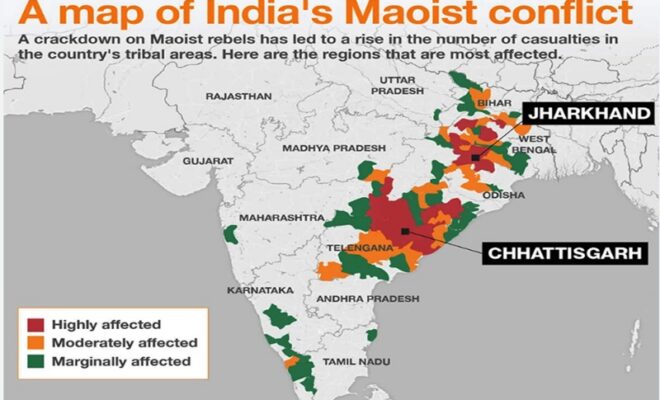
Left Wing Extremism has been one of the most intricate internal problems in the history of India, which is based on socio-economic inequality, underdevelopment of the region, and political marginalization. The ideology which emerged through the 1967 Naxalbari movement disseminated in central and eastern India and formed what was later to become the Red Corridor. The rise and decline of Left Wing Extremism over decades was the measure of the attempts of the state to reconcile the security responses and the inclusive development. Sustained counter-insurgency operations, governance reforms and selected welfare initiatives have in recent years resulted in a massive decline in violence. This transformation is important in understanding how to influence the future security and development policies in India.
Historical Roots and Expansion
Left Wing Extremism has its origins in agrarian distress, land alienation and marginalization of tribal communities. Under the influence of the Maoist ideology, the extremists tried to overrule the state by armed resistance to try to take up the role of the oppressed. By the early 2000s the movement had grown at a very fast pace now involving almost a third of all India districts. It was the high point of rise and decline of Left Wing Extremism as the absence of infrastructure, bad governance, and basic services enabled the extremist discourses to take off.
Peak Years and Security Concerns
Left Wing Extremism was a direct threat to the internal security of India at its peak. Routine attacks on security agencies, damage to infrastructure as well as extortion hampered governance in the affected areas. The movement utilized challenging geographical features and regional dissatisfaction to continue controlling isolated regions. The years marked the way in which developmental shortcomings and lack of security supported each other, extending the conflict and further mistrust between local people and the state.
Decline and Policy Shift
The rise and decline of Left Wing Extremism entered a decisive stage following 2014 when India began to pursue a multi-dimensional policy of integrating security activities with development projects. Intelligence networks were enhanced, coordination of central and state forces improved and targeted campaigns greatly damaged the leadership of the extremists. At the same time, better access to roads, access to the digital world, education and outreach to healthcare enhanced the state presence in previously isolated areas. Consequently, the distribution and the level of Left Wing Extremism have significantly decreased in the last ten years.
India’s Future Imperatives
Whereas the decrease is significant, the long-term fix is not limited to the security measures. It is necessary to deal with land rights, livelihoods creation, former extremists, and rehabilitation, and responsive governance. To avoid a resurgence, the effort should be long term development, political inclusion, and grassroots confidence building. The experience of the rise and decline of Left Wing Extremism in India is that lasting peace occurs when security and social-economic justice coexist.