
Samudrayaan Project Update: MATSYA-6000 Human Submersible Completes Unmanned Trials
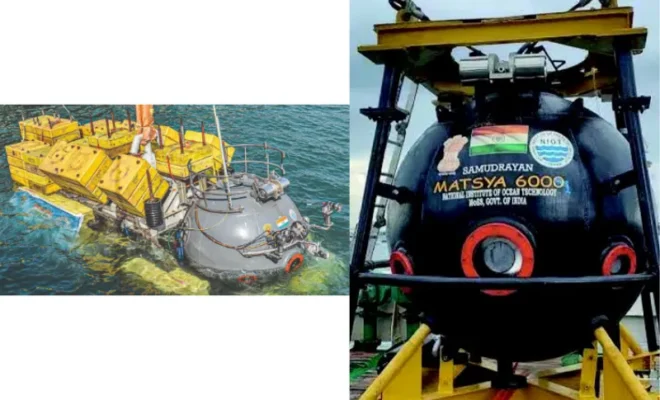
Another step in India’s deep sea exploration program has been accomplished with the successful completion of unmanned tests of the home-grown MATSYA-6000 human submersible at the shipyard of Larsen & Toubro in Kattupalli, Tamil Nadu.
MATSYA-6000 is being developed by the National Institute of Ocean Technology, Chennai, under the Deep Ocean Mission program of the Ministry of Earth Sciences for the Samudrayaan Project that will take Indian aquanauts down to 6,000 meters below the surface of the ocean.
The trial was attended by Srinivasa Kumar Tummala, Secretary, Ministry of Earth Sciences and G. A. Ramadass, Director, NIOT.
MATSYA-6000 Successfully Tests Critical Systems
These recent tests have determined the flotation capabilities, stability and ballast systems in submerged conditions. It is worth mentioning that the engineers were able to assess the performance of specific components to decide on the compliance of the vehicle with required test requirements.
The successful completion of these tests has paved the way for the upcoming stage of technical testing of the submersible.
MATSYA-6000 has been designed to transport three aquanauts in the titanium personnel sphere. This submersible will help scientists to study deep-sea habitats, marine ecosystems, and collect samples in conditions of severe underwater pressure.
It is equipped with navigation and communication equipment, underwater cameras, oceanography sensors, and life support system.
India’s Deep Ocean Mission Gains Momentum
The Samudrayaan Project is an important part of the Deep Ocean Mission that was initiated in 2021 to enhance India’s ability to explore the ocean and use its resources sustainably.
This mission aims to develop technologies related to deep-sea mining, robotic underwater technology, oceanography, and marine life preservation.
The MATSYA-6000 will be used to carry out scientific research related to the ocean floor, specifically the investigation of polymetallic nodules with minerals like manganese, nickel, cobalt, and copper. These minerals can be used in batteries and electronics.
What Comes Next for Samudrayaan?
Despite the success of the unmanned trials, the submarine needs to go through additional testing before embarking on its intended manned expedition.
Initial wet trials at Kattupalli in January and February 2025 examined the aspects of flotation, stability, maneuverability, communication, and safety systems. The current trials are an extension of the initial engineering tests.
India seeks to build the capacity for conducting manned expeditions to depths of 6,000 meters. Realization of the aim would help India gain an edge in deep-sea science.
The latest feat has brought the SAMUDRAYAAN project closer to realizing its ambitious goal. Nevertheless, the future validation and safety approval will establish the time when MATSYA-6000 will embark on its first manned deep-sea dive.
Entertainment, Weather, Gaming & Gen Z Lifestyle Trends
Why Has Naga Chaitanya Been Honoured with a Best Actor Award?
Discover the award-winning performance, explore the recognition behind the honour, and find out what makes this achievement significant in his acting career.
Why Are Deficient Winter Rains Bringing Early Summer to India?
Explore the impact of below-normal winter rainfall, understand changing weather patterns, and discover what the early arrival of summer could mean for India.
What’s New in LEGO Super Mario Minifigures for 2027?
Discover the newly announced characters, explore their features, and find out what LEGO fans can expect from the upcoming collection.
Is Heeseung Really Leaving ENHYPEN?
Explore the viral departure rumours, understand what has triggered online speculation, and separate confirmed updates from fan discussions.
Why Is Gen Z Embracing Solo Dates as a New Form of Therapy?
Discover why young adults are choosing solo outings, explore the appeal of independent experiences, and understand how this lifestyle trend encourages self-discovery.